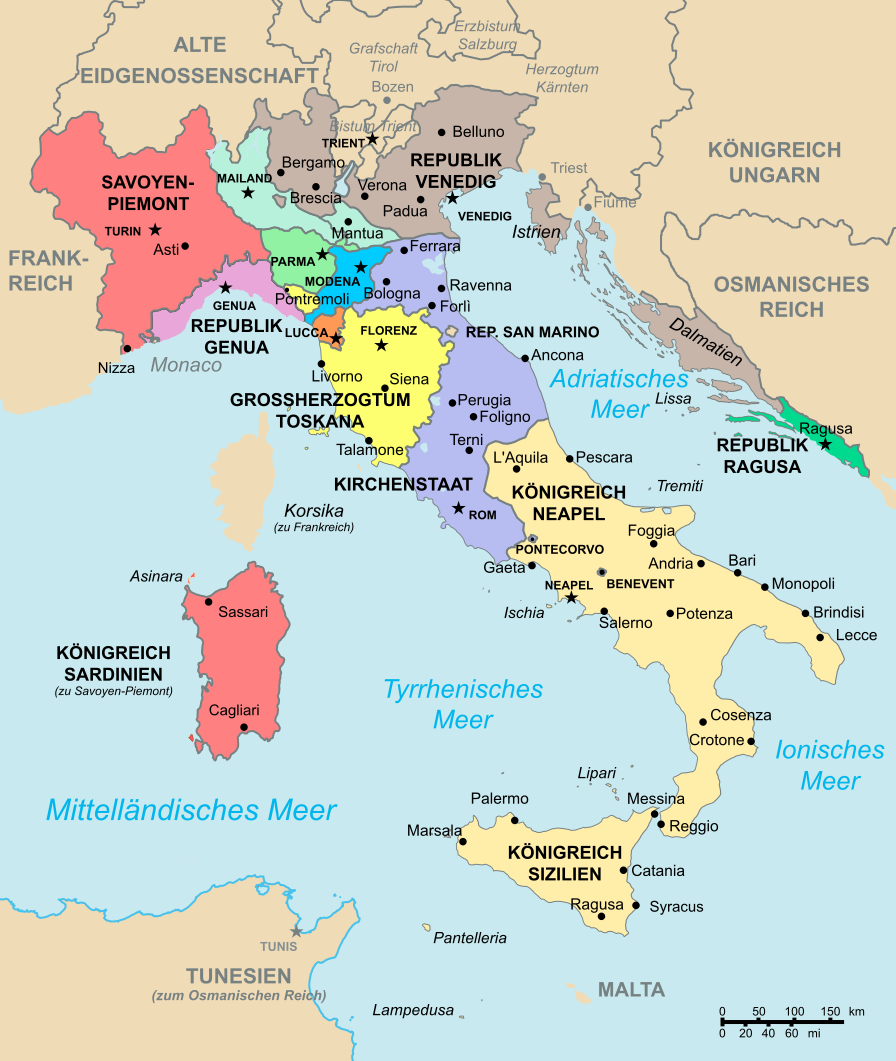
I know in the past, after the fall of rome, Italy consisted of multiple independent city states, republics, and whatever else. But I've honestly never heard of how those individual constantly bickering kingdoms came to be united as the country we know today as italy.
When did it happen? Who was responsible? Did it all happen reletively at the same time or was it spread out over many years? What were the reactions of the citizens of the individual states to their former state being dissolved?
This is a rather complex question, that may require a long and extended answer. What I'll provide here is a basic re-editing of an old answer of mine that dealt with the general events and some ideas behind the Italian unification. As your question already assumes, it is not something easy to summarize in all its facets.
For the purpose of introduction, a very short breakdown.
With the French Revolution a score of new ideas ranging from national identity, people's sovereingty, republicanism, make their entrance into the Italian society. There were of course other views, ranging from absolute legitimist (that is supporters of the idea that the King was the holder of absolute sovereignty) to moderate, consitutional monarchists on the British model. But the influx of French Revolution ideals was crucial to the Italian unification.
With the Napoleonic wars the structure of the Italian States gets shaken in a major way. Skipping the whole mutating configurations, experiences such as that of the Cisalpine or Cispadane Republics during the 1801-14 period begun to inspire the Italian intellectual world to seek the opportunity of creating a Republic or Kingdom of Northern Italy - which was also a realistic political opportunity in the context of the new European structure driven by the Napoleonic conquests. Meanwhile in the South, Sicily had made experience of the Briths rule and received a sort of "military constitution" that was nonetheless far more advanced than the traditional forms of government of the Island.
With the fall of Napoleon various patterns of restoration were attempted, from outright police reaction to some moderate openings to constitutional rule. It was clear though that Italy was to remain resltess until a proper rule was established - that is the Eurpean nations begun to question whether the legitimate governments of the Italian States were able to handle things properly. And to exert pressure in order to secure stability, as well as being forced to frequent military interventions.
In this context two main ideas of nations develop: one Republican represented in the most lasting way by Giuseppe Mazzini; one - in fact two Monarchical ideas: one federative (based on the German model of the customs union, the Zollwerein) and one centralized based around the stronger political entity of the Peninsula, the Kingdom of Piedmont
In 1848 the picture eventually falls from the wall: general unrest breaks out in Europe. Austria is deeply shaken by the claims to independence of the Hungarians. The Pope is forced to escape Rome after an intitial attempt at some form of "liberalization" had led the federative party to seek for a Papal federation of the Italian States. The Kingdom of Piedmont led by the curious figure of King Charles Albert tries to win his unified Kingdom of Northern Italy but he is defeated twice and forced to abdicate.
Meanwhile in France a new Emperor Napoleon III has appeared. Under the leadership of a moderate Piedmontese Prime Minister, the Count of Cavour, who succeedes through some careful diplomatic movements to secure the French assistance in a Second and successful war against the Austrians in 1859.
The successes of the Piedmontese results more or less in the toppling of all the other Italian "legitimate" governments by internal forces. Those groups in the immediate aftermath of the armistice approved the annexation to the Kingdom of Piedmont (or rather to the newly formed Kingdom of Italy) by means of plebiscite. With few exception the local establishment approved both the unitarian form of the Italian State and the Monarchical ideas - at least as a necessary concession.
The Kingdom of the Two Sicilies was the last polticial entity still standing - but on weak legs. In 1860 a revolt in Sicily was taken as a good opportunity for an expedition of Republican and General of a small volunteer army, Giuseppe Garibaldi for the so called "expedition of one thousand" to take control of the Island. He then moved into the continental regions of the Kingdom and soon enough occupied Naples.
On the 26^th of October, in the culminating moment of the Italian unification, Garibaldi surrendered his conquests to the King of Italy, Victor Emmanuel II - de facto accepting the Monarchical rule over the whole nation in what represented the "political sacrifice" of the Republican fraction - with only Mazzini to remain critical of the Monarchy institution.
Now, a few more detalis on the ideological background of the events.
The process of Italian unification was followed by both the European Governments and the public opinion with both interest and concern. For the most part though, those weren't rooted in the issue of preserving the set up inherited from the Vienna Congress of 1814, as this had been already – if not shattered – deeply shaken, during the 1848-49 revolutions.
In fact the agreement between the major powers had ceased to exist early after the Congress; and while all more or less looked for a stable European balance to prevent a new age of wars, there was a significant difference of opinions on how this balance was to be kept.
The cornerstone of the Vienna Congress had been the principle of legitimacy: to this was inspired the Italian political geography after the award – notably the Congress did not restore the various political entities as they existed before though, as an immediate comparison shows. The basic idea was instead that the source of political authority of the State – i.e. the ruling dynasty – was neither God nor the People but rather the agreement of the various sovereigns: Italy was divided and ruled as it had been agreed upon by the major powers and that was the origin of the authority over the land.
In the words of Prince Metternich himself, addressed to to British Prime Minister Lord Palmerston in August 1847: The Italian peninsula is composed of states sovereign and mutually independent. The existence and the borders of those states are grounded on the general principles of public right [droit public general] and strengthened by political agreements that are not subject to challenging. The Emperor, for his part, has resolved to respect those agreements and to contribute, as far as his power goes, to secure their unalterable conservation.
In this overall picture, the “people” played no role and had no saying in the legitimacy of their rulers. Yet, despite the vague and uncertain nature of its political force, despite the often confuse nature of its claims, its oscillations between anger and dullness – certainly stronger in a Country where the social development was far less advanced than in other European Nations – the people appeared by 1847 already unwilling to submit to the agreements of the great powers.
And the ruling class had begun to take notice, realizing how the conservation of stability was no longer a matter of agreement between Kings but also of agreement between the Institutions of a State and the will of its people: in this light, many believed that the way for a European balance was paved with moderate social reforms – and in a way, those much moderate reforms advocated by a Palmerston for the Italian States, would have often appeared almost revolutionary to the Italians, used as they were to absolute censorship of the press, absence of any constitutional rights, persistent foreign interference in internal matters of public and private nature. It was not a surprise that the Sicilian patriots, looking for autonomy from the Naples Government, appealed to the 1812 Constitution forced on the King by the British Military Governor Lord Bentinck; nor that the Lombard elite looked to British liberalism as an inspiration to oppose the Austrian system of tariffs.
If we factor in the weight of public opinion, it would have been extremely hard for a British Government – either liberal or conservative – to outright refuse the plea toward reforms of the Italian moderates, especially since those looked explicitly to Britain as a model to balance the extreme principles of the French Revolution. This is evident in Palmerston's answer to Metternich's letter [unfortunately, I am translating it back from Italian – for those who can find it, it's Aug 12 to Ponsonby]. While reassuring his counterpart that the Kingdom was not looking for any change of the Italian political situation, he pointed out that Her Majesty's Government, on the basis of information coming from various sources, has developed a belief that a deep, widespread and well motivated discontent is dominant in a large portion of Italy. And where one is to consider how deeply flawed and full of any sort of abuses is notoriously the form of government of those states, and more prominently in the Roman State and the Kingdom of Naples, it should not surprise that such evident ailments give origin to the worst turmoil; and it is more than likely that men, feeling full the weight of the oppression they suffer and suffered for long years, without any hope of relief coming from their present rulers, would embrace even the most extravagant plot, hoping for any source of salvation.