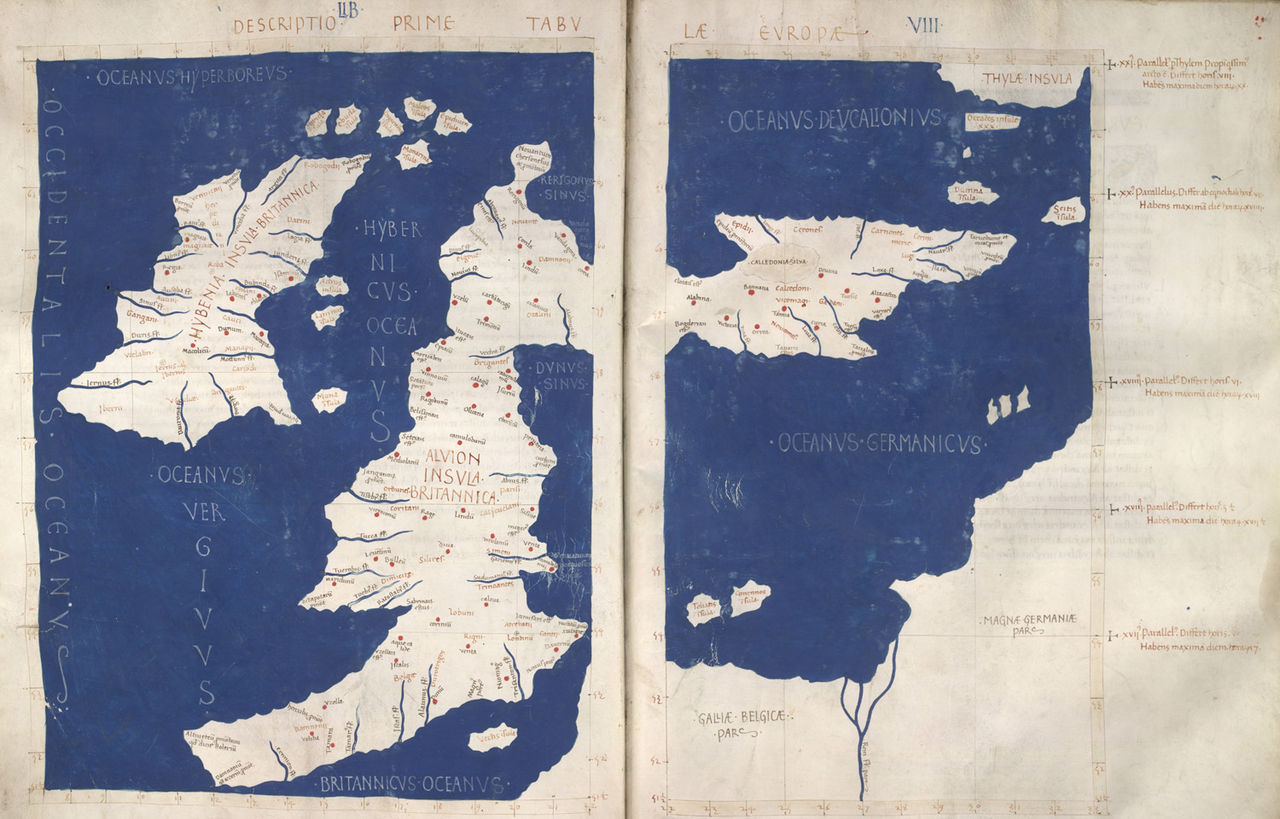
They did know that Ireland existed, they called it Hibernia. The name comes from Tacitus' Agricola, a biographical work about his father-in-law, who was the governor of Britannia from 77-85 AD.
To the best of our knowledge, Ireland was first discovered in the Greco-Roman world around the 320s BC by the Greek explorer Pytheas of Massilia, whose explorations of the British Isles and the Baltic Sea survive in an extremely fragmented state. However, Ireland is referenced by the Greek writer Polybius (who was writing in Rome, though for a Greek audience) and by the Roman authors Strabo and Pliny the Elder, and by Julius Caesar. In the 2nd century AD, the geographer Ptolemy produced an atlas including this close up map of the British Isles including Ireland, preserved in several medieval manuscripts: https://upload.wikimedia.org/wikipedia/commons/thumb/7/7f/Descriptio_Prime_Tabulae_Europae.jpg/1280px-Descriptio_Prime_Tabulae_Europae.jpg
As best we can tell, there was no need or want to invade Ireland at the highest levels of power. It had very few natural resources worth sending an army to claim, and the locals did not often trouble the Romans, though they did engage in piracy and occasional raiding. Tacitus attests that Agricola said many times that Ireland could be conquered with just one legion and that he wanted to invade, using the restoration of an unnamed exiled king as a casus belli. No full invasion and occupation ever took place, which suggests that the emperors were less keen in bringing Ireland into the Roman Empire and were unwilling to grant Agricola a spare legion for such a task, but there is some evidence that Agricola did get to at least restore this king.
There is an Irish legend about a king named Tuathal Teachtmhar, who fled to the Romans in the late 70s AD. It is said that he returned to Ireland to restore his power at the head of an army. This legend first appears in the 9th century, and until quite recently was thought of as being almost entirely fabricated, a bit like the legend of King Arthur. However, archeological discoveries have found Roman weapons at sites associated with the legend, particularly Leinster, Tara, and Clogher. It was thought that these weapons were just traded, but coins found with them date to around 80 AD and there are a few Roman burials in these areas as well. There is also a passage in Satire 2 of the Roman poet Juvenal, which references Agricola’s campaign and includes Ireland as a place where Roman soldiers have been. This passage, the weapons, the Irish legend, and Agricola’s dealings with an exiled king line up too well to be just myth. In 1995 an article called "Tuathal Techtmar: A Myth or Ancient Literary Evidence for a Roman Invasion?" stitched the pieces together to argue that Agricola did stage a military intervention in Ireland to restore a king, forming the historical foundation of the legend. Whether this was a proper invasion or simply exporting arms and money to prop up a king friendly to Rome is up for debate. As /u/typologyguy has pointed out below, Roman weapons found are all locally produced copies rather than 'official' Roman arms, this combined with the absence of any such campaign in literary sources suggests that any intervention was small in scope and done covertly, possibly without imperial approval, but Agricola definitely had his hand in Ireland’s affairs and eyed it up for full invasion.
One year after that article was published, a suspected Roman fort was discovered in Drumanagh, which, if confirmed, suggests a lasting Roman presence on the eastern shores of Ireland and suggests that there was a limited Roman military presence on the eastern shores of Ireland, probably to help deter piracy. It is generally thought to be Roman from archeological finds, particularly coins from the reign of Titus (79-81 AD), but as it is yet to be properly excavated we can't know for sure if Drumanagh hosted a genuine Roman fort.
Sources:
Vittorio di Martino, Roman Ireland, The Collins Press, 2006
R. B. Warner, "Tuathal Techtmar: A Myth or Ancient Literary Evidence for a Roman Invasion?", Emania 13, 1995, pp. 23–32
Raftery, Barry. "Drumanagh and Roman Ireland." Archaeology Ireland 10.1, 1996, pp. 17-19
Adams, Colin. "Hibernia Romana? Ireland & the Roman Empire." History Ireland 4.2, 1996, pp. 21-25
"Et Tu, Hibernia?: Frontier Zones and Culture Contact – Ireland in a Roman World." Romans and Barbarians Beyond the Frontiers: Archaeology, Ideology and Identities in the North. Oxford; Philadelphia: Oxbow, 2017