So the TLDR is going to be "I don't know. Go ask them." It's an impossible question to answer. The fact is those that defected defected and those that didn't didn't, and getting inside those heads isn't something we can do. I don't think there's evidence to look at specific Italian states and ask why one defected and one didn't, and I'm pretty sure no one's attempted such a study.
We can say something about the conditions surrounding Punic 2 that might help us understand the forces in action. I want to look at the Celtic invasion of 225, and the Social War of 91-88. I think we will see two competing forces: "Italy" as a concept was beginning to get traction in a way that meant the Italians and Italiotes (that's Greeks in Italy) understood the Celts to be a communal threat to a shared politial space, and at the same time a lot of these people were dissatisfied with the Roman arrangement of Italy in the 3rd and 2nd centuries BCE.
The Celtic invasion of 225 was a pretty big deal. Williams in Beyond the Rubicon discusses how this invasion was felt to be a threat to the political community Romans had developed in Italy. Delphi had been sacked by Celts in 279, and Romans had been using Rome's own sack in the 5th century to make a case to Greeks for a shared common enemy. In fact, after the battle of Clastitium against Celts in 222, Rome dedicated a bowl at Delphi, emphasizing this connection. We don't have, to the best of my knowledge, contemporary Greek writers detailing this campaign, but we have Cato and reports of other Romans recording it, and the sense Williams gets from those sources is one of a community which extended from the Ionian Sea to the Alps. Cato at one point calls the Alps "the shield of Italy", implying a shared political territory and indeed the title of his book Origines refers to not just the origins of Rome but the other Italian peoples as well.
There are problems with Williams' model, specifically why, if the alliance of 225 was so strong, it fractured so badly in 216 after Cannae. Here I think it's worth noting who were the defectors. Livy Liv. 22.61.2 gives this list:
Campanians, Atellani, Calatini, Hirpini, Aupliani, Bruttii, Lucanii, Uzentini, all the Greeks on the coast, Tarentines, Metapontines, Crotoniates, Locri
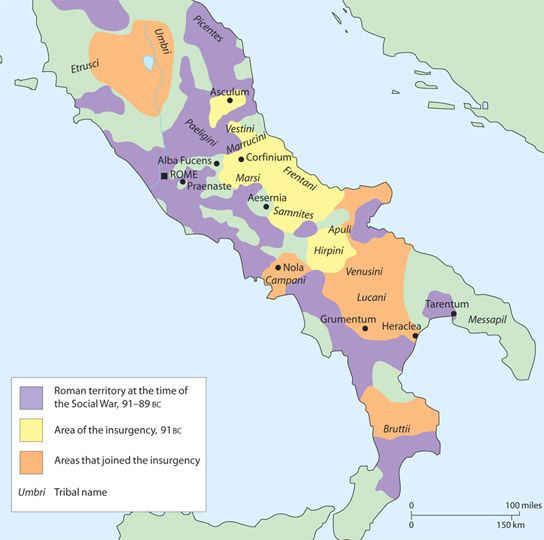
Just to be clear, that's not a direct quote, it's a summary in list form. I wasn't able to find a map that showed where these people lived, but compare the list of insurgents in the Social War (Appian, Civil Wars, 1.5.39):
Marsi, Peligni, Vestini, Marrucini, Picentines, Frentani, Hirpini, Pompeiians, Venusini, Apulians, Lucanians, Samnites
I did find a map for this.
You might not catch it, but some of these names are the same, and some of them are different names for the same groups. The Pompeiians are Campanians, for instance. If you can find a map of the defectors in Punic 2, you will see they occupy almost the same areas.
So why did the same set of people defect to Hannibal in 216 and again rebel in 91 when Rome was building this Italian political community that was effective in 225? Well, it's clear that these people were not satisfied with the Roman settlement of Italy, in which they arranged things in a series of bilateral treaties that imposed various obligations on the allies, particularly military obligations. How these different people objected to that settlement isn't clear. Some may have wanted Roman citizenship, some may have wanted independence, and some may have wanted a unified Italian state without Rome or with a marginalized Rome. This is an open debate, and honestly I think different states wanted different things. But these concerns seem persistent given the people involved in both defections.
For the defectors, Hannibal demonstrated a Roman vulnerability the Celts of 225 didn't, while for those that remained loyal, the Roman project of a united Italy still held value.
Why different states came down on different sides of that question, I don't think we can give an answer.