Considering how close and isolated Wales is to England why has the Welsh language lasted for so long? What kept it form dying off or being absorbed into English during the Anglo-Saxons?
The most important thing to understand about the history of Wales and its relations with England is geography.
Wales is, compared to England, very mountainous. They're not big mountains, compared to the Alps or something, but they're big enough to make Wales awkward for pre-modern armies to conquer.
At the same time, until the 19th century's demand for coal, Wales was not a particularly valuable territory. It's not as good for farming as England, it didn't have huge forests that were easy to cut down (it's not easy to transport logs across the mountains). It doesn't have big convenient rivers that go across to England allowing you to transport goods, you rather have to sail around the coast which is slow.
So, when the Anglo-Saxons spread across England from the West, becoming the new ruling class and dominant culture, they didn't really spread into the Western mountains. It was both difficult to defeat the locals, and not very beneficial. Thus, people there just continued to speak their Brythonic language, rather than adopting a Germanic one like most of Britain. Of course, there was some trade (and slave raids), but much of the Welsh interior was too isolated for the level of trade that would make it necessary to change languages.
So, the short answer as to why the Welsh language didn't get absorbed into English during the time of the Anglo-Saxons is because the Welsh people didn't get absorbed into the Anglo-Saxons. Saxon Kings did force Welsh Kings to accept their supremacy at times, but there was no colonial movement, or efforts to force Welsh people to learn English. As long as the King of Powys wasn't attacking the King of Mercia, and maybe sent some gifts, why would the King of Mercia try to conquer some poor mountainous territory, when Wessex or Northumbria were so much more valuable?
Then, of course, we get the Normans. William conquers England and sets the Normans up as its rulers. Now, he authorises Norman warriors with no baronies to invade parts of Wales and conquer territory (the Welsh Marches) if they like. They mostly conquer territories on the South Coast, because those are the easiest (next to England, not very mountainous) and most valuable (better farmland).
But King William and his immediate successors don't bother conquering Wales. Why not? Well, it's difficult... and poor. There are much more valuable territories in France. That's where most Norman military attention is focused. If you were an ambitious Norman warrior, sure you could try seizing territory in Wales... or less mountainous Ireland, or best of all, rich France. And that's not even considering further places like Sicily, which Normans also invaded (allowing its conquerors to become independent rulers, out of the Plantagenet's control).
Eventually, the Normans did subjugate the Welsh princes, forcing them to accept the Crown Prince as "Prince of Wales". But, notably, the Welsh lords in Central and Western Wales are mostly not replaced with Normans. They're still Welsh, they speak Welsh.
Of course, they might need to learn the language of their Norman over-King... but that's French, not English.
Now, there are exceptions to this. There were areas in the South where the Normans did Norman-ise heavily. Cardiff, Swansea, Fishguard, etc. Over time, more and more English people did move there. However, not many moved to the middle or north-west of Wales because, frankly, it wasn't a great place to live.
So you might ask, why didn't English replace Welsh in those areas that lots of English people moved to? Why didn't people under Norman aristocrats begin to learn English once the Normans began speaking English? What about after Wales was legally integrated into the Kingdom of England? What about the 19th century, when Wales suddenly became economically significant? Why didn't most people in places like Cardiff, Newport and Fishguard stop speaking Welsh and speak English instead? The answer is... they did. If you go to the Southern areas of Wales with lots of Norman castles, you will find that most people speak English at home. The only Welsh they speak is a few sentences they vaguely remember from school.
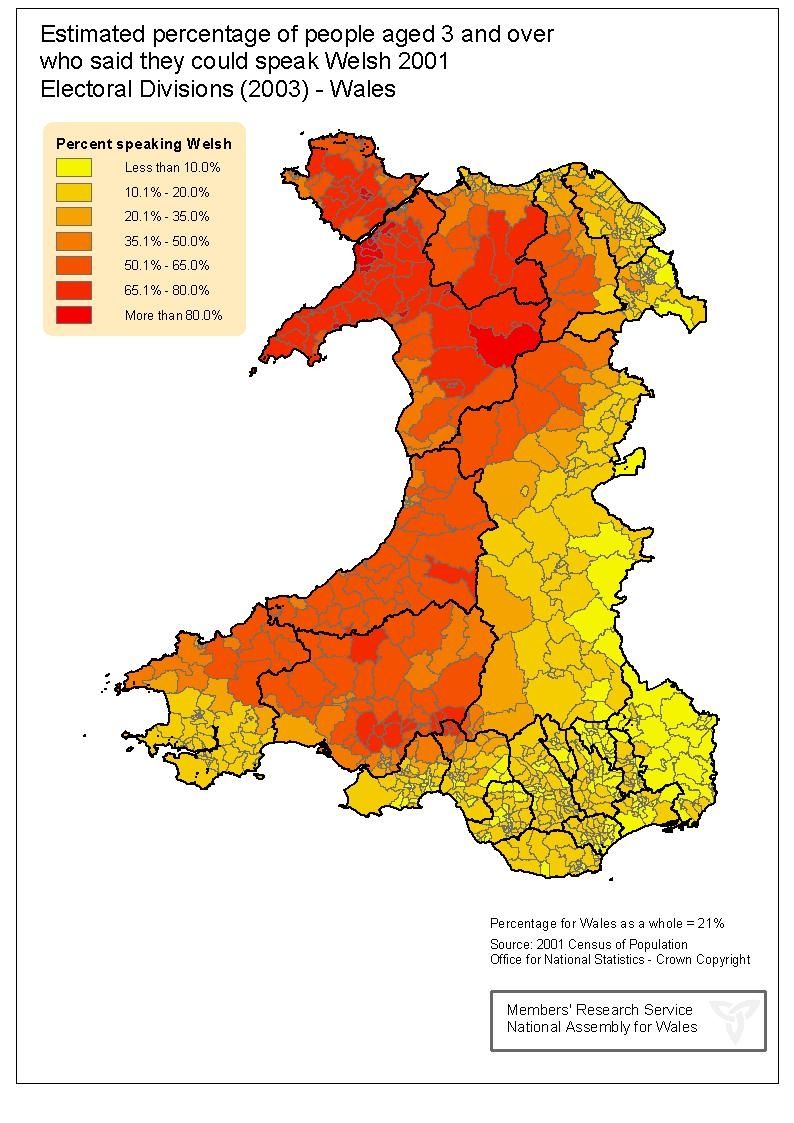
The areas where Welsh is the first language and English the second are mostly more isolated areas with less economic links to England, places that were independent of Norman control for longer, and places where not many English people moved in. And of course, Welsh is now considered an important part of Welsh nationalism and pride, so there is a deliberate effort to stop it dying out, with all Welsh students having to study Welsh in school even if they live in English-speaking areas (and Welsh grades in English-speaking areas are, frankly, very poor, as many students feel learning Welsh is a waste of time).
Here is a map of Welsh language ability in 2001 (I couldn't find 1998, but it's basically the same): https://museum.wales/media/10137/Map-of-Electoral-Division-Language-Data-2001-Census.jpg
It's probably worth noting that this isn't even a map of people who could speak Welsh more than they could speak English. It's just people who said they can speak Welsh (and they might have only spoken it to a conversational level, not be able to read it). You'll notice that in the bottom-right of the map it notes that only 21% of Welsh people even said they could speak Welsh. So in 2001 79% of Welsh people couldn't speak Welsh.
Now, compare that map of Welsh language to this map of Norman control of Wales in 1100: https://www.fitzmuseum.cam.ac.uk/gallery/normans/images/gallery/Images4fullsize/Normans_in_Eng_wales.jpg You can see that the areas the Normans took over first are also the areas where few people can speak Welsh.