Not to discourage further answers, but check out this discussion of pre-Columbian warfare, sieges, and fortifications in North America written for a previous, similar question.
This really depends on where and when you look. The short answer is yes, we do see evidence of fortified villages at various sites prior to European contact.
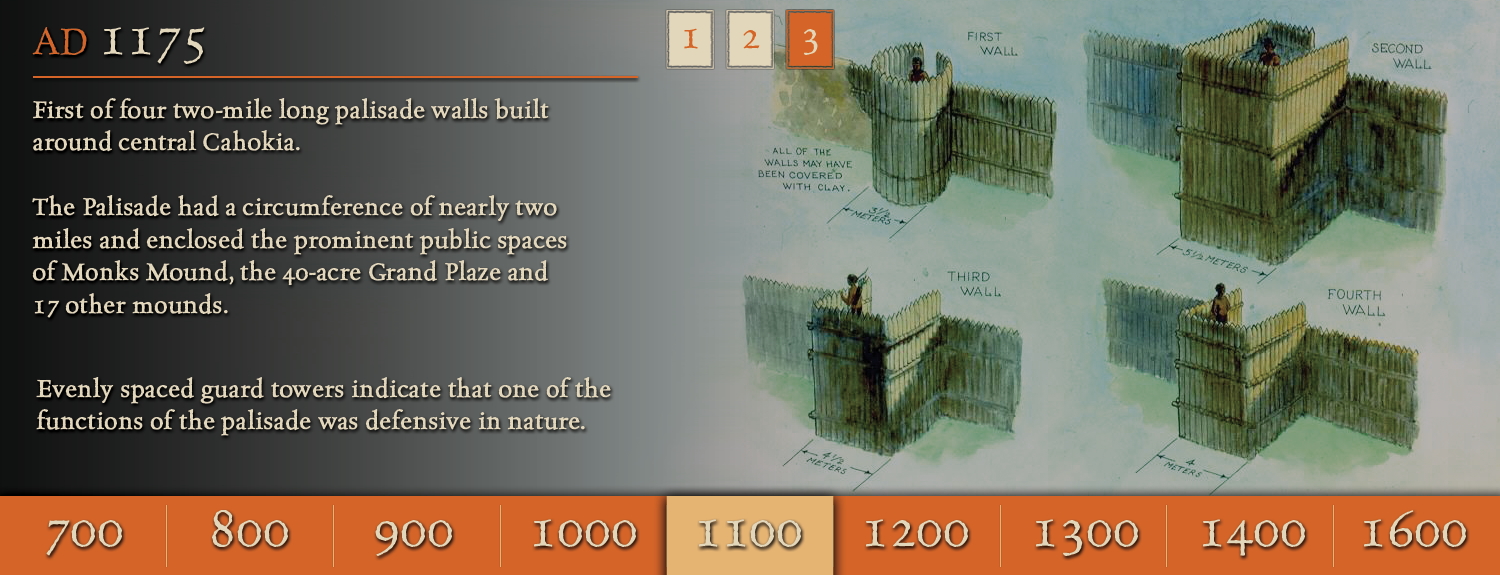
So what would a fortified village look like in pre-Columbian North America? Well an extraordinary example would be the palisade that was in place at Cahokia, a Mississippian site just east of St. Louis, Missouri. I will link some images of reconstructions of the palisade as well as the map of it in context to the site at the end, but there can be little doubt that the palisade was constructed for anything other than defending some portion of the settlement. We see guard towers that would have allowed for defenders to fire upon would-be-attackers, and some arguments have been made that the plaster material placed on the outside of the palisade may have been intended to prevent the wall from being set ablaze by flaming arrows (Dye 2018). Another Mississippian site, Aztalan in southern Wisconsin, shows evidence of palisade construction as well. Again it would have surrounded the settlement and seems to have been treated the same by the community living within it. The palisades at both Cahokia and Aztalan show evidence that they were often reconstructed without tearing down the previous palisade structure. This may seem trivial, but this may indicate routine maintenance being performed as a preventative measure.
Having a palisade for protection may seem very straightforward, but this is not the case for all settlements in this region and may indicate some level of conflict within the region that caused construction of a palisade. It is interesting to compare this to sites in Western Wisconsin/Eastern Minnesota, sites that prior to AD 1050 do not show signs of palisade construction(Theler and Boszhardt 2006). This is interesting as the 'big bang' at Cahokia is attributed to be around this time as well, and while they may not be directly related it may give insight into the pre-Columbian world at this time. Its also important to note that from 1050 on, we see major changes in how people lived in these regions such as increased trade and signs of increased conflict in the region. We also see that people begin to live more sedentary lives, we see more storage pits, we see increased reliance on agriculture, and we see more of a reliance on local game and less movement onto the plains to hunt bison (Theler and Boszhardt 2016). Prior to 1050, we see an increase in people living within this region, and after we begin to see shifts in settlement patterns, and following the collapse of Mississippian influence from Cahokia we do not see a return to the more 'egalitarian' lifestyles seen before the rise of Mississippian influence in the region. So around AD 1050 something was occurring across the Midwest, and it resulted in a brief period of increased reliance of palisades at some sites. For some reason we see an increase in agriculture, more sedentary lifestyles, and increased fortifications around when we also see the rise of more influential societies to the south at Cahokia.
This is important as it shows that fortified settlements existed in the pre-Columbian world, but they may have been more reactionary than a central point of settlement construction. This may have been a by-product of increased conflict over land, when your reliance on agriculture increases, so does the value you put on land that is better suited to farming. People begin to live in one area for their entire lives, and this is an incentive to defend your land when in the past you may have been able to leave to avoid conflict.
So to sum up, yes, fortified villages existed, but I think the answer is a bit more complicated than yes or no. While in Europe at this time walled cities may have been a common site, it seems that walled settlements in the New World were maybe a byproduct of specifics to the 'mood' of the region during which they were constructed.
Dye, David H. “Rotten Palisade Posts and Rickety Baffle Gates: Repairing Native Eastern North American Fortifications.” Archaeological Perspectives on Warfare on the Great Plains, edited by Andrew J. Clark and Douglas B. Bamforth, University Press of Colorado, Louisville; Colorado, 2018, pp. 145–176. JSTOR, www.jstor.org/stable/j.ctvgd21w.7.
Theler, James L., and Robert F. Boszhardt. “Collapse of Crucial Resources and Culture Change: A Model for the Woodland to Oneota Transformation in the Upper Midwest.” American Antiquity, vol. 71, no. 3, 2006, pp. 433–472. JSTOR, JSTOR, www.jstor.org/stable/40035360.
https://cahokiamounds.org/wpress/wp-content/uploads/2015/08/CahokiaMounds-Timeline-8-1500x575.png
http://users.stlcc.edu/mfuller/cahokia.html
https://commons.wikimedia.org/wiki/File:Cahokia_reconstructed_palisade_HRoe_01.jpg