For example, would an ancient Roman in AD 115 find the clothing from AD 90 to be outdated? At what rate did fashion change in ancient times?
Oh this is a question I love to answer (definitely not because I'm kind of a "stitch nazi" in the Roman reenactment community... cough cough...).
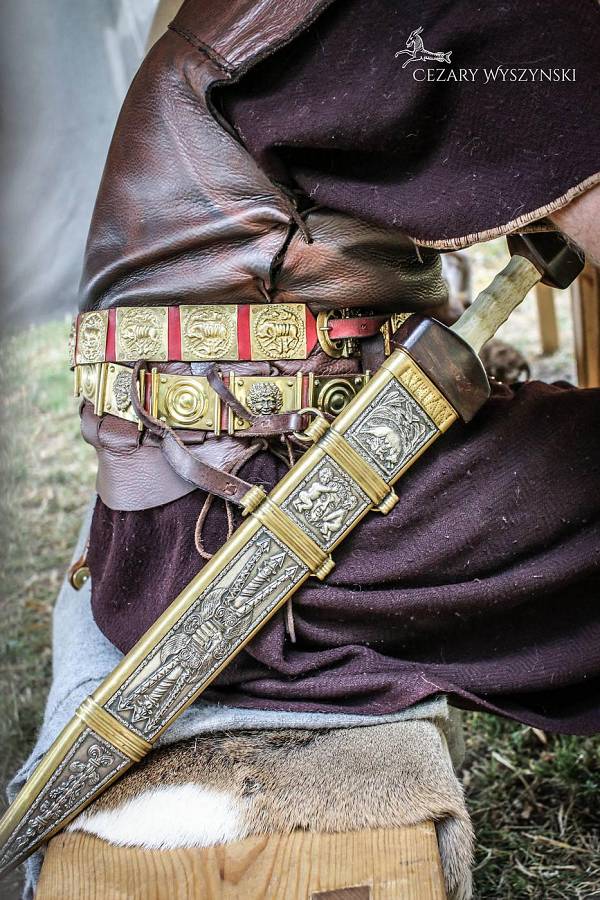
So the answer to your question is, yes, fashions did change, and could change quite rapidly too. Although clothing evolved at a much slower place, items of personal wealth or that showed off personal wealth tended to evolve fairly quickly, somewhere in the range of every 25-50 years or so. The best example of this is belt fittings, and military fittings are better evidenced than civilian fittings but we have a lot of data on both for late antiquity.
So to go to your time period specifically, we can also talk a little bit about overarching styles too. Around 70-90 AD is when the well-known stamped belts of the Roman army, for example, fall out of favor for enameled decorations.
How often did overarching styles change? Well that varied. Enamelling simply varied in popularity over the centuries, there are plenty of enameled belts in the medieval era too, and its popularity varied over time and region. It's mostly the tiny details that change. A great example of this is chip-carving, a method used to decorate belts throughout the migration era. However, from the period of about 400-500 AD, the traditional chip carved style (which was actually very similar to patterns of decoration on late Roman tunics from the 4th century) fell out of favor in Britain and North Gaul for the Quoit-Brooch style. Quoit-Brooch is chip carving, but it's a distinct style native to that time period and region.
But even smaller variations, like say the transition from Hispanic to Bienvienida type belts from 380-450 AD, take place over 25-50 year intervals. Late 4th Century Chip-carved wide belts are not going to be acceptable for early 4th century impressions, for example, because the loop mechanism and the style of plates is although both are in the chip carved style, totally different. You can see some of this in the works by Sommer and Bohme, who established the typologies for Roman belts back in the 1980's.
Tunics and trousers were different. Styles were typically adopted from the Persians, Romanized, and spread west. Their evolution was also slower: sleeved tunics first come in around 100-150 AD, but the Tunica Manicata evolved slowly over the course of the 3rd-7th centuries, first increasing in complexity of decoration and then eventually being "replaced" by a style we call the Armelausion, or the waisted Tunica Manicata, in the early 600's AD. The change in styles eventually also became tied to social status and standing, as well as specific offices, much like in China. In the late Roman and especially the "Byzantine" periods, specific bureaucratic offices required specific codes of dress. This is best outlined by Timothy Dawson in his recent book, By the Emperor's Hand.
So in short: some things, like buckles and belt fittings, sword fittings, and brooches (especially brooches, actually) changed fairly quickly. As often as every 25-50 years. But others, like tunic styles, could take much longer to transition to new forms.
On top of that, we should always remember that a lot of things were used until they were no longer useful. For example although the Type-2/3 Crossbow Brooch was an early 4th century style, we find them in use as late as 415 AD, at a time when the Type-6 Crossbow Brooch was the dominant style.