Today:
AskHistorians is filled with questions seeking an answer. Saturday Spotlight is for answers seeking a question! It’s a place to post your original and in-depth investigation of a focused historical topic.
Posts here will be held to the same high standard as regular answers, and should mention sources or recommended reading. If you’d like to share shorter findings or discuss work in progress, Thursday Reading & Research or Friday Free-for-All are great places to do that.
So if you’re tired of waiting for someone to ask about how imperialism led to “Surfin’ Safari;” if you’ve given up hope of getting to share your complete history of the Bichon Frise in art and drama; this is your chance to shine!
Week 53
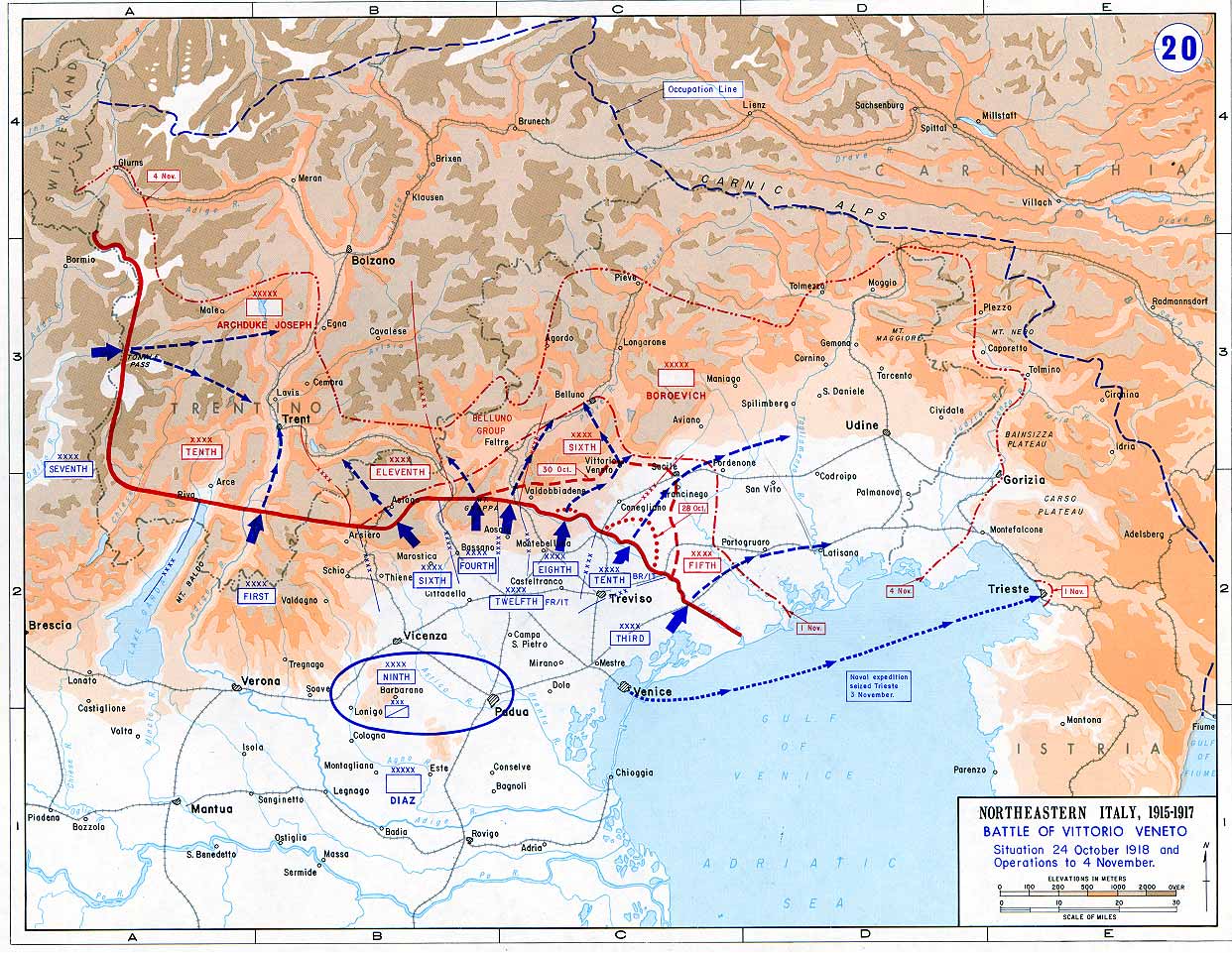
One year after the colossal defeat of Caporetto and with the Spanish flu at its peak within the country, on the 24^th of October, Italy begun its last offensive of the Great War, its third battle of the River Piave, after the stopping battle of November 1917 and the defensive one of June 1918.
Italian Chief of Staff Armando Diaz had resolved to set a date for the offensive only two days before, even if the general plan had been approved on the 13^th after a few weeks of revision by the High Command and the various army generals (which had progressively expanded the operations range in a way that might have appeared overconfident, if not for the reports of the desperate internal situation of the Austro-Hungarian Empire), and only after mounting pressure by Prime Minister V.E. Orlando, who had begun to consider the possibility of replacing his Chief of Staff if the latter had persisted in his opposition to take offensive action. Diaz's reluctance was somewhat well motivated: his army had benefited much from the long period spent on defensive positions beyond the River Piave; casualties had dropped significantly from those of the first three years of war (the ratio of casualties over active men from May to November of each year went as follows: 1915: 100 – 1916: 88 – 1917: 79 – 1918: 23) and the better logistical situation had allowed for in improved treatment of the soldier (the daily ration had returned to the original level above 3,500 calories; the introduction of a second license period during the year, and also the fact that licenses were revoked or postponed much less than they had been during the long offensive periods, had been one of the changes more welcome by the soldiers). As a result the morale of the troops had improved, but their resolve to a new offensive action, after the memorable and dramatic experience of the last battles of the Isonzo River, was something the High Command in all likelihood could not feel confident about (for instance concerns over the phenomenon of desertion had not only remained high but actually reached a peak during the Summer of 1918). More so, in order to take the offensive, the Italians would have had to cross their own defensive barrier: the River Piave, now working against them, and possibly during its worst season, that of the Autumn rains; and despite increasing rumors of internal turmoil in Austria-Hungary, the Austrian front lines appeared – and were in fact – still in relatively good shape. In addition to that, Diaz was concerned because his Army, after the bleeding suffered the year before, had already been forced to use most of the reserve to fill the gaps among the ranks: as a result, the Italian reserve was made up of the 1900 class alone, so that even a successful breakthrough might have been hard to exploit favorably.
For these reasons the Italian Army Command had originally planned for an offensive to take place during late Spring 1919, in parallel with the general plan of new Allied offensives. But major changes had taken place in the meantime: first the Central Empires appeared more and more on the verge of collapse, with Bulgaria dropping out of the conflict earlier during the month. The Germans had solicited an armistice, which had been rejected, under the request that they would relinquish all of the territories occupied during the conflict – but there were talks ongoing and a serious chance that the war would end before Christmas, at last! This placed the Italians in a difficult position, since they had not only failed to conquer their desired war goals but actually lost Italian lands to the Austrians: both Orlando and Foreign Ministry Sidney Sonnino were therefore concerned that the Italian cause at the post war peace conference might have been harder to sustain, unless some noticeable victory was gained – more prosaically, Italy would have had better arguments if it had walked into the conference in control of the desired lands, rather than with those being still controlled by the Austrian authorities or self administered by some local forces. Also, Orlando had been directly encouraged early in October to organize and initiate an offensive by the Allied Commander in Chief Ferdinand Foch who sought any mean to support the ongoing allied action.
As a result a general offensive plan had been put together with a certain haste, that involved a concerted effort spread along the entire front. The operations were to open with a smaller offensive, on the morning of the 24^th – originally conceived as a diversion – in the unfavorable sector of Mt. Grappa. This duty had fallen to the IV Army of Gen. Gaetano Giardino who soon realized the impossibility to make substantial gains (Giardino later explained that he had had no time to properly position his artillery, being informed only a few hours in advance – whether this was true or not, he seemed to have drawn the short stick in this circumstance).
Meanwhile, later in the day, the “army group center”: the VIII, X and XII Armies were supposed to begin the crossing of the River Piave; unfortunately, the water level had been rising for a few days due to abundant rainfall, so that only minor preparatory steps could be made and the establishing of bridgeheads had to be postponed. On the 25^th therefore Giardino had to resume his offensive with little hope of success; and again on the 26^th since the level of the waters had not declined in any appreciable manner. Nonetheless, the British X Army (one of the two foreign armies taking part to the offensive, together with the French XII) had managed to secure control of a fluvial island – that of the Grave di Papadopoli - in the southern portion of the offensive front.
Therefore, while Giardino struggled in the face of Austrian counter attacks, the Italians were able to eventually initiate the crossing operations in the night between the 27^th and 28^th of October – a difficult crossing since the Piave River, which during good season is large and shallow and does not have the steep banks of the Isonzo River, can grow to a remarkable size during periods of bad weather. The responsibility for the actual crossing fell on the VIII Army of General Enrico Caviglia, positioned fifteen miles south-west of the town of Vittorio Veneto, between Pederobba and Nervesa. But of the eight bridges to be built, only three had allowed a few men to cross, only to be damaged soon after by the Austrian artillery fire and the river tide. The Italian had found themselves in control of only a few exposed bridgeheads by the morning of the 28^th . In the meantime Caviglia had approved a modification to his plan, involving an anticipation of the crossing around the Grave di Papadopoli - a successful maneuver that allowed the Italian and British troops to move upwards along the left river bank, outflanking the Austrians – as well as pushing his forces to a maximum effort in light of the first showings of Austrian weakness and the general improvement of the weather conditions that made a lowering of the water levels expected.
The Austrians, who had offered to that point a valid and strong resistance on the front line, had by all accounts already begun to fall completely in disarray within their rear. Therefore, as soon as it appeared impossible to push the Italians back across the river, they begun to give ground in what soon went from an organized retreat to a complete rout. Starting with the 30^th of October, the Austro-Hungarian troops could only offer sporadic resistance, while retreating rapidly on the whole front: on the 30^th the Italian troops occupied Vittorio Veneto, in the evening the Austrian delegates reached the outskirts of Padua – close enough to the Italian High Command, in a country residence belonging to a family of Venetian patricians, Villa Giusti - to discuss the conditions for an armistice. On the 1^st of November the Italians were in control of most of the Asiago plateau; on the 4^th they had regained most of the land lost after Caporetto and the Isonzo River was again within sight. Meanwhile riots had broken out in Trieste since the 30^th allowing for an amphibious operation that secured control of the city. On the 4^th – around 30 hours after the armistice had established the line of separation between Italy and Austria – the I Army of General Pecori Giraldi entered the other “unredeemed” city of Trent.


.JPG)