As a follow-up question, when was the word "Kingdom of Spain" or "Spanish Empire" first officially used?
Well, Spain was at the time of Habsburg rule considered one of the key domains of the Habsburgs.
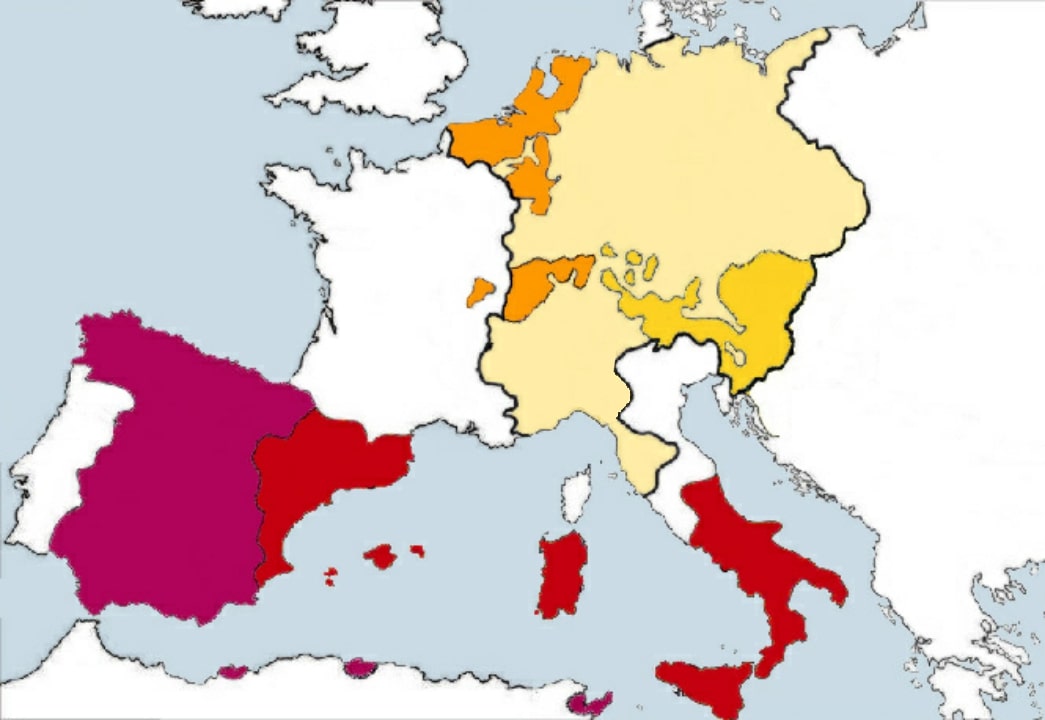
Only under the reign of Charles V were these domains governed under a single executive head. It was not a single political entity; kingship (and by extension empire) in the early modern period tended to be what was what the eminent historian J. H. Elliott termed a composite monarchy. In a composite monarchy, the Trastámaras, later Habsburgs, were not so much rulers of a single state, but instead monarchs of many different ones. While some of these titles were politically dead appendices, such as King of Jerusalem, other kingships were quite alive. The post-1469 Spanish monarchs had to navigate a bewildering labyrinth of local privileges, laws, and rights. For example, Castile's Cortes (legislative body) was considerably weaker than that of Aragon, so Spanish monarchs found it much easier to squeeze subsidies and taxes out of Castile, while getting a smaller amount from Aragon necessitated protracted negotiations. Thus Charles V was not "King of Spain," but King of Castile and León and King of Aragon and Sicily, and Count of Barcelona and known as Charles I in Spain. The unique conditions that brought Charles V this vast patrimony (the right level of marriages and timely deaths of heirs like John, Prince of Asturias) and encouraged some political thinkers to float the idea of a universal monarchy under the aegis of the Hapsburgs. The Florentine historian Guicciardini wrote that:
the foundations of the greatness of Charles were such and so mighty that adding that dignity imperial, there was great hope that he might reduce into one monarch all Italy and a great part of Christendom.
But although the spirit was willing, the flesh was weak. The nature of this composite empire meant cracks showed as soon as Charles V flexed his muscles. The local elites often perceived their monarch as pursuing foreign interests rather than native ones; an imperial mentality never really coalesced within these leadership bodies. So Castilian elites saw little reason for their taxes to go towards Charles's Italian and German wars, similarly, Burgundian bodies did not like sending wealth to fight the Turks. The tenuous nature of communications in the early modern period precluded any timely smashing or mollifying of dissent. The latter period of Charles V's reign was spent putting out the fires of these revolts. Meanwhile, organized Protestantism's arrival added a further religious dimension that ate away at the cohesion of the empire.
So when Charles V abdicated, he hoped that the Hapsburg family (his son in Spain, Italy, and the Netherlands, his brother in Austria) would work in synchronicity. This split reflected how much he had been overwhelmed in the last decade of his reign by various crises. His 1548 testament to his son, Philip II, instructed him to visit his various domains and build personal relationships with regional elites. In the subsequent century, Spain and Austria tried to have a degree of a unified foreign policy, but were often at odds with what direction that policy should take. Spain wanted imperial help to crush the rebels in the Dutch Republic, but such aid against this bastion of Protestantism would upset the delicate confessional balance in Germany established by the Peace of Augsburg.
To answer the OP's question more broadly, "Spain" really only existed to outsiders in the early modern period. The reality of the Habsburg's Iberian rule was that the peninsula was the host to some of their larger domains and while Iberia was a bedrock for their power, it was never a given that they could rule there. The Revolt of the Comuneros in 1520/21 in Castile was a harbinger of the various problems of a composite monarchy. While older historiography stressed the Comuneros' populism and Charles V's end of the revolt as a signal of Spanish absolutism, recent research by the likes of Aurelio Espinosa and Helen Nader have revealed a much more complicated interplay of power and negotiations between the monarch and his elite subjects. Revolt was a tool of last resort by the elite to ensure that Madrid heard their voices when they objected to hardships created by their sovereign. Rebellion and revolt thus became a consistent concern for the Habsburg monarchy, especially as it became a global power.
Sources
Elliott, J. H. The Count-Duke of Olivares: The Statesman in an Age of Decline. New Haven: Yale University Press, 1986.
Maltby, William S. The Reign of Charles V. New York: Palgrave, 2002.
Tracy, James D. Emperor Charles V, Impresario of War: Campaign Strategy, International Finance, and Domestic Politics. Cambridge [u.a.]: Cambridge Univ. Press, 2002.