What do we know about the site?
Well, Adam's account is one of those very very few contemporary accounts of Viking Age Scandinavia, even if it is a secondary account at best. There are obviously false and fantastical elements in what he writes; on cyclopes and amazons living in the mountains and far north. (Although the latter has a plausible explanation as a misinterpretation of the proper noun for the Kven people as the word kvænar - "women")
The importance of Uppsala 1000-1200
But at the same time there in his account which is not at dispute - that Uppsala was a political and religious center of the Svear has never been in entirely doubt - all evidence concurs there. It's relative significance is another matter though, as I'll get to. He writes about Birka (which is also in Vita Anskarii, which he no doubt used as a source), although it was either abandoned or in decline by that time, modern archaeology has verified some of the more verifiable claims he made about it - e.g. in the middle of Svealand near Uppsala, that it was a trading post, with piles stockades to block entry if necessary, that the harbor was on the north side of the island. For centuries we did not know where Birka was, and we're still calling it by the latinized name from these sources. (turns out it's actual name was likely what it still is - bjorkey, now björkö - birch island) He also mentioned Sigtuna which is still there, and a good place to go get lunch if you have a layover at Arlanda Airport, so that's not in doubt either.
Now when historians started treating the sources critically in the late 19th century, a lot of stuff was questioned. Was there even a "Thing of all Svear"? Asked Curt Weibull in the 1920s. (who, with his brother, were major figures in that period of reevaluation) After all, no domestic sources mention it. The Westrogothic Law mentions a Thing of all Götar, so perhaps it was assumed the Svear had one too? Or did Snorre perhaps project the Icelandic Allthing onto Sweden?
Was Uppsala that important?
Whatever the status of Svíþjóð and Uppsala within it previously, in Adam's day it was not. The Götar had already been christened and under the bishops of Skara and Linköping. Uppsala in the mid 11th century was a pagan stronghold in a region that was becoming christened rapidly, and letting its advances be known, given the huge amount of mid 11th century christian runestones in the area.
Sigtuna had become a christian center under Olof Skötkonung, introducing coinage there in 995 with blatant ripoffs of Anglo-Saxon coin designs. It's commonly suggested that Sigtuna's growth was as a Christian counterpoint to the still-pagan Uppsala, and in the late 11th century it becomes a diocese. However, the strategic location of Sigtuna is entirely due to its location at two of the approaches to Uppsala via the Stäket route; Arnö and Långhundraleden being the other two, less navigable at that time, and un-navigable today. Uppsala itself was no longer reachable by the river either, for which reason it had a southern harbor at East Aros (Aros meaning "river-mouth", that of Fyrisån, as opposed to West Aros - now Västerås) which is the current Uppsala. Some decades after Uppsalas conversion (probably around 1100, give or take a decade or two) the bishop is moved (diagonally?) from Sigtuna to (Old) Uppsala in 1164. Despite being an established town, with coinage and stone churches, and whether it was the intent or not, Sigtuna appears in retrospect to have been little more than an interim capital of the Svear while Uppsala was still pagan.
So construction of Old Uppsala church began a in the mid-12th century. Whether or not the church is on the location of the supposed temple, that seems like a good terminus ante quem for the destruction of the temple.
The difficulty of Christianity making advances in the area is perhaps illustrated by the story of Blot-Sweyn, a supposed brief pagan-restoration in the 1080s, where the king's brother was briefly made king on the condition he reinstate the blót at Uppsala. Whether true or not, it seems to bear witness of strife at the time. There's no record of Sweyn as a king of Götaland, which says little, as it's unlikely these Christian parts of the country would have recognized him as a king in any case. As late as the early 12th century there is still some resistance in that we have stories of missionaries being martyred by pagans in the Mälardalen region - Saint Eskil and Saint Botvid, and later Saint Henry over in Finland. All of which, we may note, were English - which is important in illustrating that Adam probably had a motive with his work to assert the sovereignty of the diocese of Hamburg-Bremen over Sweden's souls, in the face of foreign competition. He makes no mention of English missionaries, but more of their own such as Saint Stenfinn, whose historicity are more doubtful than the former ones.
Another very important martyr here is Saint Erik, national saint of Sweden about whom extremely little is known, who is martyred around 1160 - in East Aros, where the cathedral now is. Stefan Brink has suggested this first native saint of Svealand may have served to reinforce Uppsala's role as a religious center in the Christian era, where it was at a disadvantage against the longer-Christened Götaland with their saints like Elin of Skövde. It may also have helped justify moving the archdiocese from Old Uppsala to the new cathedral at East Aros, which was renamed Uppsala in the process. (thus saving the Holy See a lot of paperwork)
So that's the circumstances around the christening of Svealand and the period Adam was writing in, and also underlines the religious, political and symbolic importance of Uppsala to the Svear, which is also attested in the Sagas and Saxo Grammaticus.
As for Adam's description of the actual cult at Uppsala, almost the only description of Old Norse religious ritual, he describes the temple as being dedicated to Wodan (Oden), Fricco (generally considered to be Frö/Frey) and Thor. He describes Wodan as being the god of war and strength against enemies, Thor not only as a thunder-god but also of weather and sacrificed to for good harvests and in time of hunger, while Fricco is a god of fertility, sacrificed to by newlyweds.
These roles and the relative prominence of Frey is rather at odds with the Eddic literature, and has frequently been disregarded in favor of the latter. However, Anders Andrén has made the case that these may more accurately represent the popular cult. There exists many places named after these gods, which is interesting since Freyr has a relatively small role in the Eddas. The discrepancy is even greater for Ullr, while major mythology figures like Heimdal and Loke have left no place names or indications of any actual cult. For ordinary people ritual and cult were probably more important than the poems of the skalds. Widespread veneration of Thor is more in line with a weather god that could help you get good crops, than it is with him merely being a badass giant-slayer. Not that these things are at odds with each other; it's merely that the Eddas are not necessarily reflective of what ordinary people practiced in their daily lives.
Norse Cult
We know that as a rule, rituals were not usually practiced at temples. There were holy bogs/lakes where sacrifices were made, and also holy (vi) sites. Texts tell us very very little about these. One thing we do know from archaeology is that vi sites had posts (whether unadorned or veritable totem poles, we don't know) and the posts seem to have amulet rings hung on them. A record two hundred such rings were recently found in a site in Hjulsta north of Stockholm, at a site that'd earlier only been known as a burial site, but apparently had been a cult site for centuries. 65 such rings and post-holes were also found at Lilla Ullevi in Upplands-Bro, a bit further north. The Forsa Ring is likely to have begun life as such a ring, and survived due to being re-purposed as a church door handle. It is inscribed with runes (the type of which date it to the Viking Age) that (in one interpretation, it's a contentious artifact) stipulate harsh penalties for people who fail to restore the vi to the state in which they found it, especially on repeat offense. (this type of note survives to this day in Sweden in communal laundry rooms :) )
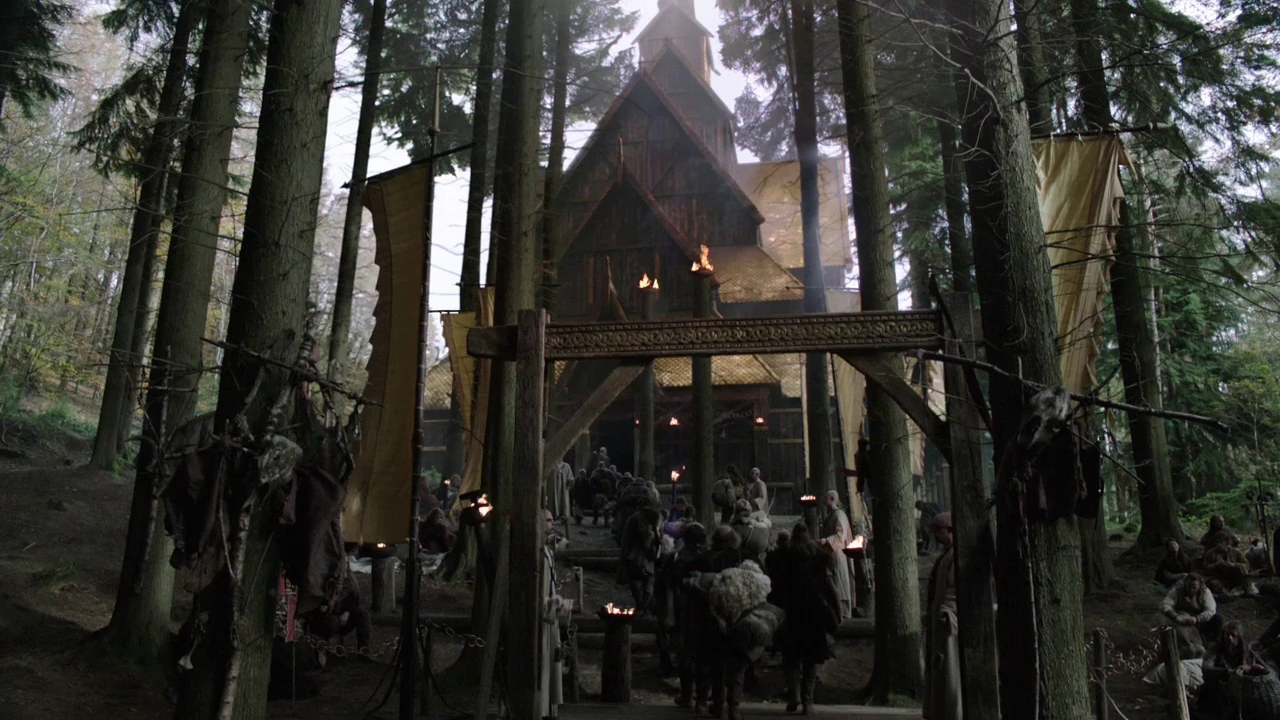
Follow-up: and how reliable is the depiction people might be more familiar with, the one by the TV show Vikings?
Example of a ritual of human sacrifice at Uppsala: https://www.youtube.com/watch?v=YuhBDkIn_RM
View of the temple: https://vignette.wikia.nocookie.net/vikingstv/images/6/6d/Uppsala.jpg/revision/latest?cb=20140126065842
Are the rituals and the setting right? Seems strange that such an important site would be just a single stave church-like building, isolated in the middle of the woods, with no lodgings or other infrastructure to house the influx of people during the festivities.