Does the east-based orientation of maps originate with Christianity? If so, how were maps originated before. If not, then why did pre-Christians put the east at the top?
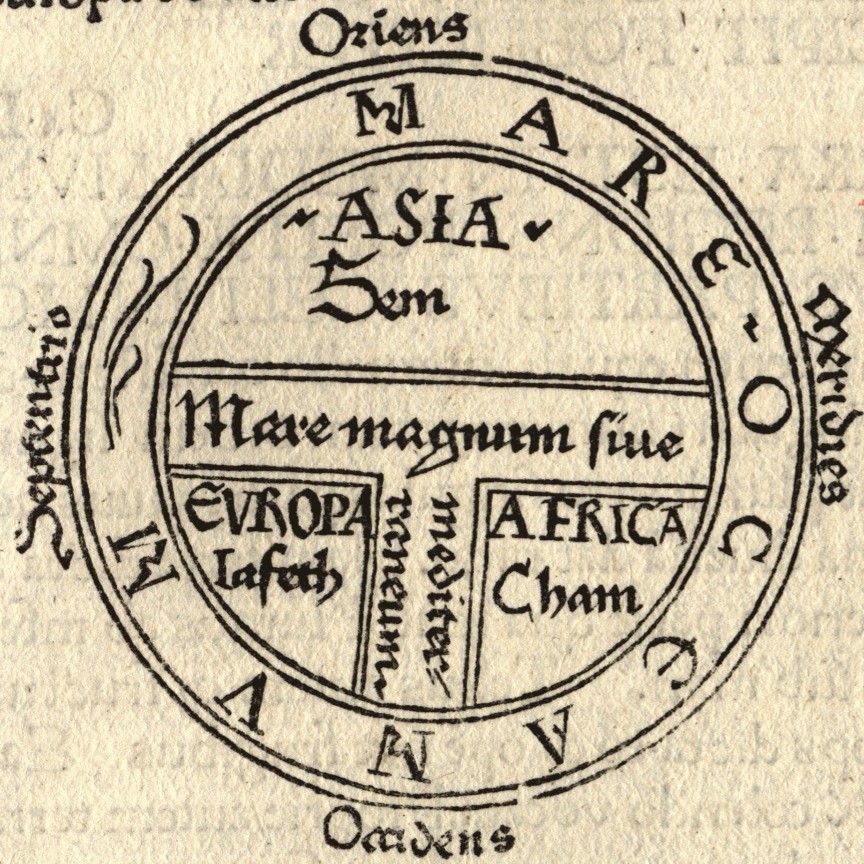
I can speak a bit to the worldview underlying medieval European mapmaking. When you're looking at an image like a TO Map, it's pretty clear that the point is not to faithfully depict geography like you would in a modern atlas, but to convey a truth about the world and the way that God ordered it that is borne out in the shape and placement of the continents.
The TO map says a couple of things:
- The world is tripartite, like God
- The world is cruciform, like the Cross
- The world is shaped like an O and a T, which is elegant because in Latin a way you refer to "whole world" is with the phrase Orbis Terrarum ("circle of the lands")
This method of looking at things so that they fit together elegantly evokes a hermeneutic--a way of reading or interpreting an important text like the Bible--known as "typology." A typological reading is one in which the reader takes one person or event to anticipate another or to reveal a truth that only becomes clear when the type and antitype are held up to one another. Some typological relationships rely on consonance (saying that Noah is like Christ because Noah spared humankind from temporary death, just like Christ would spare humankind from death eternally) while others rely on dissonance (Adam is like Christ because Adam was a man who sinned and delivered humankind unto sin and death, but Christ is a man who did not sin and delivered humankind from sin and death). Still popular in Orthodox Christianity, the burning bush from which God speaks to Moses is a type of the Theotokos (Mary), because the bush contained the blazing vitality of God just as Mary contained the infinite vitality of her son Christ, but neither were consumed--but the physical stress of bearing a divine child isn't one that you'd necessarily think of without having the bush there as a comparison.
An example that's very relevant to your question concerns the Tree of Knowledge. This is the tree that Adam and Eve eat from in Genesis, so that tree is a type of the Cross, which is the "tree" on which Christ atones for Adam's (and Eve's) sin. These typological readings give rise to traditional pairings that show the elegance and symmetry of the created world. The Tree of Knowledge is--in salvation history--related to the True Cross, and so for the purposes of sacramental reasoning, you might as well say that the Cross was built from the wood of the Tree of Knowledge. That's just how good God is at ordering the universe.
(A good author to consider while trying to get into this mindset is Isidore of Seville, who was concerned with--among a great many other things--demonstrating the divine elegance of the Latin language. A go-to example from the Etymologiae is that the eagle--aquila--is so named for the sharpness--acuitas--of its vision.)
So to bring it around, it's correct to say that the eastern orientation is because of the Garden of Eden, but it's not just the Garden of Eden or even primarily the Garden of Eden. In the narrative of salvation history, Jerusalem--where the Temple stood, where Christ lived, taught, died, and came back to life--is the most important place in creation. Because Golgotha (the hill on which Christ was crucified, accepting death to achieve everlasting life) is an antitype of the Garden of Eden (where Adam rejected everlasting life to achieve death), it's not quite wrong to say that Golgotha and the Garden of Eden occupied the same space.
---
For reading:
A very dense book on using typology to make sense of the Bible (which is a weird book) is Northrop Fry, The Great Code (Penguin 2014)
Karen Armstrong goes off on the occasional weird tangent, but for someone starting out or reading out of curiosity, I would recommend her book The Bible: A Biography (Atlantic Books 2012 and evidently like 40 other editions)
For a close reading of a particularly exquisite map along these lines, see Lisa Deam, A World Transformed: Exploring the Spirituality of Medieval Maps (Cascade Books 2015)