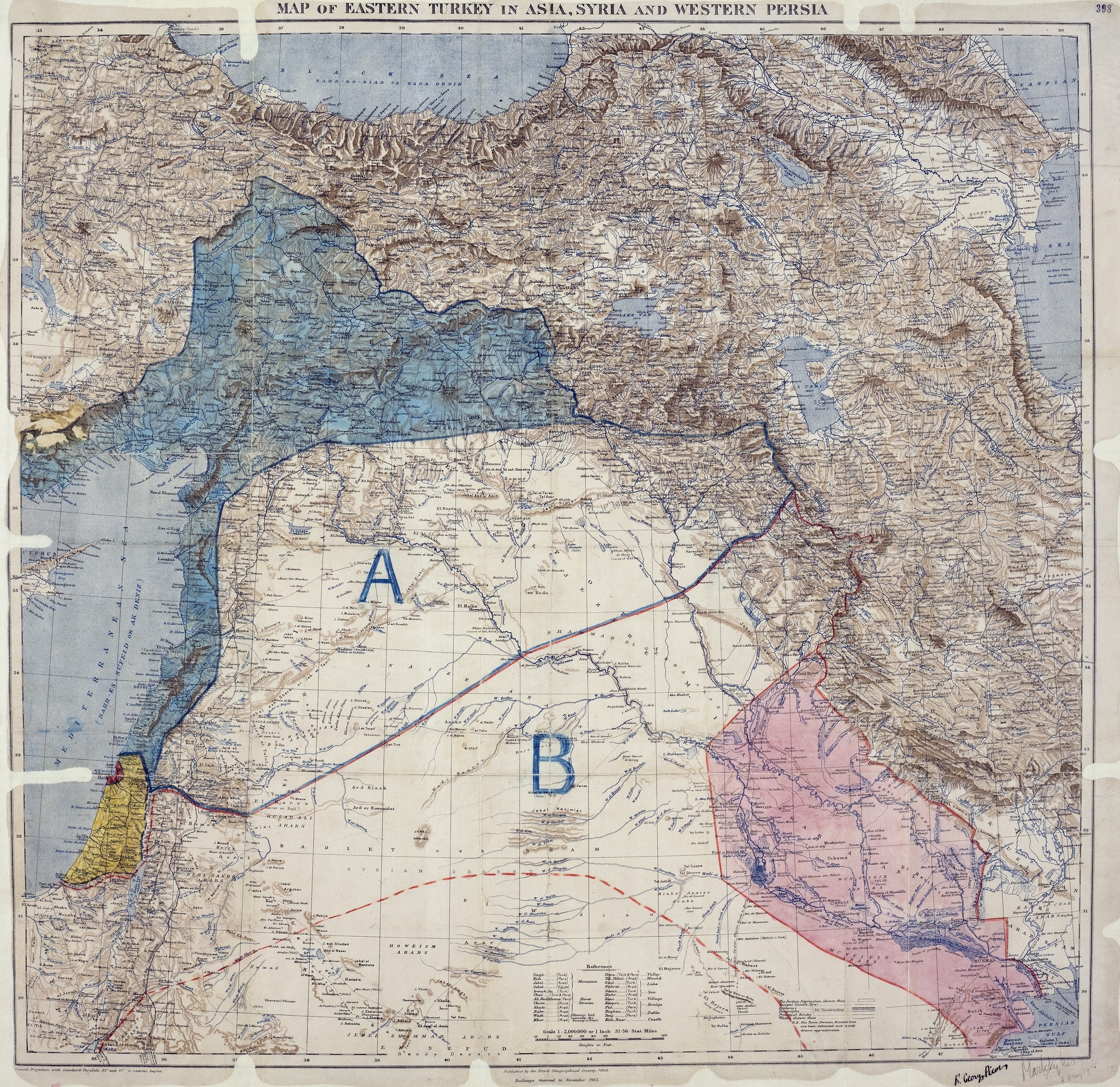
I've been lead to understand that, prior to Sykes-Picot, there were a number of treaties regarding the borders of an independent Arabian state, but I can't understand exactly what they would have looked like, due to a certain amount of ambiguity. Did either the Arabians or the French and British assume that the border would be in one particular place, or was it all up in the air until after the war?
Did either the Arabians or the French and British assume that the border would be in one particular place, or was it all up in the air until after the war?
Mark Sykes and Francois Georges-Picot were tasked by their respective governments to enter into the negotiations precisely because of the ambiguities in their respective positions and the lack of clarity about where, precisely, the limits of British, French, and Arab interests might lie.
Some background:
I'll ignore the agreements prior to Sykes-Picot that related to non-Arab parts of the Ottoman Empire as being less relevant to your question (e.g. the 1915 Treaty of London.) Although these are of course important in the broader context.
Let's start at the beginning. British policy in the 100 years prior to WWI was, in general and with a few very notable exceptions (e.g. the occupation of Egypt in 1882), devoted to maintaining the territorial integrity of the Ottoman Empire as part of maintaining the balance of power in Europe. They were not alone in this. At one point or another almost all European powers, even traditional Ottoman rivals like Austria, had at one time or another adopted this position in order to deprive their other rivals of gaining any advantage by carving up Turkey (post-Thanksgiving pun somewhat intended). This issue of what to do about the Ottomans was so pervasive in pre-WWI geopolitics that it acquired its own name: "The Eastern Question." The Eastern Question was: after the Ottoman empire, then what?
Some European powers had relatively clear answers to that question. Russia wanted Constantinople and the Bosporus Straits. France had a historic and trade connection to the Levant, particularly the Catholic Maronites of Lebanon. Both the Russians and the French as the defacto Orthodox and Catholic powers, respectively, had religious/ideological claims to Jerusalem.
For Britain, the advantages to further territorial acquisition from the Ottomans were never very clear, while the advantages to Russia and France were very obvious. It should be remembered in this context that it was Russia and France were Britain's primary imperial rivals for almost the entire 100 years prior to WWI (Russia threatening British India, France and Britain racing to carve up Africa and the far east), not allies.
The entry of Britain in WWI on France and Russia's side eliminated the fears of those allies gaining territory. The much-lobbied-against entrance of the Ottomans in WWI eliminated the need for Britain to feel any need to preserve the Ottomans.
That solved the problem of the Eastern Question, but given that this had been an insolvable diplomatic/imperial issue for most of the previous century, the specifics very much needed to be hammered out.
On March 4th, 1915, the Russians moved first, sharing an aide memoire (an intentionally informal, ambiguous, and deniable diplomatic document) stating the Russian claim to Constantinople and the straits.
The British upon receiving this--which also stipulated that the Russians would favor any French and British claims in exchange for recognizing Russia's claims--decided that after 100 years of a policy of preserving Ottoman territory, they needed to figure out exactly what it was they wanted if they were going to carve it up.
The result was the DeBunsen Committee, which produced its report in June 1915. While it did not recommend partition of the Ottoman Empire, the committee's report concluded that if the Ottoman Empire were partitioned, that Britain would want to gain control of all of Palestine, all of Mesopotamia (i.e. the three Ottoman provinces of Basra, Baghdad, and Mosul, now roughly constituting modern Iraq) and the territory that would create a land bridge linking the two (i.e. what is now the state of Jordan).
Less than a month later, the British government authorized their High Commissioner for Egypt to enter into negotiations with Sharif Hussein of Mecca to agree upon terms for the Sharif to launch what is now known as the Arab revolt.
The initial Arab position, agreed between Hussein and a number of the Arab nationalist societies operating secretly within the Ottoman Empire, was the creation of an Arab Kingdom led by Hussein within the territory of the Damascus Protocol.
The most important of the letters between Hussein and McMahon (the British High Commissioner in Egypt), was McMahon's letter on 24 October, 1915, in which McMahon wrote:
"The two districts of Mersina and Alexandretta and portions of Syria lying to the west of the districts of Damascus, Homs, Hama and Aleppo cannot be said to be purely Arab, and should be excluded from the limits demanded... As for those regions lying within those frontiers wherein Great Britain is free to act without detriment to the interests of her ally, France... Great Britain is prepared to recognise and support the independence of the Arabs in all the regions within the limits demanded by the Sherif of Mecca."
I say this I think without exaggeration: this is perhaps the most troublesome sentence in the history of diplomacy.
It bears repeating:
The two districts of Mersina and Alexandretta and portions of Syria lying to the west of the districts of Damascus, Homs, Hama and Aleppo cannot be said to be purely Arab, and should be excluded from the limits demanded.
No one at the time or since has ever been able to figure out what this sentence means. For one thing "districts" is misused here. It's unclear what administrative unit is being referred to, and the Arabic translations did not correspond correctly to Ottoman administrative units. Among other issues, both the Wilayet and Sanjak of Aleppo border the sea, so there are no districts Aleppo's west.
Partly because of the importance that this sentence would play later on as we shall see there has been intense scrutiny of what was going on here, ranging from mere incompetence, to intentionally misleading maliciousness, to the idea that the entire phrase "Damascus, Homs, Hama, and Aleppo" was an obscure literary joke reference to a line in Gibbon's Decline and Fall of the Roman Empire.
The true intentions of the British officials in Cairo in staking this reservation are unclear. What is clear is that later claims that this sentence is entirely consistent with later promises and agreements is nonsense.
Now to return to your original question, how do we get to Sykes-Picot?
Britain, having agreed to the creation of some sort of Arab Kingdom, but having made reservations largely on behalf of the interests of France somewhere vaguely to the west of Damascus, Homs, Hama, and Aleppo, now desperately needed to determine what exactly France's interests were.
And so Mark Sykes entered into negotiations with Francois Georges-Picot, having told the cabinet before the start of the negotiations that he intended to draw a line "from the "E" in Acre to the last "K" in Kirkuk."
The result was the Sykes-Picot map, which established clear British and French spheres of control (red and blue shaded areas, respectively) and general influence (areas "A" and "B") which would be effectively areas of autonomous Arab rule. (NB, the map linked to above is not a reproduction. It is the actual map that Sykes and Picot agreed to. You can see their signatures--Sykes' somewhat hilariously done in pencil-- in the bottom right.)
Now, to address one aspect of your question on what "borders" looked like, I think this might require a bit of a change of conception. British imperial policy thrived on ambiguities around things like borders. British Egypt is a great example of this. Though Egypt had been occupied and entirely under the control of Britain since 1882, de jure Egypt remained part of the Ottoman Empire until the outbreak of WWI. This 1904 map is accurate, if unusual, in showing Egypt as an ambiguous pink among the other more solidly red British possessions.
The agreement made by the diplomatically amateurish Sykes was almost immediately and universally criticized by more seasoned British diplomats as being overly specific and inventing control/influence distinctions that were better left ambiguous. One of the reasons why British officials promised the Arabs an "independent" Arab state in the first place is they knew that it would be British dominated. De jure Arab independence and de facto British control were not at all contradictory promises in the minds of early 20th century British policy makers.
That being said, it's worth noting that Sykes-Picot(-Sazonov, after agreed by the Russians) still has enormous ambiguities in regards to borders.
I'm running out of character count so I'll have to continue in a brief part II.