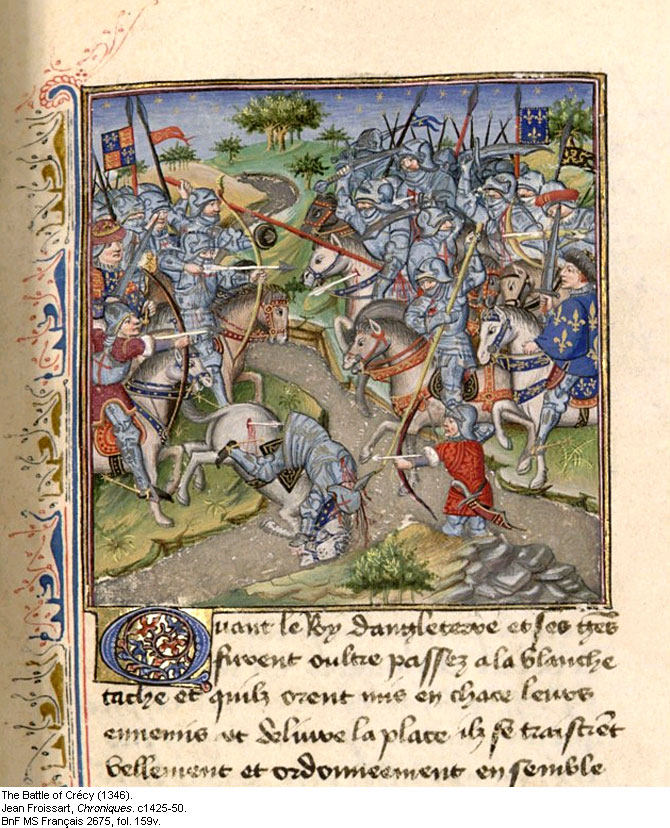
I sometimes hear people (ok, YouTubers) use details in period art as a source for a number of purposes. Least among these is to supposedly correct misconceptions or make authoritative statements about medieval combat. But how accurate were these sorts of details? Aren't they just as likely to have the same sort of misconceptions that Hollywood perpetuates, if not more so? How likely was a tapestry maker to know the gritty details of arms and combat?
Is there any historical fact backed up by archaeological or archival evidence that does not jive with period art?
There are limitations to the use of art as a source for Medieval arms and combat.
Some art is simply fantasy: https://jonkanekojames.com/wp-content/uploads/2015/05/rabbit-1.jpg (see https://jonkanekojames.com/2015/05/why-are-there-violent-rabbits-in-the-margins-of-medieval-manuscripts/ for a discussion of what killer bunnies might mean)
Some art is anachronistic. For example, consider this David and Goliath: http://ica.themorgan.org/manuscript/page/53/158530 which has multiple anachronisms (of different types). First, David and Goliath are armed in Medieval-style, and this art can't be used as a source for ancient Israelite or Philistine arms. Second, it incorporates things described in the Biblical text, such as Goliath's greaves, and his shield slung over his shoulder. This art shouldn't be used to support greaves being worn at the time the artwork was produced, nor the slinging of shields over shoulders.
Some art uses weapons and armour to identify the two sides in a battle. First, this is likely to result in each side looking more uniformly equipped than would have been the case. Second, the equipment of at least one of the sides will sometimes be quite different from the usual. As a result, we see battles from the Crusades with Saracens wielding European falchions: https://commons.wikimedia.org/wiki/File:Combat_deuxi%C3%A8me_croisade.jpg (and the headbands instead of helmets might be more of the same), and also French armies uniformly equipped with falchions: http://www.luminarium.org/encyclopedia/crecyfroissart.jpg Some more examples, mostly Crusades, can be seen in https://www.reddit.com/r/AskHistorians/comments/86it3s/why_did_eastern_armies_prefer_curved_swords_over/
Some art probably shows certain weapons etc. as the predominant type because they are conventional, rather than because they were actually the predominant type. For example, the mounted English archers in the preceding http://www.luminarium.org/encyclopedia/crecyfroissart.jpg might have horses because "warriors ride horses" rather than them having fought as mounted archers. Similar, swords are probably over-represented in art.
Some art is exaggerated. For example, the helmet-cleaving shown in http://ica.themorgan.org/manuscript/page/46/158530 and http://ica.themorgan.org/manuscript/page/48/158530 is impossible with most helmets. The artist wanted to show soldiers being killed, and it's a convenient way to show it, even if not so realistic. Some effect of weapons in art is realistic, e.g., [NSFW, gore]: http://ica.themorgan.org/manuscript/page/49/158530
There are technical mistakes in some art. For example, the curved bowstring here: https://i.pinimg.com/originals/a8/c6/41/a8c641608d678e563af5a46a9c400041.jpg is wrong (it is also unlikely that the arrowhead was the size of the archer's hand). More common things in archery that can't be automatically trusted are arrows on the wrong side of the bow, the exact details of the draw (the height of the drawing hand at full draw, the length of the draw).
These problems are not restricted to European art, nor to Medieval art. For example, one sees, in Chinese art, Guan Yu shown wielding a guandao, even though it hadn't been invented yet, and many of the above things in Greek vase art.
But that said, art is a very valuable resource for learning about combat and the use of weapons, because it shows them being used - something that is almost invisible archaeologically (some details about use can be inferred from damage to weapons and armour). In particular, fight books (i.e., martial arts manuals) and military manuals are often valuable for this - illustrations were intended to inform, to convey useful information about fighting and the use of weapons.
To judge the reliability of art-based conclusions about weapons at fighting, ask:
Is there more than one piece of artistic evidence?
Is the art shown cherry-picked?
Is the individual shown a special individual (e.g., Goliath, Guan Yu) or a member of a special group (e.g., a Saracen)?
Are small details being deduced from art where large details are not accurate?
Look at more art yourself. It's much more accessible today, with tools like Google Images readily available. (Try using "manuscript" as a search term when looking for Medieval art - e.g., rather than searching for "medieval archer manuscript", search for "medieval archer manuscript" and you'll find more art and fewer photos of re-enactors and modern military miniatures.)
In fashion/material culture, we use artwork a lot - and just as with militaria, there are drawbacks.
The greatest problem is the use of costumes in portraiture, which is not obvious to many people. In the seventeenth and eighteenth centuries in particular, many had themselves painted in something non-fashionable that theoretically wouldn't age. The earliest were based to some extent in Classical dress, often Roman military-inspired outfits for men, and oddly loose and seamless clothes for women, both frequently accessorized with a flowing scarf.
Two Ladies of the Lake Family, by Sir Peter Lely, ca. 1660, at the Tate Collection
In some cases, women's costumes are very much like wrapping gowns (dressing gowns), but there was a sliding scale all the way up to outfits that appear to match the fashionable silhouette, with bodices that simultaneously appear to be loose and wrinkled but also to be worn over stays (a corset). These latter versions are tempting to see as real gowns, but with their full sleeves, pulled up a little bit at their flaring ends, and lack of any visible seams or openings, they do not resemble any extant clothing of the period and must be considered unreal dress - either painted from the imagination of artists who specialized in drapery and fabric (a real thing!) or being based in actual clothes worn to the sitting but with judicious "editing" on the part of the painter.
Mrs. David Chesebrough, by Joseph Blackburn, 1754, at the Metropolitan Museum of Art
Another form of deliberately old-fashioned dress in portraiture was the "Van Dyck costume", a copy of seventeenth-century dress used in mid-to-late eighteenth-century portraits. (Ironically, AnthonyVan Dyck himself used Classical dress in some of his paintings.) In some cases, this could be relatively close to accurate - compare George III and his sons in George III, Queen Charlotte, and their Six Eldest Children, by Johann Zoffany, 1770 to Lord John Stuart and his brother Lord Bernard Stuart, by Van Dyck, ca. 1638. These tend to be more difficult to identify as costume, since they're more likely to be actual garments that once existed, but were only used in the portrait studio or in a masquerade. For instance, Thomas Hudson seems to have had a Van Dyck gown that clients could wear, as in his portraits of Frances Hunt, ca. 1755 and Anne Parsons, 1753.
There were also costumes that did not mimic a historical period. One very popular one was based in the actual Turkish outfit that Lady Mary Wortley Montague (wife of the British ambassador to the Ottoman Empire) was painted in - Lady Mary Wortley Montagu with her son, Edward Wortley Montagu, and attendants, attributed to Jean Baptiste Vanmour, ca. 1717. The salient details for sitters later in the century were the blue overrobe with ermine lining or trim and the lack of corsetry, which were enthusiastically copied and intermixed with other elements at will. Some examples:
Elizabeth Ross (Mrs. William Tyng), by John Singleton Copley, ca. 1766
Herzegovin Louisa of Schleswig-Holstein-Sonderburg-Augustenburg, by Jens Juel, ca. 1785
As with the previous category, it's likely that these were actual garments kept in studios for sitters and models to put on for their portrait, given the detail and realism found in their painted representations.
Lastly, some combined the antique/classicizing and Turkish costumes into a nonexistent dress. A great example is in Mrs. Anne McCall, by Robert Feke, 1746: this has the Turkish element of the blue overrobe (as well as buttons, which you see on many Turkish-costume portraits), plus the pinned-up flaring sleeves and lack of visible seams of antique portraiture. In my opinion, this is not even a real garment worn for the portrait sitting, since the buttons don't appear to be under any tension while everything else is quite realistically depicted - I suspect Feke was simply very accomplished at the rote features that were supposed to be shown in this style, such as those sleeves, and could manage the imagined details while his sitter was in contemporary fashionable dress, which gave him the silhouette, the pleats at the top of the skirt, the ruffles, etc. (Feke has a portrait of another sitter in exactly the same improbable dress, and I have seen at least two more by a more folk-style painter imitating it as well.)
The trouble with these misleading representations is that it takes a certain amount of expertise to give you the confidence to deem a portrait's clothing as a costume - you have to make a judgment call. I have gotten into a number of arguments online with non-scholars who take these paintings at face value, because it is safer and simpler to insist on their being real when you don't have the experience with extant garments or with staring at other portraits for hours to be comfortable saying, "X feature or anything like it does not exist on any known surviving clothing of the same type, so it's not a representation of fashionable dress," or, "all of the portraiture showing a person in a garment that looks like this copies the colorway and the pose and even the wrinkles, so it's artists copying each other." But it seems fairly clear that portrait artists in western Europe and America in this time period used a decent amount of fanciful dress, particularly when painting women.
At the same time, this is helpful! Once you become accustomed to what was desirable in costumed portraits, it also becomes easier to tell what is real and what can be trusted as a source for understanding the clothing of a particular period.