Today:
AskHistorians is filled with questions seeking an answer. Saturday Spotlight is for answers seeking a question! It’s a place to post your original and in-depth investigation of a focused historical topic.
Posts here will be held to the same high standard as regular answers, and should mention sources or recommended reading. If you’d like to share shorter findings or discuss work in progress, Thursday Reading & Research or Friday Free-for-All are great places to do that.
So if you’re tired of waiting for someone to ask about how imperialism led to “Surfin’ Safari;” if you’ve given up hope of getting to share your complete history of the Bichon Frise in art and drama; this is your chance to shine!
Week 58
Our weeks of wandering off the main path come to an end (almost), we have urgent matters to attend in Italy: but first we need to return one more time to Mario Toscano's argument on the Italian foreign policy – or rather on foreign policy in general.
Foreign policy – explained the fascist historian in his 1931 thesis – was
in its fundamental lines, fixed by the geographical position, the historical tradition and the economical interests of a state. […] A perfect foreign policy therefore is one that coincides with the geographical and economical interests of the state. And, as it is easy to understand, both the geographical position of a state and the substantial elements of its economical interests are constants, hence a consequent continuity of its lines of foreign policy.
And, quoting Mussolini's speech to the Chamber on November 12^th 1924
“Foreign policy is never original. Foreign policy is strictly constrained by matters of fact, of geographical, of historical, of economical nature. No originality therefore; rather autonomy.
The first purpose of those who are called to direct, or study the foreign policy of a state, is therefore to research and define properly those vital and fundamental interests.
If you have been following the previous weeks, you probably realize that I am not entirely sold on this sort of approach. Not that geographical, historical and economical factors are irrelevant, or unworthy of consideration – far from it. But this kind of “naturalistic” diplomacy clearly carries the imprint of the early XX century nationalist view of the state; where a set of given factors determines the identity of the nation and drives its action, while individuals are either expected to conform to those factors or bound to operate in opposition to the true national goals, with little hope to impact on those, except for purely contingent matters. Again, there is no reason to take this view as being completely without merit, but at the same time it is insidiously inaccurate, since we are in our experience used to consider those elements (of geography, economy, and cultural heritage) as constants, even when in a larger time frame they clearly are not (the nation itself is arguably not an absolute) and the choice to elevate them to absolute factors, once carried to the extreme, may lead to absurdity.
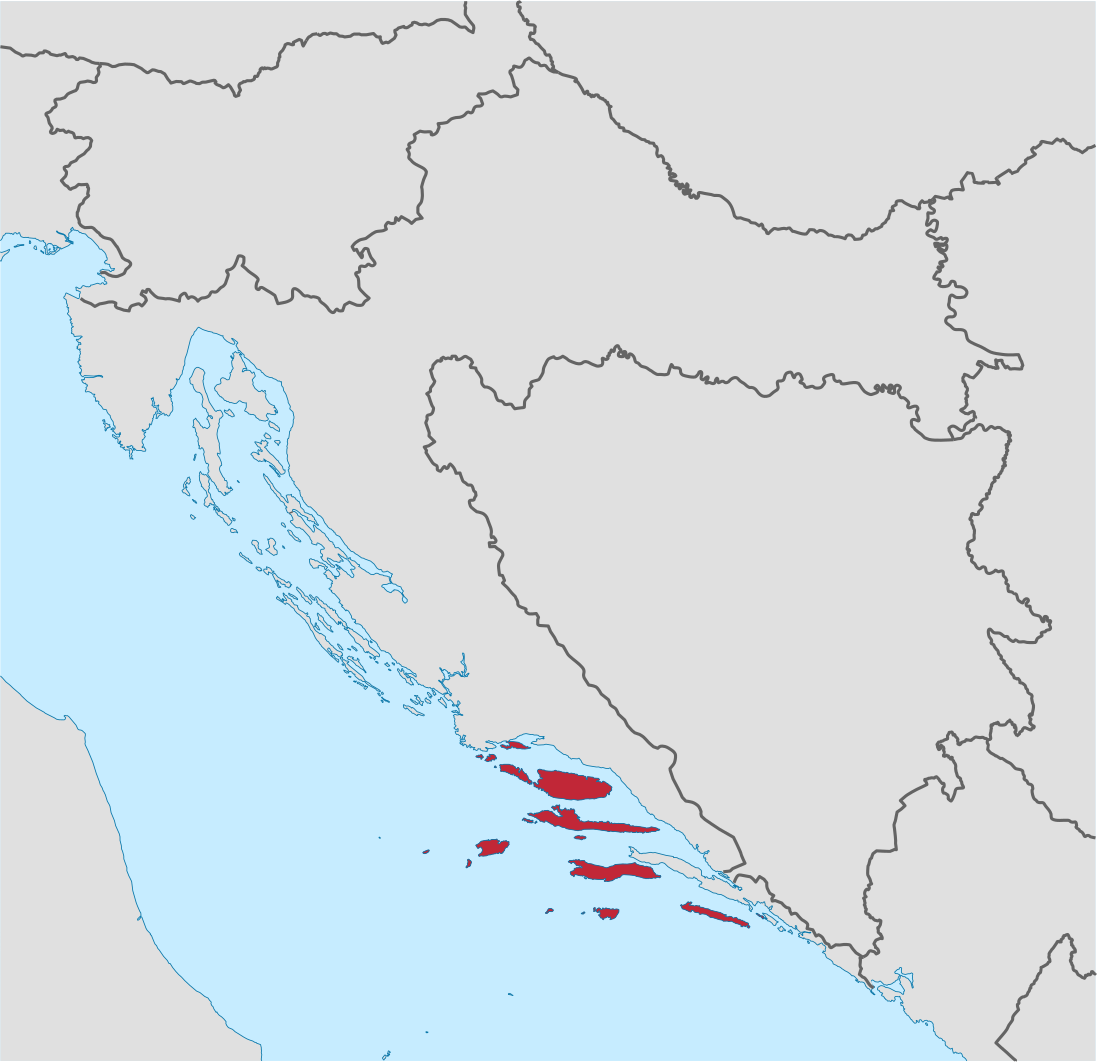
In early April 1915, with Italy busy in the final stages of the negotiation for the Treaty of London that would secure her intervention in the Great War, Foreign Ministry Sidney Sonnino and Prime Minister Antonio Salandra shared their view that, any agreement that did not grant Italy the possession of the Curzolane Islands would have made “absolutely impossible to understand why we entered the conflict, taking upon ourselves such an immense weight and danger”.
Those islands, once owned by Venice, Austria-Hungary, Yugoslavia and now a part of Croatia, are a fairly nice vacation place – with clear water, beaches and various architectural testimonies of the Venetian rule. They are also an important strategic position that overlooks the port city of Split and substantially neutralizes any fleet based on the coast. Control of those islands may help secure that of the Adriatic Sea.
It is far too easy to blame those early XX Century politicians for their myopic attitude towards the great problems of their age. To ask whether the possession of those isles was indeed a good compensation for the over 600,000 Italian dead – Sonnino and Salandra didn't know at the time, nor could they foresee, maybe, how much the war was going to cost. And when Italy failed to secure the Curzolane at the Peace Conference of Paris, like other parts of the Dalmatian coast, Sonnino claimed indeed that this failure marked his “moral death”, that he had “ruined Italy while he had thought that he was just doing his duty”.
The Great War had tested the Italian Foreign Ministry – called abruptly to replace the Marquis of San Giuliano in October 1914, after his death – he had put together the Treaty of London, laboring through the negotiations more by strength and obstinacy than by craftsmanship and diplomatic sensibility; he had defended it when it had been disclosed by the Bolsheviks after the October Revolution, he had resisted the pressure for his resignation in the difficult months that followed the Italian rout of Caporetto, while losing his collaborator of a time when Sonnino had been somewhat of a progressive liberal in the Italian political landscape – that Leopoldo Franchetti, who had shot himself in November 1917, struck by both personal and political misfortune. As a result, Sonnino had grown even more inflexible and made his stand on the line of the Treaty he had contributed to create, resolved not to give up one foot of land. It may be that one day, Sonnino's fear comes true and the Dalmatian isles become the key for a Yugoslav nation to secure mastery of the Adriatic Sea – it may be that, for all the talks of immutable factors, geography, history and economics, something has changed since the days of XX Century imperialism. It's not unreasonable to imagine war on the borders of Croatia, nor tension between Italy and Yugoslavia. But it might be a mistake to imagine war to be driven by those same immutable factors, and to constrain diplomacy and international relations within those boundaries, despite the evidence suggesting otherwise. Boundaries that inspire views often irreducible to reality – such as Sonnino's declarations that Italy sought friendly relations with the “Austro-Hungarian people” (I did not forget the “s” at the end); which certainly appears a curious point to make in the century of nationalism. Or that a few islands made the difference between war and peace for a nation of forty million, often unaware and untouched by the possession of those lands.
These considerations, by themselves, do not seem to warrant a general disregard of those “naturalistic” elements of diplomacy and foreign policies – but suggest for them to be taken into closer examination, to understand their frame of reference, their organization and the development of the social and intellectual elaboration that contributed to establish them; in short their material and ideological background. Hence to consider them within their context, as running themes of an internal political debate, to discern how much they were in correspondence with the other, less “naturalistic”, elements of diplomatic formulation, to see how much they harmonize with the “contingent” - to use Toscano's words – elements of a diplomatic formulation. In his review of the Treaty of London, “The Present Significance of the Treaty of London of 1915" published in September 1939, R. Albrecht-Carrie delineates the general character of the Italian diplomacy behind the formulation of the Treaty:
When war broke out in the summer of 1914, Italy was allied with Austria-Hungary. The fact that these two countries, especially the latter, did not live up to the letter of the treaty of alliance, and the considerations that the aims pursued by Austria-Hungary in July 1914 ran counter to Italian interests, combined to insure Italian neutrality at the outset of the conflict. Once it had been established that the Austro-German plan had to reach a quick decision by arms had been thwarted, the question became for Italy how to best profit from the situation.
The following negotiations have been discussed already in abundance; so that we'll jump to the final form of the Treaty:
The drawing of [the European frontier] was predicated on two principles: the redemption of Italia irredenta, which had been a cardinal tenet of Italian policy from the beginning of the unification movement in the nineteenth century, and strategic security. As a consequence of the application of the latter principle, roughly a quarter million Germans in the Tyrol and three quarters of a million Slavs in the east would be annexed to Italy. […] Control of, or at least security in the Adriatic had been […] one of the principal aims of Italian policy, and the Treaty of London went a long way toward the realization of that aim. […] With security once achieved in the Adriatic and with a foothold in Albania, Italy would be in a good position to press her influence in the Balkans.
From a general point of view, the Treaty could be broken up into four parts:
the northeastern land frontier, well defined, on which the Italian claims were granted in full; the Adriatic and the Balkans, also defined with precision, where Italy had been willing to abate some of her original claim; Asia Minor where a claim was staked out with a fair amount of definiteness; finally, Africa, the subject of the vaguest terminology.
With this set up, the Italian Government and Foreign Office had to face the unexpected turns of the Great War: the Russian collapse and subsequent revolution, that also disclosed the terms of the secret treaties among the Entente powers (and prevented the application of the Saint Jean de la Morienne agreements of 1917); the growth of the autonomy revendications in central Europe (and more concerning for Italy, those of the Slavs within the Balkanic region), to which Italy looked with a mixture of sympathy and concern – and after Caporetto a measure of (instrumental) enthusiasm culminating with the Congress of Rome of June 1918; the intervention of the US, with their political and economical weight and the loaded question of Wilson's fourteen points; the dissolution of the Austro-Hungarian Empire that deprived Italy of her traditional diplomatic counterpart in the Balkans.