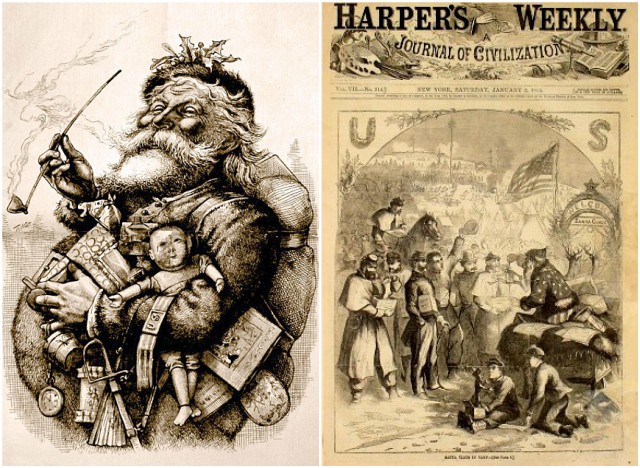
It depends a lot, in different cultures we can notice other names for Santa Claus, like Father Christmas, St. Nicholas, Sinter Klaas, among others.
No doubt Santa Claus is seen as a popular legend more "venerated" by children, but we can not put the Santa Claus as a legend really, since there are no epic tales, or even tales of Santa Claus's origins, as stated by Lévi-Strauss. Now, in a deeper study of Lévi-Strauss, he understands that all societies have this kind of Christmas feeling of delivering gifts to kindhearted children.
It looks at a tribe farthest from the society we live in, and they also feature that feeling and feature a character who delivers gifts to children.
Speaking about the Santa Claus of the United States, we have a popular tale in the founding of New York in the seventeenth century, this legend unfolds on a dutch ship en route to the new world, on the bow of the ship there was the Sinter Klaas in charge of protecting the ship of the storms, besides other attributions to this character. Unfortunately the ship sinks and the sailors are on the American coast; During the night, one of the sailors dreams of the Sinter Klaas, he asks the sailor to merge a city on the island of Manhattan, in exchange for this, the Sinter Klaas promises to visit its inhabitants every year to bring gifts to the children.
However, the real Santa Claus appears many years later, with an artist named Thomas Nast, who draws a "gnome covered in fur, potbellied and playful". As early as 1930, the Coke brand created a character different from Thomas, a character in a red hat, coat, black boots and belt. Then Santa Claus becomes a Coke brand as early as 1930, the Coke brand created a character different from Thomas, a character in a red hat, coat, black boots and belt. Then Santa Claus becomes a brand of Coke, and begins exporting this character with the Marshall Plan after World War II, France was one of the countries that most accepted Santa Claus because of the economic and advertising appeal of the character.
Sources:
LÉVI-STRAUSS, Claude. Le père Noël supplicié.
Le Seuil, 2016.PERROT, Martyne. Idées reçues Noël, Le Cavalier Bleu, 2002.
(Sorry for any english mistakes)