#“I didn’t know I had the same question until I heard someone else ask it.”
About a year and a half ago I posted this thread asking why you participate in AskHistorians. That thread, follow-up interviews, and a whole lot of lurking became the basis for half my PhD dissertation in which I explored why people participate in online communities. If you want to see the dissertation in all of its 300+ page glory, you can access it here. At long last, I’m sharing some of the results of this work through a series of three posts – this is the first. Since AskHistorians is a place to learn about history, this post discusses what and how we learn through participation, and some of the challenges faced by the sub when it comes to knowledge exchange. The next will discuss AskHistorians’ position on reddit and the last the experiences of the mods. But before I get into the results, I want to provide a bit of background information first.
Methodology
The methodology I used to learn about participation in AskHistorians was somewhat ethnographic and results were derived from a variety of sources, such as:
To analyze the interview data, I used a process known as coding where I read (and reread over and over again) the interviews looking for common themes to describe and explain why my participants were motivated to participate in different ways. If needed I pulled in observational data and secondary literature to supplement and sometimes explain what I had learned through the interviews. For example, if a participant recalled a particular thread, I would read it to understand more about the context of their recollection.
Coding can be a pretty subjective process, so to help identify and mitigate bias I engaged in a process referred to as reflexivity, in which researchers examine how their beliefs, values, identity, and moral stance affect the work they do. A brief introduction to positionality can be found here. Since my position relative to the topic I’m discussing is different for each post, I’ve included a section on positionality in each one. Of relevance to this post is my experience as an AskHistorians user. I’ve been a lurker since I discovered the sub in 2012. I have a bachelor’s degree in history, so when I first found AskHistorians, I thought I might be able to provide an answer or two, but quickly realized I had nowhere near the expertise as other community members. Thus, as someone with an interest in history but not the level of knowledge required for answering questions, I found that I shared a lot of the same learning experiences as the other lurkers I interviewed.
One more quick note before I move onto the results. The quotes I’ve used mostly come from the interviews, but I’ve also included a few public and removed comments. Public comments are linked and attributed to the user who made them. Removed comments are not attributed to anyone and are quoted with all spelling/grammar errors retained. I contacted interview participants whose quotes I’ve included and let them choose how they wanted to be attributed in the posts, e.g., with their first name, username, or pseudonym. If I didn’t hear back I used a pseudonym.
Now, without further ado, the results!
Learning through participation in AskHistorians
One of the things I love about AskHistorians, and that was reflected in the interviews and meta posts, is that learning through the sub is so often serendipitous. Some variation of: “I didn’t know I had the same question until I heard someone ask it,” was a common refrain. Often this statement was made in reference to learning new topics. The people I interviewed described how they would have never thought to ask about things like the history of strawberry pin cushions, how soldiers treated acne during wartime, or succession in the Mongolian Empire. However, serendipitous learning was also expressed by experts with regards to their own areas of expertise as well. For example, several participants, such as flaired user, u/frogbrooks, described how questions encouraged them to look into their own subject areas from a different angle or take a deep dive into an area they’d previously overlooked:
A couple of the responses I’ve written have opened doors to new topics that I otherwise wouldn’t have read much about, but ended up being extremely interesting.
Another recurring theme was that AskHistorians made learning about history accessible. Several participants described having an interest in history, but not necessarily the means to get into it in any depth. For example, some didn’t have access to primary or secondary resources, while others described not having the time or energy to try to search through books to find the exact information they wanted. Accessibility was not only important to people who wanted to learn more about history but couldn’t– it was also important to those who thought they hated history based on how it had been taught in school. The interesting questions and engaging writing styles of AskHistorians’ panel of experts helped some of the people I interviewed realize they actually liked history after all, such as lurker, KR:
All the history taught in class beyond the ancient Greeks was super duper boring . . . [but] it turns out I actually really love history, and the sub made me see that.
Not too surprisingly, learning about the past was important to everyone I interviewed; this is, after all, a sub dedicated to discussing history. However, new historical knowledge was not the only thing participants gained. For example, people described learning more about how history is practiced professionally, and the methods historians use. This was expressed not only by total history novices, but also by those who majored in history, such as Jim:
I’m learning more from Reddit on historiography than [from] my teachers.
Jim’s statement also reflects my own experience: as a history major (albeit 15 years ago) I also learned more about historiography and historical methods from AskHistorians than I did during my degree. On the other side of the coin, AskHistorians also provided experts with a way to learn more about how the broader public understands history. For example, u/CommodoreCoCo, a PhD student, said:
I’ve really learned a lot about how the public perceives history and how, in some ways, it’s been taught to them incorrectly and what misconceptions they have, which is absolutely important if we want to interact with them better and teach them better and train better historians for the future.
In AskHistorians, experts and laypeople come together and meet each other’s needs: laypeople learn things they want to know from experts, which illuminates for experts topic areas that are missing or need to be better addressed.
While most people described learning new information through participation in AskHistorians, several described learning more about other things, such as negative aspects of human nature. These lessons were not learned after discovering terrible things people did in the past; rather, participants described learning them by seeing the prevalence of racism, sexism, and bigotry on reddit as well as seeing how questions reflect biases, often in an attempt to justify bigotry. Each of the people I spoke to who described learning more about the negative aspects of human nature were mods. For example, when asked what he’d learned, Josh responded:
I guess I’d had a rosy-eyed view of humanity and thinking that people are mostly good. And I do think that people are mostly good, but I didn’t think that people could be so malicious. I don’t know if I want to go so far as to say evil, but hurtful to other people and that’s one of the sadder things, but I think it’s one of those things that have made me more mature as a person.
However, non-mods were among those who described learning how to detect bias in question asking, such as Oliver:
after a while you get used to the moderators or the person responding saying, ‘you’ve made this assumption here and this is how the question should be stated in my opinion’ and that’s one thing that’s helped me being able to recognize a loaded question, because I find myself often asking, not just in history but in other situations in life . . . [learning to detect bias is] one way that’s helped me in this turbulent time, kind of go, what is this person really saying: is he making underlying assumptions or questions or anything like that? It’s a helpful tool.
Why learning about history is important to AskHistorians users
When I asked participants why learning about history was important, a common response was that learning about the past provided a way to better understand the present. Participants described wanting to know why things are the way they are, and then going back and back and back– deep down that rabbit hole I’m sure many of us know all too well. Further, participants, such as Oliver, were also hopeful that learning about the past would help make the present world a better place:
I just kind of look around and go man, if everybody just knew the history of this or that, or of this family or the history of their neighbourhood, things would be so much better!
Learning through participation in AskHistorians was described in overwhelmingly positive terms, even when learning more about negative aspects of human nature, which, for example, was often described as contributing to personal growth.
One last thing I want to highlight before I move on to describing why participants share their expertise is that the learning that happens through participation in AskHistorians is social. We learn not only from what the experts tell us in response to questions, through debate, or in requests for follow up information, but also by watching them in action. Oliver’s quote above showcases how practical, real-life tools, like detecting bias, are learned by watching mods and flairs in action. The “teaching” side isn’t always intentional, overt, nor require subject-specific expertise, and the learning that happens in the sub extends well beyond history.
Why participants share their expertise
Needless to say, while learning through participation on AskHistorians may not always be about history, it is most of the time. Therefore, the sub’s success depends on the contributions of experts. The reasons for sharing expertise were varied, and participants often described several factors that motivated them to share. First, participants described sharing expertise purely because they can, a sentiment known as self-efficacy (Bandura, 1997). For many participants, self-efficacy changed over time. Some described feeling more comfortable answering questions on a wider range of topics as they learned more through school or on their own. Conversely, others described learning more and realizing how much they didn’t know, thereby decreasing self-efficacy and their comfort responding to questions. In one case, a participant revoked his topic-specific flair in favour of the more general, “quality contributor flair.” And on the subject of flair, getting it was also important to several participants who saw the merit-based process of earning flair as representative of a history of high-quality contributions. These participants described flair as an important mode of recognition for having knowledge in their subject area and for their contributions to the community.
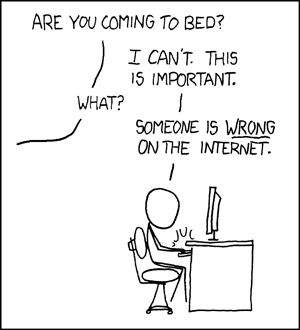
Another motivation for contributing expertise was seeing errors that needed to be corrected. Correcting errors was also often the impetus that inspired people to make their first ever comment on AskHistorians. For example, when recounting his first post, former mod u/edXcitizen87539319 alluded to the popular xkcd comic, saying,
It was a case of ‘somebody’s wrong on the internet’ and I had to correct them.
Similarly, others were encouraged to participate because they saw that they held expertise in a particular topic area that no one else seemed to have, for example, mod, Anna:
I realized there wasn’t anybody out there who was going to answer them but me. So, I basically filled a gap that I had self-identified.
Most of the time gaps were identified in a given topic area. However, one participant saw how he could fill a gap with particular source material: Oliver, who wasn’t a flaired user or mod, had inherited rare books written about a former president, so when a question came up, he was able to use these books to write a response to a question. His answer got accolades from the OP and was shared on that week’s Sunday Digest.
Self-efficacy, earning flair, correcting errors, and filling gaps were all important motivations for sharing expertise. However, the next two were the most highly valued: helping and bringing enjoyment to others and promoting historical thinking. When people described sharing their knowledge to make people happy, it was often accompanied not only by a sense of personal happiness but also a sense that some good was being done in the world, as is reflected in this quote from u/TRB1783:
If I’ve taught someone today, I’ve done a good thing. You know, something in the real world. Something that matters.
Tied in with the idea that teaching people something new is a worthwhile endeavor is that sharing expertise can be used to promote historical thinking, particularly to an audience that may not have in-depth experience with the humanities and historical methods. AskHistorians was viewed, and valued, as a public history site, which I’ll address in detail in the next post. Before that, however, I’d like to quickly touch on some of the challenges of sharing expertise on reddit.
Challenges
Sharing expertise was described as an overwhelmingly positive experience. However, several participants described challenges as well, mostly in the form of rude or aggressive pushback and abuse. Because such comments are often sent via PM or removed by the mods, much of this pushback is unseen by the vast majority of users. Here’s a slightly redacted example of some of this pushback and abuse that was directed at a user who responded to a question:
Christ have you ever thought about changing or removing the stick up your ass? Its sad when someone who claims to be a historian can’t seem to remove his perspective and bias from 60 years later and impose it on a historical context . . . because you are such a prissy uptight know it all you feel compelled to place your tight assed point of view onto it. Grow up Sheldon.
Obviously, the people who make comments such as these are responsible for them. However, there are social, cultural, and technical constructs of reddit that enable them. In my next post, I’ll discuss these factors and how they affect participation on AskHistorians.
Reference
Bandura, A. (1997). Self-efficacy: The exercise of control. New York: W.H. Freeman.
Shout outs
I'd like to send a full-on, heart out thanks to everyone in the AH community. Your questions, comments, and even upvotes all helped inform this work. I'm extra thankful to those who took time to respond to my discussion thread and chat with me about their participation, and the mod team for their continued support of my work. I'd like to extend a special shout out to u/AnnalsPornographie and the mods who read and provided feedback on my posts.
And last but not least, I'd like to thank my advisors, Drs. Caroline Haythornthwaite and Luanne Freund for all their input into my dissertation work.
As an AskHistorians community member and moderator (and survey participant), I would like to say:
Sarah (Dr. Gilbert!), I think you really did justice to AskHistorians and to the AH community. I know that wasn’t your formal goal, but you aced it anyway. Thank you!
Congratulations on what seems to be (at least a third of an) excellent dissertation.
May I also thank you for making a meta post so I get to finally make a comment without it getting deleted :D
Congratulations on your dissertation! Thank you very much for doing this research and for sharing the results here. I'm glad I could contribute to it in a small way by doing the interview; it was a pleasure talking to you about Reddit and AskHistorians. The fact that you're an user yourself and were already knowledgeable about it no doubt made the interviews (and the dissertation as a whole) a lot better.
I'm looking forward to your other posts, though the entire dissertation is worth reading for those interested in this subject. It sure gave me a lot of insight in how others view AskHistorians and their participation in it (I must admit I only skimmed the parts about Twitter).
I'd also like to thank the moderators for supporting this research. I believe research like this complements other efforts (such as panels at conferences and print media contributions) to make AskHistorians more mainstream. Keep up the good work!
... when suddenly I realize how much time I'd have saved by writing my PhD *about* AskHistorians, instead of writing a history PhD *while* contributing here... Real life skills I guess.
Seriously though congratulations! This looks fascinating and I can definitely identify with some of the reasons for participating that you outlined - looking forward to the next posts.
Congratulations!! This looks like a fantastic dissertation!
This is incredibly interesting and matches my own experience well. In my case I actually worked to acquire knowledge in my area over the course of about a year and a half in response to realizing that even on AskHistorians there was a knowledge gap on Zoroastrianism. Questions would go unanswered or receive subpar answers that would go unopposed. Having a vague personal connection and interest in the subject, though no formal history training but having done a decent amount ofl academia-level reading under my belt, and knowing the primary and secondary source material was limited in scope I figured it was feasible to acquire a flair-worthy understanding. The biggest obstacles are that older scholarship is tough to contextualize and that a nontrivial amount even in recent decades is published in French, German or Chinese (!).
Congratulations Doctor.
If you haven't done it yet... good luck on your Defense.
This isn't my field (I'm a robotics engineer) but this subforum is a daily read for me... it's just so ... interesting. And thank you mods for doing such a great job!
What a unique idea. Brilliantly filling a gap about a question I didnt even know I had. Thanks so much for sharing.
looks around for mods
So. Were you able to submit karma for school credit? Asking for a grad student.
I love that people are able to use internet communities they participate in as valid pools of research. We have come a long way, I think, in establishing the internet and its cultures as being worthy of study and academic sourcing. Congrats on your success!
I'm mostly shocked that there are any historians who think that people are basically good. I can't see how at least a mild misanthropy isn't the end result of the study of history, especially for anyone who interacts with people on the Internet.
I clicked on your dissertation, and I see that you went to Mount A! So cool! I'm a current student, and I'm actually writing this from the Mount A library.
So awesome to see where MTA grads end up :) Congratulations!!!
How did you manage consent for data collected in your 'lurking' phase?
Hey, have you read Rigneys Monograph is no longer the medium? I think this is exactly what she was talking about, it looks incredible!
Thank you for posting this and congratulations on your new status as a PhD historian.
This is so great! And congratulations on your PhD!
I plan on writing my (Masters level) thesis on the role that crowdsourcing plays in understanding/researching/disseminating history, particularly Jewish history. I'm still in the early stages (as is evident from my messy explanation of my topic), but I'm definitely bookmarking your thesis to include in my research.
Congratulations on completing your PhD!
damn. bravo!
Congratulations!
Thanks Dr. Gilbert!
Thanks for sharing this OP. I've been a fairly regular participant in online fora of various kinds since the BBS days of the 1980s, most heavily Usenet in the 1990s, and have always wanted to see someone do a rigorous study of a forum in which I participated. So you've made my dream come true!
Congrats on the diss-- maybe it will become a standard reference for future historians writing about the quaint old days when history was "discussed" in text form rather than pure thought transferrence.
First of all congratulations on your dissertation. I really enjoyed reading this and i'm looking forward to what comes next, Dr Gilbert.
Are dissertations normally so long?
Congrats on your successful defense! I think it was an incredibly unique way to go about it.
I didn’t know I had the same enjoyment until I heard someone else expressed it
SarahAGilbert.
While recognizing that I've only read part 1 of 3 summaries for 300 pages of work, I'm going to say that your entire dissertation could be the epitome expression of what many AH users (as stated in previous comments) wish we could describe and said for ourselves. This has been a joy to read. You have given me a greater overarching understanding of AH entire existence and the social exchange that occurs as users ask and answer questions. Thank you so much for doing what you have done. I look forward to reading the rest. Congratulations on finishing your dissertation and defending.
- A Lurker
Fantastic! I'm so glad to even observe this communities at the borders. It really makes the dream of the internet closer to reality and uplifts me when I stray to other areas of the internet.
I really appreciated the coding-reflexivity pairing and hope more disciplines and people incorporate this in how they assess the world at large. Congrats!
Edit: ❤❤XKCD❤❤
This is super meta and super interesting. I think about possibilities for this kind of thing quite often. I mean this subreddit really is a venue for public history and shaping the public memory.
Congrats, Doctor!
Given the time in Dalhousie, can I ask for any recommendations on the best places to drink in Halifax?
Very nice and congrats.
The fact that the "I can help people and it's something I really care about" agency still applies is something I love. I remember the early days of Wikipedia and how people were utterly shocked that experts in their field would submit, for free, the articles.
The people on this subreddit are true heroes and I only wish there were more topics that I could help on (I have on the few that I could)
Fantastic! Thank you Dr. Gilbert (soon-to-be) for your deep dive into our little community. I saw your initial post and thought, OH COOL!, but then failed to follow-up at all. I skipped over most of medical group sections but found the methodology and results interesting. As someone who has always wanted to obtain higher degrees, awesome job!
Congrats, Dr. Gilbert!
u/sarahAGilbert, this is amazing. I'm still getting my head around it. Congrats on completing your diss.
As a qualitative researcher (in mathematics education), I'd just like to note that this is such an excellent example of how to accessibly describe coding, positionality, and reflexivity, and also a big and complicated data corpus. I'm bookmarking this so I can show it to future qualitative methods students. :)
Whoa that's really interesting! I just lurk, but I love this community. I think back when the original thread was made, I told myself "I should help out a fellow Vancouverite!" and I never remembered to do it. Sorry.
I'm looking forward to the other parts of this summary. Question though: was there anything in conducting this research that was totally unexpected?
I'm definitely surprised that someone responded so aggressively though, especially since I would consider perspective and bias as key elements to history.
So much applause to you!!!
Tied in with the idea that teaching people something new is a worthwhile endeavor is that sharing expertise can be used to promote historical thinking, particularly to an audience that may not have in-depth experience with the humanities and historical methods.
This is one of the reasons that I think more philosophy needs to be included in education, at least in American schools. Facts are great, but the ability to question and think logically and clearly is even better.
cool
Another UBC PhD. Nice work, comrade!
Awesome topic!
I love this post for a bunch of reasons. One, I'm one of those terrible people who's done qualitative research without ever getting round to giving feedback to participants - and seeing how great it is to see that feedback makes me low-key ashamed in an amused way.
Secondly, did you use Grounded Theory or an adapted form? I just recognised that term, 'reflexivity,' with a sense of nostalgia. I did a project with the later, revised form of Grounded Theory and, weirdly, as I've grown older, I've actually become more convinced that they had the right idea - that the best form of qualitative research might be to go in with no question at all and let the investigation emerge from the data.
Finally, I'm sure in a long-ago dissertation about a vocational-training project in Khayelitsha township here in Cape Town, South Africa, I used the concept of 'self-efficacy,' and I'm pretty sure I must have referred to Bandura as a result. That really made me laugh.
Awesome post, Looking forward to the other parts! Congratulations!