Roman education was designed to prepare elite boys for entry into public life. Thus, though there was no objective standard of assessment, conspicuous success in the public exhibitions at which students displayed their rhetorical skills could be a real asset in gaining access to the highest circles of Roman society.
In the imperial era, Roman education had three stages. Young children (roughly ages 7-12, mostly male) were taught to read and write in Greek and Latin by the magister. Around the age of twelve (the age depended on the student's progress), some of the boys continued to the classroom of the grammaticus, who used readings from poets and orators to teach grammar and composition. Finally, around the age of fifteen, young male aristocrats moved on to the rhetor, who – as his name suggests – taught the skills of public speaking. After working through a sequence of preliminary exercises, students were expected to produce the rhetorical set pieces known as suasoriae, in which they offered their juvenile advice to historical or mythological figures like Theseus or Alexander the Great. In the final years of their training, students moved on to controversiae, in which they argued one or both sides of fictional cases. Most of these cases, which were designed to test ingenuity, were lurid, ridiculous, or both. In a typical controversia, a woman is thrown off a cliff for offending the goddess Vesta, but prays to Vesta as she falls, and survives. The orator has to argue for or against pushing her off the cliff again (Seneca the Elder, Controversiae 1.3 "incesta de saxo"). For all their absurdities, however, controversiae provided a useful and highly entertaining format for public displays of rhetorical ingenuity.
Students demonstrated their ability to deliver controversiae at semi-public exhibitions that sometimes drew considerable audiences. Students who shone at these performances (which were meant to develop skill in forensic (judicial) oratory) tended to be noticed.
Plutarch tells us, for example, that Cicero first gained fame in school:
"...for when he [Cicero] was of an age for taking lessons, his natural talent shone out clear and he won name and fame among the boys, so that their fathers used to visit the schools in order to see Cicero with their own eyes and observe the quickness and intelligence in his studies for which he was extolled, though the ruder ones among them were angry at their sons when they saw them walking with Cicero placed in their midst as a mark of honor"
(Life of Cicero, 2.2)
Without his brilliance in school (and then in the law courts), Cicero, who was not a member of one of Rome's old Senatorial families, would never have been able to gain the patronage and influence he needed to ascend the cursus honorum and gain the consulship.
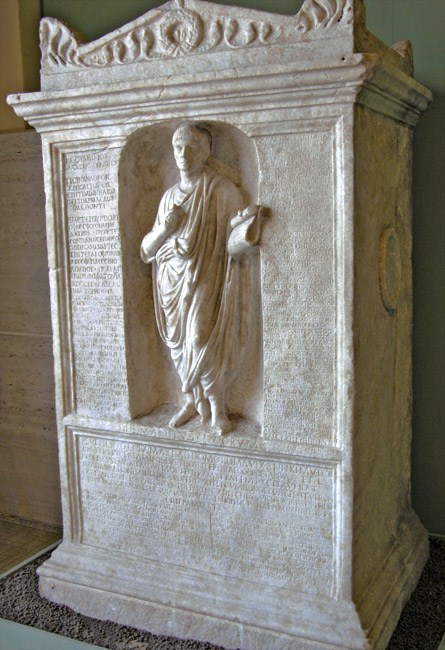
To show conspicuous literary talent in school was another path to early fame. Perhaps the most evocative testament to the notoriety that a talent for composition could win a young student is a first-century funerary altar (photo here) found outside Rome. This base honors Quintus Sulpicius Maximus, a boy already well-known for his poetic skill by the time he died at age 11. The epitaph is worth quoting:
" In memory of Quintus Sulpicius Maximus, the son of Quintus, of the Claudian
tribe. His home was at Rome. He lived eleven years, five months, and
twelve days. In the third lustrum of the contest [Domitian's Capitoline Games], entering the competition as
one among fifty-two Greek poets, he roused to admiration by his talent the
favor he had won by his tender years, and came off with distinction. That
his parents may not seem to have been unduly influenced by their affection
for him, his extemporaneous verses have been inscribed below....."
For young Quintus, who was probably the son of a freed slave, education was clearly a path to distinction.
J. Raleigh Nelson, "The Boy Poet Sulpicius: A Tragedy of Roman Education" The School Review 11 (1903), 384-95