I'm from the Portland area and am familiar with Fort Vancouver and its history. However from what I understand Vancouver was a larger fort/trading operation designed to manage a huge area, playing old Oregon Trail games I remember several forts were stops along the route, what was life like in those smaller forts? How were they made, who would live there.
Also if anyone has any reading/research reccomendations I would love to delve deeper.
The nature, size, layout, and occupants of the forts varied wildly. Even same fort could undergo some radical variation over time.
Let’s take a look at a fort I’m a bit familiar with, Fort Bridger. Jim Bridger had worked as a trapper in the area for a decade and he identified the area as a good supply and waystation for folks on the overland trails to Oregon, Utah, and California.
The original fort in 1843 was basically two low log cabins. Exact dimensions are unknown, but apparently we’re looking at about 40’ long, 10’ wide, and 7’ feet tall each. These cabins acted as two walls surrounding a pen for holding oxen, cattle, mules, and/or horses. Over the next 10 years or so the pens were enlarged additional out buildings were constructed and a continuous fence built to connect the buildings and form a semblance of a stockade. But it remained small and about as defensible as your average suburban backyard. Here’s a sketch as it would have appeared in the early 1850s. During this period the fort was largely a large store room and the only permanent residents were Jim Bridger and his partner Louis Vazquez. Descriptions of the fort from the era almost always mention a small neighboring village of teepees and tents occupied by visiting trappers, Shoshone, etc.
After the Mormon settlement in Utah, they consistently tried to bully or buy Bridger out of the fort. In 1855 while Bridger was out acting as a guide, the Mormons either drove Vazquez from the fort or paid him to leave (accounts vary), and moved in. The Mormons were far more interested in potential military use for the fort, and expanded the buildings and build a large stone wall enclosing the entire site and exapanded the size and number of buildings in the fort. Once the Utah war kicked off in 1857, Brigham Young decided the fort wasn’t defendable vs a Union army. So he had “Wild” Bill Hickman burn Bridger and all the other forts in the Green River valley. Even the stone wall was largely pulled down.
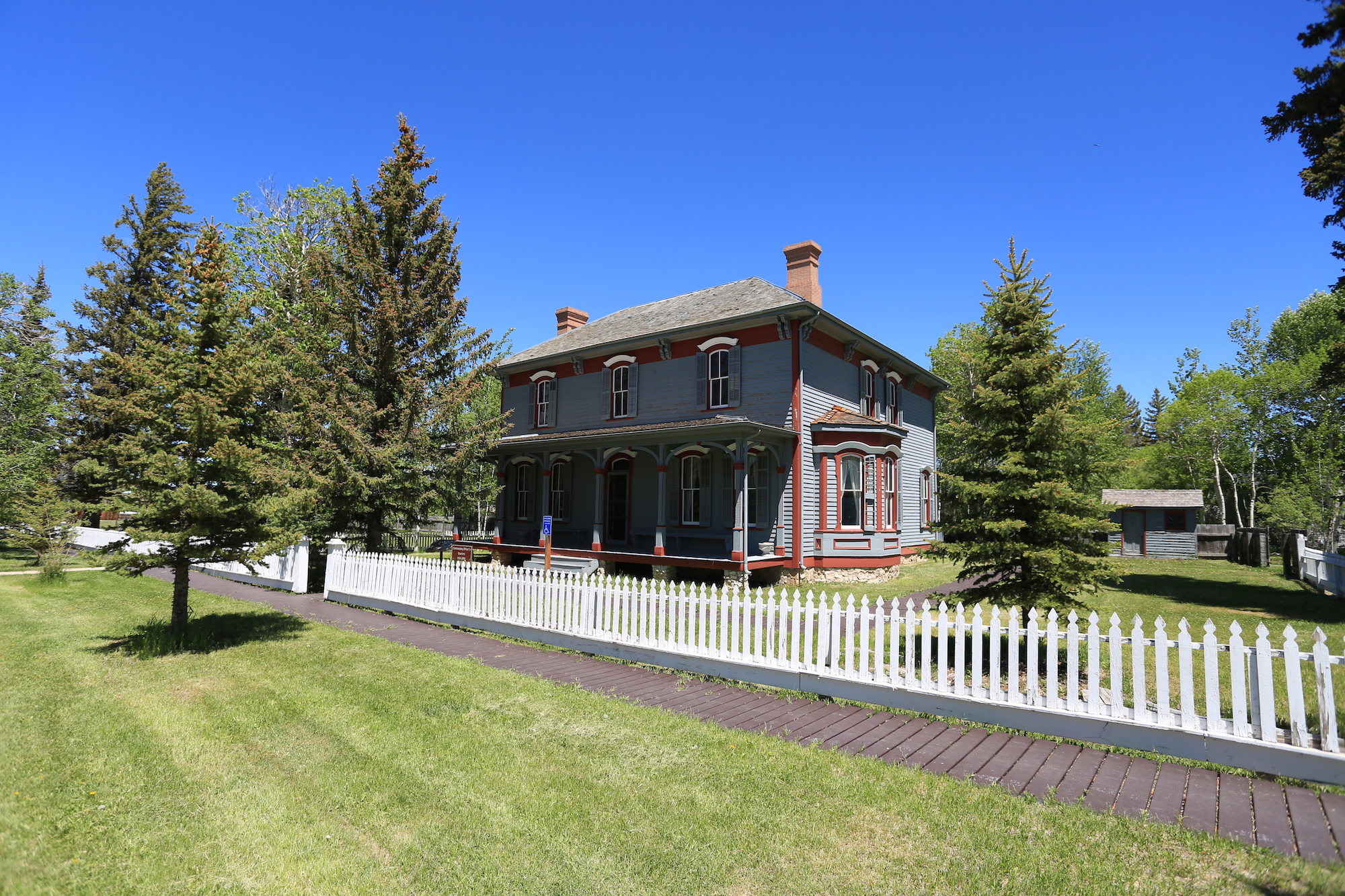
Buchanan’s expedition did winter in the general area of the burned out fort. And at the end of the war the US army took ownership of the site and rebuilt the fort. It never again had a real stockade. Instead it was centered on a parade ground with barracks, officers homes, and all the other buildings built around the square. Initially these were adobe and double log cabin construction. But over time these were slowly augment with brick and clapboard buildings. And most of the buildings at the modern historic site date from the 1860s to 1880s.
During the army years the exact number and type of residents varied. A town popped up attached to the fort. A pony express station was there for as long as the pony express existed. The Indian agents to the Wind River Shoshone were based from the fort. And it acted as a supply station for the transcontinental railroad and numerous wagon trains.
All in all the fort varied greatly from its founding in 1843 to its closing nearly 50 years later.
The Hudson's Bay Historical Society has published two books containing the correspondences of Dr John McLaughlin. They provide a glimpse into life at Fort Astoria while it was owned by the Northwest Company and later the Hudson's Bay Company. They are rare, hard to find and usually expensive when you do find them.
Alexander Caulfield Anderson was a factor in many Hudson's Bay Company forts in the Okanogan, Northern Washington and Idaho. His journals are available on Amazon.
Daniel Harmon was a fur trader in charge of the Northwest Company's trading post at Fort St James, BC. He lived there among the Indians just 7 years after first contact with Europeans was made there. His journal provides us with a fascinating insight into the life and culture of the local natives.