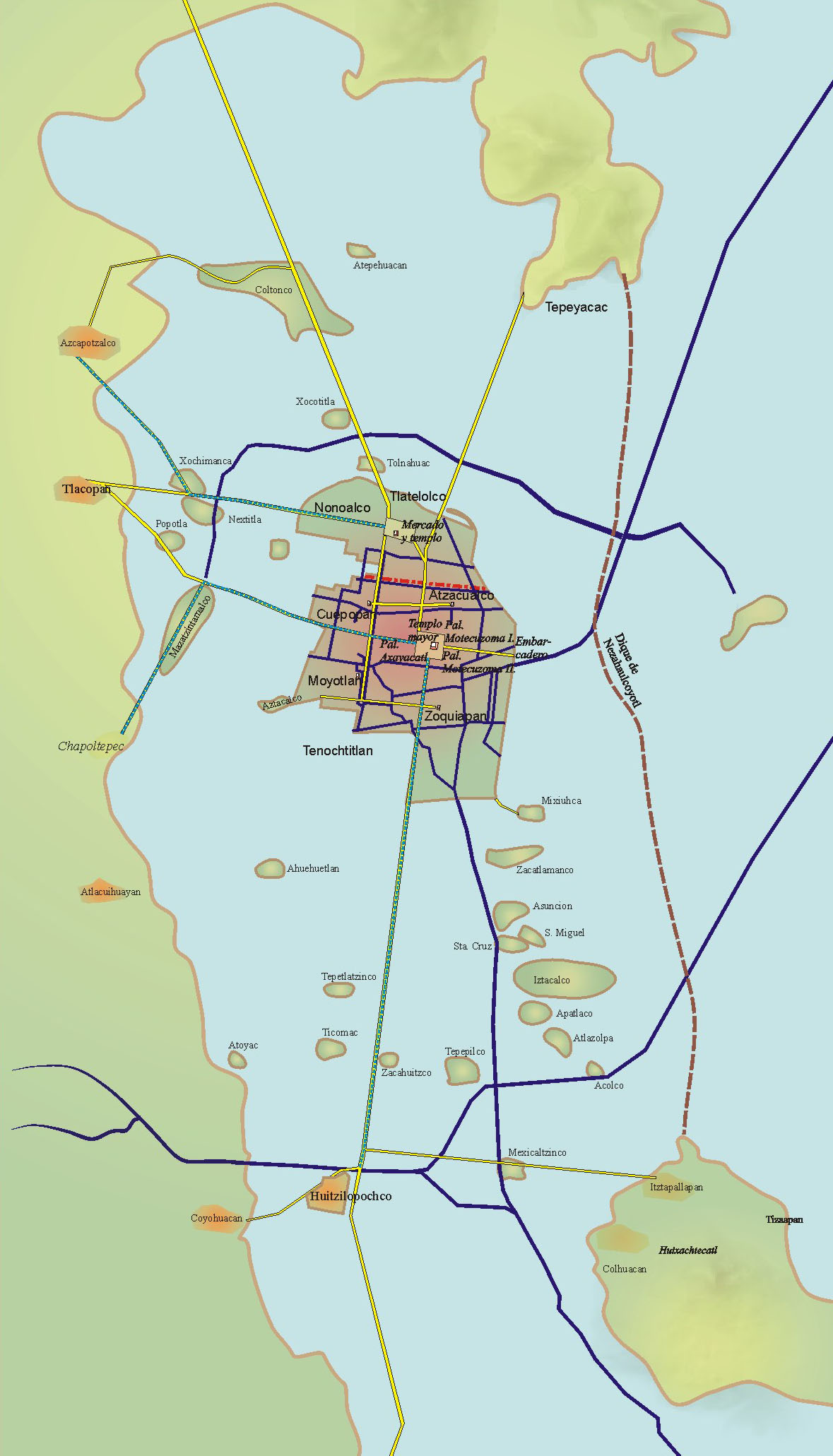
Let me give it a shot, so the city of Tenochtitlan as we know was one of the largest cities in the world during its time, settled in the middle of a lake both Cortez (well, his historian Gomara, actually), and Bernal del Castillo in his True History of the Conquest of New Spain describe the city as shinning like silver (probably because it was painted some shade of white) and being extremely clean describing how human feces and other filth was carried away from the city daily to be presumably recycled in agricultural uses.
Indeed we know the city made wide use of public toilets and baths, on top of the private ones that should have existed, the Mexica were a culture that was relatively hygienic with most people being described as taking steam baths at least once a day in both public and private baths, the Temazcal, a related, but decidedly religious custom still exists as an example.
We also know 3 important factors about sanitation, the first is that the streets were swept at least once a day in the mornings, either by people with that being their job, by the individual citizens who had the custom of sweeping their nearby streets daily, or more likely a combination of both.
This is important to note because it comes as a result of Mexican social and economic structures, the city itself was divided in "calpulis" which roughly translates to a modern city's wards, these calpulis though were the basic political entity of the empire, the leaders of the calpulis would be elected by the inhabitants who in turn would elect the rulers of the altepetls (cities) who in turn would elect the rulers of the empire (until the last part of Moctezuma II, but thats another story), unsurprisingly keeping the population of a calpuli happy was relatively important, which included sanitation.
Second is that the calpuli, indeed the city itself wasnt privately owned, a Pipiltlin (noble... kind of) of ranking could be recognized and be given the rent of a particular territory (think an hacienda), but at the end of the day, neither of these belonged to an individual, but to the community, it was thus in the best interest of the community as a whole to mantain their communal property in working order.
The last factor to take into account is the "tequio", a form of tax payed not in spice (the mexica had no formal currency), but in labor, each year a population would be asked to help build/perform some kind of pubic works service, ie. building a road or a bridge, mantaining a public edifice, etc..., now I dont have any source claiming public services in Tenochtitlan would be directly payed in cleaning services, but it is important to note nonetheless as a possibilty.
Finally its the Mexican architectural ability that should be noted, as you can see the city was equiped by a series of waterways, canals, aqueducts and most impressive, a dike that allowed the Mexicans to control the water levels of the lake, sadly it was destroyed by the spaniards (who funnily enough didnt knew what it was until next year when they were informed they had destroyed the only means of controlling the floods now claiming the city), obvious advantages of having several sources of fresh water into the city (the lake surrounding it was salt-water), Alvarado Tezozomoc, in his Chronicle of Mexico, makes note of at least 1 time in which this complex system was used to slightly "flood" the city in order to clean it.
I hoped I answered most of your questions, even if Im doing it in a rather erratic way, I had been meaning to answer this earlier but closed the page by accident :P.