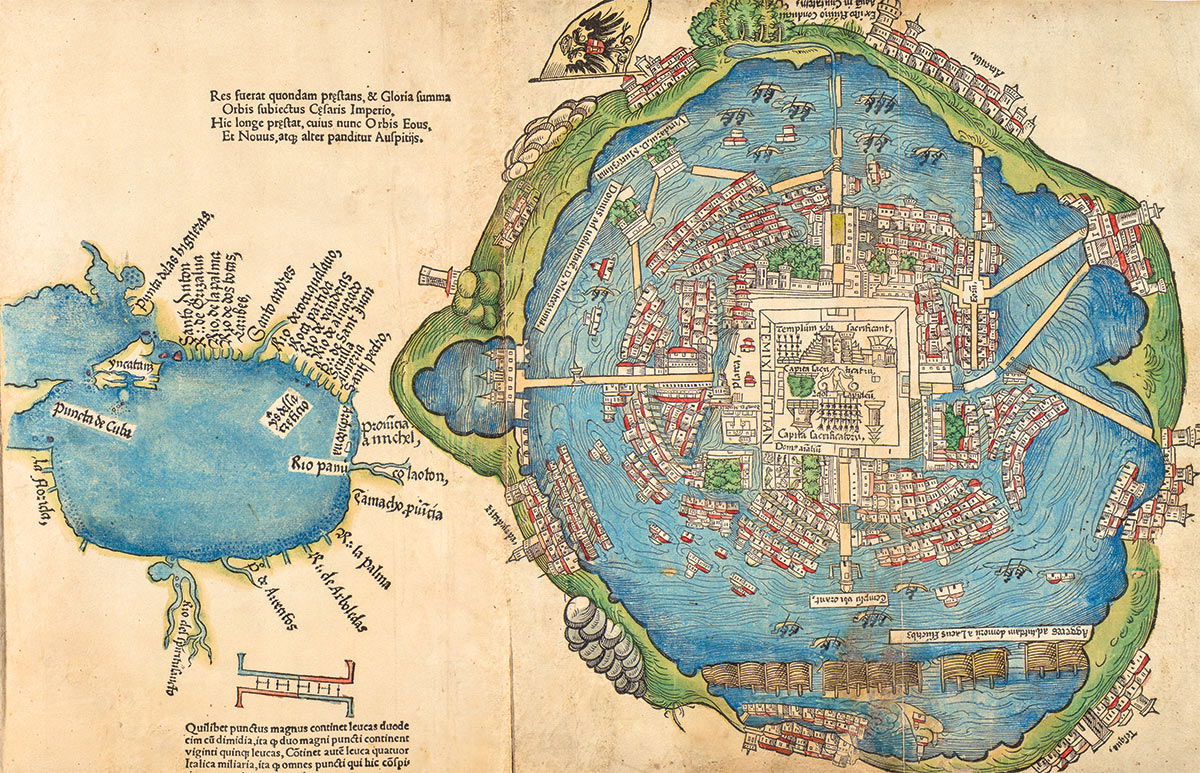
Tenochtitlan at the time was one of greatest civilizations on earth. An Aztec city built on a lake with heigh pyramids along with a network of roads and bridges. Wikipedia says that Cortés and his men were astonished by the sight of it when they found it and thought they were dreaming. I could also imagine that no other european had ever seen such an organized society in the new world. But why not only conquer but also destroy the entire capital city and build your own city over it? I understand it was a different time and the conquistadors declared everywhere for Spain, because they could, but why erase something of that magnitude?
Lots of Tenochtitlan related questions recently... So we can note at least two reasons for Cortés' comparatively harsh actions against Tenochtitlan (and the Mexica): military and religious reasons. His native allies also used the fall of the Mexica as an opportunity for revenge. Lastly, not all of pre-hispanic Tenochtitlan was destroyed with the Spanish victory, as its indigenous population rebuilt parts of the city afterwards.
As you say, the Spanish were at first very impressed with the huge city they found built on Lake Tezcoco (estimates are of roughly 250.000 inhabitants), with its large markets and canal system. This changed with the Noche Triste, when after a massacre carried out by one of Cortés' generals the Spanish were chased from the city. Barbara Mundy notes (in “Death of Aztec Tenochtitlan, the Life of Mexico City“)
While Cortés initially wrote admiringly of the city in his letters to Charles V, his attitude and those of his fellow conquistadores would change dramatically when they attempted to capture the watery city. The surrounding lake functioned like a great moat protecting the island city, and the bridges spanning the breaks in the causeways, which allowed the flow of water from one part of the system to another, could be removed to further isolate the island capital.
[During the Noche Triste, the Spaniards] found that their enemies used the urband canals as transport routes for canoes filled with as many as 60 armed warriors each. Slogging around the canals slowed the conquistares in their retreat, and when, exhausted, they fled on foot along the causeways, those raised roads served to organize them into a neat firing line for the Mexica sharpshooting archers gathered alongside in the lake in their canoes. Small wonder that they emerged from the war with little appreciation of the role that these causeways and dikes played in protecting the city from the scourges of floods. (p. 76)
This knowledge of the canals and dikes was then used by the Spaniards in their siege of the city about a year later. They methodically destroyed these structures that had helped the Mexica, used them to their advantage, and even cut the city fresh water supply. These were methods of warfare only bent on conquering the city that Cortés and his men had lost once before, without much thought about the long-term effects. These effects were harsh: For centuries after conquest, the city then known as Mexico City would be plagued by heavy floodings, lacking the protection of the dike system, the knowledge of which was lost by then. This led to many projects of draining lake Tezcoco, finished centuries later, which has led to massive other problems for the city.
Here's the earliest European map of Tenochtitlan, sent with one of Cortés letters in 1524 so 3 years after the siege. It's probably based on native maps and gives a good idea of the bridges and moats I find.
But getting back to general military reasons: For Cortés at this point it was imperative to conquer Tenochtitlan, since his whole plan was built on overthrowing the Mexic, leaders of the Aztec Triple Alliance. The year between the Noche Triste and the siege of Tenochtitlan he had spent preparing by planning attack plans with canoes, and bringing together more native allies – including from Tlaxcala, Tezcoco and HuejotrincoHuejotzinco. His strong reaction against Tenochtitlan was partly typical European siege warfare; and party due to the city's special position lying on a lake, and to his necessity of conquering it. They also fits in a pattern of Cortés using sometimes extreme violence as examplary punishment, so that other native groups would not oppose him (also evident in his later hanging of the last Mexica ruler Cuauhtemoc).
And his native allies were not passive either after the city's fall. One native chronicler (Fernando de Alva Ixtlixlochitl) describes that the Tlaxcalans actually were more brutal against the Mexica who remained in the city, who had been their traditional enemies. While Alva Ixtlixlochitl had an anti-Tlaxcala bias, we can deduce that overall it was in many native allies interest to avenge themselves of their former overlords the Mexica – in part by looting their former capital.
After the city had fallen into Spanish hands, major buildings like the palace and the temple were destroyed. However, their fundaments remain intact until today (the temple can be visited), with e.g. the palace building the base of the later colonial palace. In the descriptions of conquistadors like Cortés and Díaz de Castillo they already note their disdain of the temple during their first visit – in contrast to their suprise and admiration of the canal system, and the large markets that were according to them bigger than any in Spain.
Of course, the conversion of the native population to Christianity was officialy the main reason for Spanish colonial expansion. So the destruction of temples fits with a larger pattern of destroying any important symbols of native beliefs: especially statues, art, manuscripts, and of course the large temples. This has to do also with the influence of religious orders in early colonial Mexico. Especially the Franciscans were called by Cortés there shortly after conquest, and showed fervour for destroying signs of native faith; but also of learning about it in order to replace it more effectively.
Stepping back from Tenochtitlan, I'add that the destruction of temples happened in many other cities in central Mexico after they fell under Spanish jurisdiction or were conquered. Even though many were not destroyed as systematically as Tenochtitlan was (in part due to its special position). What is more, destroying temple of other religions and building Christian cathedrals has a long tradition in Iberia. This is what happened during the “reconquista” in medieval Iberia, with the major cathedrals e.g. in Sevilla and Cordoba built over the remains (or partly inside) the former mosques. So that the Mexican conquistadors also built on medieval Iberian patterns here, as in many other areas. We have then in Tenochtitlan also a symbolic replacement of native buildings representing state power (palace) and religion (temple) with their Spanish equivalents.
The traditional view is how the Spaniards completely destroyed Tenochtitlan and then built Mexico City on its ruins. Barbary Mundy's fascinating study of the city challenges this view by describing continuing indigenous influence in the colonial city. This goes beyond your question so I'll keep it briefer, but hope it adds an interesting perspective.
After the siege, Cortés contemplated leaving Tenochtitlan abandoned and making his new capital in nearby Coyoacan. But something of the city's former splendour seems to've stuck with him, so that he eventually allowed the native people who had mostly fled to return to their city. Of the original ca. 250.000 as many as 100.000 may have returned. He also started the rebuilding process of the city center, following European architecture and city planning. But the many neighbourhoods and outskirts surrounding this centre followed much more pre-hispanic customs.
Mundy notes various continuing indigenous influence in the city: For example to markets were rebuilt, that were so important to the city's ecomony. And the four indigenous neighbourhoods surrounding the centre followed native patters, aligned with the four cardinal directions. They also had indigenous officials in their local administration, and at least until the 1560 the city's governors were descended from the Mexica. Traditional agriculture on the lake also continued on the outskirts.
More basically, while Spanish officials called the city “Mexico City” since the mid-16th century, indigenous elites continued to use the name “Mexico Tenochtitlan” into the 17th century (edit: I go into the name Mexico some more over here). Even today, we can notice the continuing presence of Tenochtitlan in Mexico City – one nice example is the city's metro, which has many stops named after pre-hispanic places and rulers. While most of Tenochtitlan was initially destroyed, parts of it were rebuilt and its memory kept alive.
In this way, Mexico City exemplifies how indigenous cultures have since colonial times continued to shape the society of modern-day Mexico. It shows that the idea of a clear break with the past is too simple. Traditional history writing has focused mainly on sources by Spanish priests, conquistadors and historians, who would argue for such breaks: native belief systems were simply replaced by Christian ones, as were native polities, writings, art and languages. By incorporating indigenous alongside European sources, more current research has shown that in all these and other areas, indigenous modes of life did not vanish. They mixed with European counterparts in myriad ways, often in forced ways due to colonial violence, bringing forth new forms. Tenochtitlan did not fall in a day, after all.
Edit: Also check out 611131's excellent answer elsewhere in this thread for more on Cortés and on early colonial Tenochtitlan/Mexico City.
Edit: Added context; last part; spelling
Edit 2: Added a last paragraph; maps
Edit 3: Wow! Thanks for the gold kind stranger!