I’m watching Pirates of the Caribbean and there’s a naval battle and ship boarding. It occurred to me that with large long range guns like on battleships that naval engagements eventually got further and further away. And nowadays you probably don’t even visually see a ship you’re shooting at, let alone attempt to board it.
When was the last military conflict where opposing forces actually boarded each other and fought for control with small arms?
Thanks!
Naval engagement ranges were actually still fairly close in 1860s and 1870s. Naval artillery wasn't especially accurate. Visibility was limited, even with the basic telescopes of the day. Guns were still being laid and aimed by the gunners without much help from the rangefinders or directors that ships of the late 19th and early 20th century would feature.
One of the best examples of this is the July 1866 Battle of Lissa between the Austrian and Italian fleets. The ironclads of both sides repeatedly try to ram each other, with varying success. One Italian ironclad was sunk by an Austrian ramming attack. Another limped away with an Austrian figurehead still stuck in its hull after being rammed!
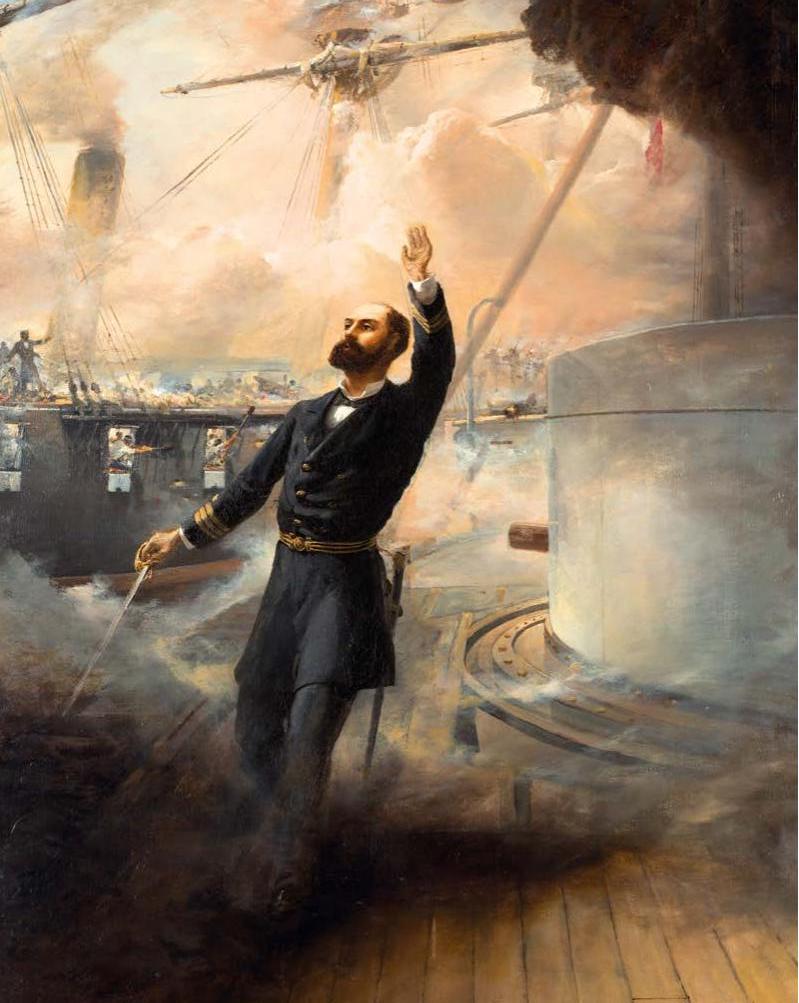
Boarding actions, however, had largely fallen out of favor by the 1850s and 1860s, in favor of ramming or gun duels with large-caliber guns firing exploding shells. Modern small arms like machine guns (ex. Gatling guns and Nordenfeldt guns) and rifled muskets had also made boarding actions nearly-suicidal. The death of Arturo Prat in 1879 is a good example of this.
Between 1879 and 1884 Chile fought Bolivia and Peru, a conflict commonly known as the War of the Pacific. Chilean naval officer Arturo Prat lead a small flotilla of his vessel, the wooden corvette Esmeralda, and the wooden schooner Covadonga. Prat's small force was left to blockade the Peruvian port of Iquique. Peruvian Captain Miguel Grau tried to break this blockade with his own flagship, the ironclad turret ship Huáscar, the ironclad frigate Independencia, and his magnificent side whiskers.
The ensuing exchange of gunfire resulted in a comedy of errors - the Peruvians couldn't get their gun turret to work right, rubbernecking Peruvians on shore kept getting in the way of Grau's fire, Prat's fire bounced uselessly off Huáscar's iron sides, and the engineers on Esmeralda blew up one of her badly-maintained boilers trying to maneuver the ship.
Eventually Grau decided to end things the old-fashioned way and tried to ram Esmeralda, but a last-minute maneuver from Prat meant the ram only struck a glancing blow. At point-blank range, Huáscar poured cannon fire into the Chilean ship, wreaking carnage on her decks.
Prat yelled a command to board Huáscar and jumped over the rail, sword and pistol in hand. Unfortunately for him, only one other sailor, petty officer Juan de Dios Aldea, heard the command and followed him. Running across Huáscar's exposed deck, Pratt and Aldea were quickly cut down by Peruvian gunfire. Prat died and Aldea was badly wounded.
A few minutes later, Grau tried a second, more-successful ramming attack. In response, Chilean officer Ignacio Serrano tried a second boarding action with eleven men carrying machetes and rifles. Peruvian sailors gunned them down with a Gatling for their trouble. It wasn't until Grau rammed the Chileans a third time that the battered Esmeralda finally began to sink.
In the aftermath of the battle, Prat and Grau became national heroes - to this day, they are still patriotic icons on their home countries.
--
This certainly wasn't the last boarding action, by any means. Perhaps one of the most famous incidents in the Altmark Incident of 1940, where the Royal Navy violates the then-neutrality of Norway by storming into a fjord with a force of destroyers to board the German tanker Altmark and rescue British POWs who'd been captured by the German commerce raider Graf Spee. The Royal Navy's bluejackets fought a short and bloody duel with bayonets and rifles against the German sailors and managed to free the captured seamen with a now-famous cry of "The Navy's Here!"
There's at least one anecdote that the Royal Navy boarders even used cutlasses during the assault, which would make it one of the last times a sword was used in anger by a modern military.