No. Suicide attacks were not a thing during this period. Quite the opposite actually. One of Meiji’s goals was creating a European style standing army, with European style traditions. Japanese officers took care of their men, treated their wounded well, took prisoners, treated those prisoners well and surrendered without shame.
It was not until after this conflict and after the death of Meiji, that Japan’s “warrior ideal” began to change. The perception was that the “white” nations - particularly America - had betrayed them at the peace table. Japan had done quite well for itself in the conflict, but their longtime allies forced them to concede nearly all their territorial gains back to Russia. The belief began to spread amongst the military elite that their “warrior spirit” was what had given them victory, and the European ways had taken it from them. The military began to abandon foreign methods in the belief that the fighting spirit of the soldiers shaped by the codes of Bushido were all that were required for victory.
Over time, the codes of Bushido became horribly twisted. Better to die than to surrender. Those enemies who had surrendered were less than human. Pain made you stronger etc. As the military’s power in government became stronger, these beliefs became more widespread and grew deeper roots.
There is MUCH more to it, but I believe your question is answered.
“Rising Sun and Tumbling Bear” - Richard Connaughton (History of the Russo Japanese War)
“Flyboys” - James Bradley (not super relevant but delves somewhat into the evolution of the Japanese military mindset)
“The Imperial Cruise, A Secret History of Empire and War” - James Bradley (US and Japanese relations post Russo Japanese War and more of the evolution of the Japanese military mindset)
“Embracing Defeat” - James W Dower (post WW2 Japan, and shaking off this twisted concept of Bushido)
I think it's worth thinking about "suicide attacks" on a continuum that begins in the Russo-Japanese War and reaches its most extreme form during WWII.
It starts with very dangerous attacks (where death is very likely, but not certain or desired) -> suicidal attacks (opportunistic attacks that result in death or attacks where death is essentially certain, but death is not the objective) -> suicide attacks (where death is an integral and necessary part of the tactic and even something to be sought for). And Japanese propaganda plays a major role in moving people from one point to the next.
From the Russo-Japanese War onwards, the Japanese armed forces start to slide further down this continuum. By the Showa Period and the 1930s and 1940s, suicide becomes a more and more important part of the Japanese military ethos.
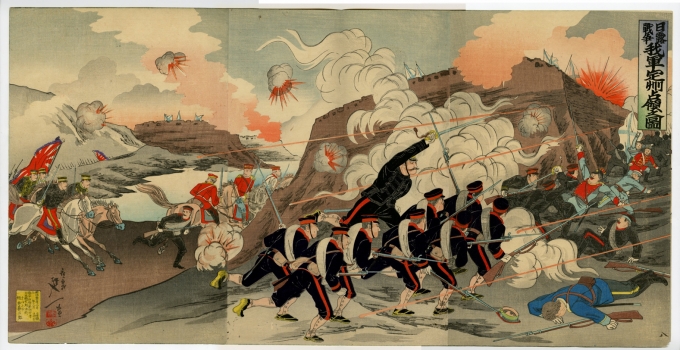
The frontal assaults at Port Arthur, Liaoyang, and other battles involve enormous personal risk to soldiers. After the war, Japanese soldiers become known as Niku-Dan ("human bullets"), a name drawn from Lieutenant Tadayoshi Sakurai's 1906 war memoir Nikudan: the record of the battle of Port Arther. The phrase “storming with human bullets” becomes a euphemistic metaphor for the hard, bloody attacks of the war. Major Tachibana Shūta, is killed leading a frontal charge against Russian machine guns at Liaoyang. He becomes a gun-shin - a literally deified war hero. The idea of willingly taking on dangerous missions and risking a heroic self-sacrifice becomes a greater and greater part of Japanese military, and even civilian culture.
As Eriko Kogo writes:
magazines and newspapers had published similar images of officers and men being rushed into the enemy position. In those descriptions, many scenes of fierce assault with flesh and blood were honored as loyal and brave activities.
Traditional Ukiyo-e woodblock prints seize the image of heroic Japanese soldiers and sailors charging into battle, despite heavy loss of life and limb. You can see some examples below:
https://www.japanese-finearts.com/item/item_images/35/1-92-182-03/1-92-182-03_680.jpg https://russianculture.wordpress.com/2010/06/17/the-russo-japanese-war-through-the-eyes-of-the-japanese/
However intentional suicide in combat or to avoid capture is not encouraged. But as time goes on and the bushido ethic and Japanese militaristic nationalism hardens in the 1930s - the ideal and reality of suicidal attacks starts to appear in the Japanese military, often drawing upon the same themes used to glorify Russo-Japanese War heroes.
During the Siege of Shanghai in February 1932, three Japanese combat engineers, rushed into Chinese defenses carrying a large explosive charge. Thirty-six of their comrades had to side in previous attacks, entangled in the Chinese barbed wire. Just as the engineers reached the Japanese wire, the charge exploded, instantly killing all three men. Eyewitnesses accounts of the exact nature if the incident only emerged after the war. The three engineers had discovered the explosive charge had too short a fuse the safely use - when they balked about carrying the mine up and placing it in the wire, their commanding officer had bullied them into going. Before the men could plant the bomb and escape, it exploded and killed them. Other accounts (including a post-war interview with Major General Tanaka Ryukichi) suggested that the engineer's commanding officer had cut the fuse too short on accident or that the fuse had been faulty and gone off too early.