In general, the comment of /u/bloodswan in the almost same topic in this subreddit probably offers the best answer to your question (at least much better than I would write).
As for the latter part of your question, however, it is very difficult to discern the regional differences mainly due to the different characteristics as well as distributions of the primary documentary and non-documentary (i.e. archaeological) sources in Viking Age (ca. 800 - 1050) Scandinavia.
- Indigenous literary sources like sagas of the Icelanders (that /u/bloodswan and her/ his references mainly focus on): written in 13th century Iceland, and mainly focuses on the past events in Icelandic rural society during the 10th and 11th century.
- Laws: Available in all the three Scandinavian kingdoms as well as Iceland, but mostly allegedly codified in the late 12th century onwards and tell very little on the daily activity of women.
- Archaological finds (like burial finds): possibly available across wider parts of Scandinavia, but the quality as well as the quantity of the sources vary.
- Rune Stones: concentrate mainly on the middle part of now Sweden (Svealand), so it is not so useful to depict the regional difference of the social presence of women, but it is actually one of very few contemporary kind of documentary sources from the Viking Ages, and recorded by the Norsemen (Scandinavians) themselves.
The following are a very brief summary of the survey conducted by B. Sawyer for the women's involvement of erecting rune stone (with inscription), mainly in Sweden.
- Premise: the Norsemen erected this kind of stone monument with to commemorate the deceased person(s), mainly relatives or comrades in a few cases of the patron, mainly around Year 1000. In contrast to general assumption, the majority of the rune stones were not so even closely associated with the Norse pagan religion, but rather with the new Christianity, as shown in the inscripted message like 'God will help the deseased'. The main purpose of erecting such monument has recently been interpreted from a social point of view: According to B. Sawyer, the monument was to enhance the social prestige of the patron's family within the local society, or, more specially, to secure the claim of inheritance to connect the patron and the commemorated. In short, to erect the rune stone was costly and mainly reserved to the middle to large land owning elites.
- In diverse regions of now Sweden, the proportion of women erecting the rune stone to commemorate someone on their own within the whole patrons are between ca. 10.5% and ca. 15.5% (in average, ca. 11.1%) (B. Sawyer 2000: 39). This number must be much lower than real demographic ratio of women, so probably reflect the social role expected to women in the contemporary Swedish society. Sawyer notes the possibility that the majority of the women were not so willing to act on their own as long as any of their male relative was alive. In some regions like Uppland, the joint act of commissioning stones between the women and her male spouse was more commonplace (ca. 15%) than the woman as a sole patron.
- From these numbers and analysis, Sawyer points ot that not a small number of the elite women in Viking Age Sweden could except to inherit sometimes considerable properties either from her spouse or her sons (!) due to her longevity of life span. They often erected not only the grand rune stones, but also the bridge for the soul(s) of her family, and displayed her presence in the local society (Sawyer 2000: 111-16). This trend could be more prominently observed in Scandinavian East (middle of Sweden) than in West, and possible reflects the Christian influence of the womens' social practices like the commemoration.
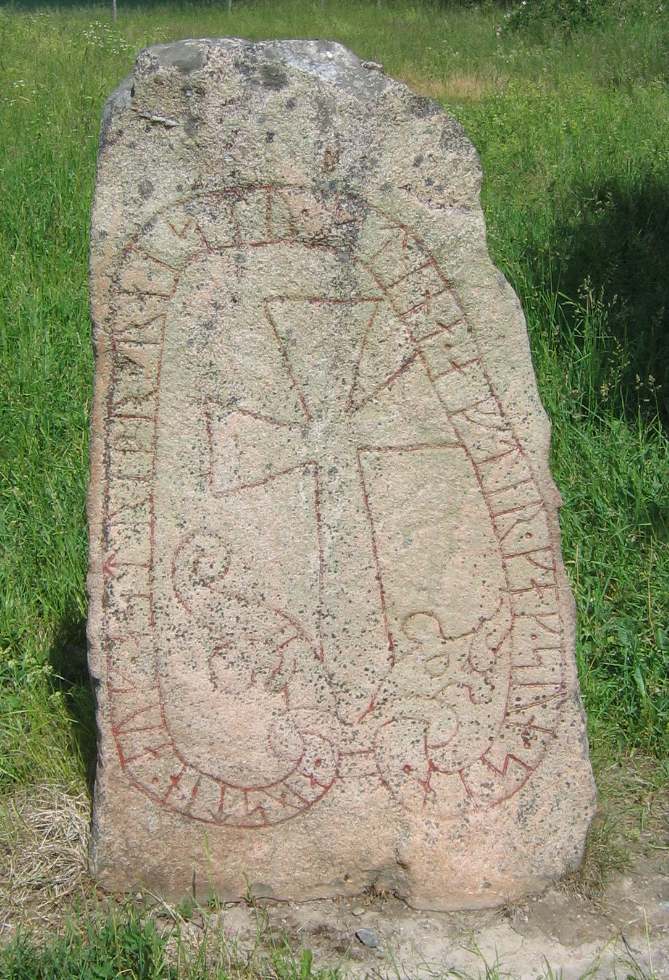
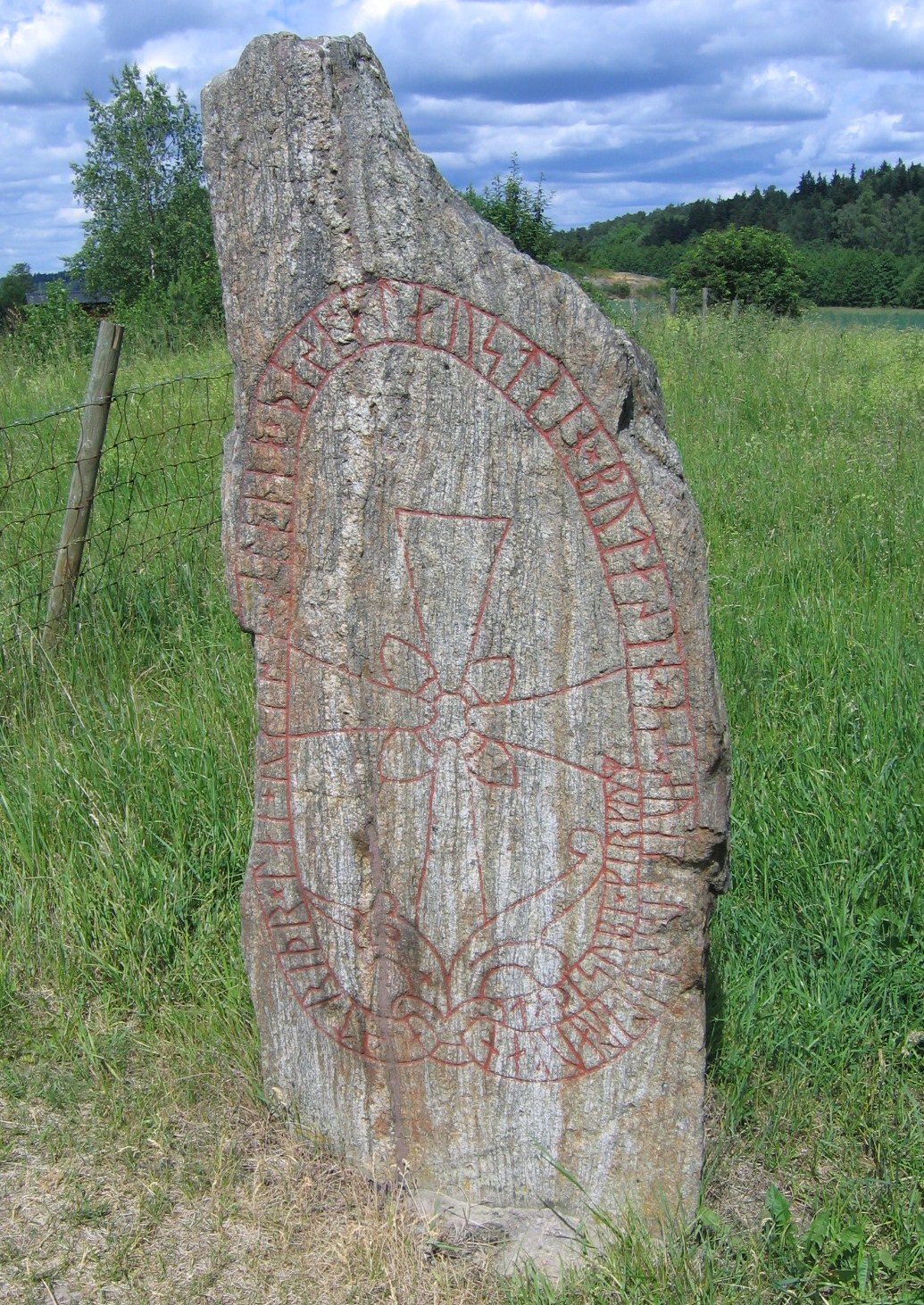
[Added]: The following two runic texts are from Broby Bro stones, erected in the first half of the 11th century in Uppland, Sweden, to illustrate the role of women in raising such rune stones in Eastern Scandinavia.
- U137: aystin:auk: astriþr:raistu:stina:aftir:kak:sun:sin, roughly translated as: 'Eystein and Astrid raised this stone after their son, Kagr (?)'
- U136: astriþr:la(t):raisa:staina:þasa:[a]t:austain: buta sin:is:suti:iursalir auk antaþis ub i :kirkum ('Astrid let this stone raised in commemorating Eystein, her husband, who had visited in Jerusalem, and dead in Greekland, out of the country'.)
These two are very famous ones, and the chronological order were U137 to U136. Astrid had at first acted jointly with her (still alive) husband to commemorate her deceased son (U137), then, as a widow, inherited some properties from the dead Eystein and raised the second stone (U136) on her own.
+++
Reference:
[Added]: typo fixes, adds some rune stone pictures & texts as examples.