Romeo and Juliet...
I've found some images of Capulet and Montague coats of arms/family crests. (I'd post images, but it's not allowed).
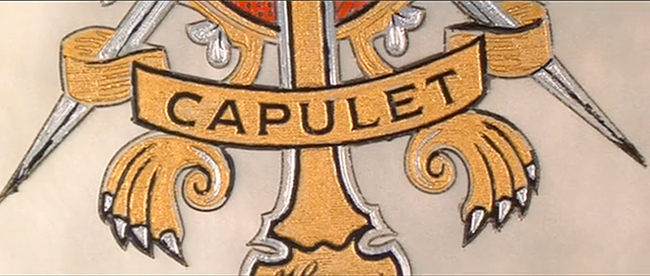
One example is derived from the Baz Luhrmann film which are crosses; one with a lion, the other with a bee.
Another is sort of clip art/ms paint looking, with a lion/feathers and wolf/roses, as well as some latin (I think, lol) text:
C=rex felium which might be 'king of cats', which at least makes sense
and M=rosa alieno nomine, which translate likes to say is 'pink alien appointment', which is obviously insane.
Others seem to be people's drawings and so forth. I know Shakespeare loved coats of arms and made one for his own family after his father's death.
Does anyone have any art/history knowledge as to the origin of this imagery?
I haven't read it in ages, are these created/mentioned in the play?
Lions, a wolf or a bee...did he have anything to do with these?
Where did this stuff come from?
Why is this information so hard to find?!
Thanks for any help!
The family coats of arms that turn up on a Google Image search are all one of two things: they're either unrelated crests associated (whether accurately or fraudulently) with the surname "Montague" (think those mall kiosks that offer mugs and mousepads printed with your Real, Genuine, Authentic Family Crest) or they're fanmade crests for the households in the play. The fanmade crests might be used in a particular staging like the Luhrmann ones or the ones that seem to have originated in school productions, or they might just exist as fanart drawing on the play's civic setting. The Luhrmann film's designs for Montague and Capulet insignia incorporate the visual motifs of the film -- red and blue, guns and swords, skulls and gilt, all the visual similarities and contrasts that production designer Catherine Martin and costume designer Kym Barrett used to establish the film's alternate 20th-century version of Verona. In this context, heraldic imagery is juxtaposed with corporate branding and the aesthetic subcultures of organized crime -- the film's other aesthetic divisions basically take the place of color-coordinated livery or coats of arms, and the use of heraldry is a deliberate anachronism alluding to that.
The Capulet coat of arms featuring crossed feathers and lions is a fanmade design by fanartist [Seko-Dragon](https://www.deviantart.com/seko-dragon/art/Romeo-and-Juliet-Coat-of-Arms-326361430]. Without any deeper insights into the artist's creative processes, the lion image and "rex felium" motto in Seko-Dragon's version of Juliet's Capulet crest read like allusions to Tybalt, as you'd expect. (Tybalt shares his name with the fictional feline opponent of the medieval trickster-fox Reynard, and in the play Mercutio pokes plenty of fun at this with his "king of cats" and "prince of cats" quips.) The idea of the lion as the king of beasts had been around in European literature since at least the Reynard stories; it was well-entrenched in heraldic imagery, and Shakespeare uses the image in Richard II, so it had enough traction that a sixteenth-century English viewer would likely have gotten the visual joke here too. Since Tybalt seems to be the chief male heir of the Capulet family, reverse engineering that the central emblem on the Capulet coat of arms is a noble big cat isn't a reach.
On the flipside, Seko-Dragon's art of the Montague crest incorporates roses and wolves; the wolf seems to be an arbitrary choice, but the rose seems like a pretty clear allusion to Juliet's pronouncement in Act 2 Scene 2 that
That which we call a rose / By any other word would smell as sweet. / So Romeo would, were he not Romeo called, / Retain that dear perfection which he owes / Without that title.
In the first quarto version of that passage, it's the better-known phrasing "[t]hat which we call a rose, / By any other name". "Rosa alieno nomine" seems more likely to be an attempt to translate "a rose by any other name" in Latin -- "rosa" (nominative singular, f.), "alieno" (ablative singular, m.), "nomine" (ablative singular, m.) I can't vouch for how naturally it flows, but it seems like a decent meta choice for quotes to associate with the Montague name.
So, we've got something like: crowned lion rampant (argent), and two crossed feathers (or) on a field gules, versus wolf's face (or) and three roses (gules) on a field azure. (Or… something like that. The grammar and terminology used by heraldry enthusiasts are so far out of my wheelhouse it's not even funny.) In terms of history of theater, this set of simple and clear-cut designs falls into a really common 20th-century trend in stagings of this play: one house is red, one house is blue, you pick which is which. This pops up freakin' everywhere, and in some ways, color-coding is only natural as one option to visually convey the families' division and opposition, but it's not based in anything concrete from the play's text.
Why are there so many of these coats of arms out there? On top of the myriad stagings of the play over the years, it appears to be a relatively common classroom assignments for students discussing the play to design fantastical coats of arms for the characters as an exercise in distilling the play's imagery -- a Google search shows lots of swords and pistols, city walls and castles to symbolize the Montague and Capulet houses or the city walls Shakespeare attributes to Verona in Act 3 Scene 3, and so on. I can't vouch for the choice of bees or any of the other motifs that might be floating around, but the most anyone can say for them is that they're inspired by the text of the play, rather than drawn directly from it.
It's possible that Shakespeare used banners, livery colors, etc. in the early stagings of this play to differentiate between his characters, but imo, not likely in this play's case. In Shakespeare's England, heraldic designs were much more regulated than these fanmade projects -- they were intimately tied up in one's inherited social status and legally recognized privileges, which is why Shakespeare's own coat of arms and pretenses toward the gentry were such a big deal at the time. So it strikes me as doubtful that real-life identifiable designs (or designs that could be mistaken for the same) would be depicted on stage in a fictional context, outside of exceptional circumstances. Anything else where an author tries to link the fictional Montagues and Capulets with "real" extant families named Montague or Capulet (like the English surnames of Montagu/Montacute/etc.) or to link the imagined real-life analogues to Shakespeare's warring houses to corresponding real-life Renaissance Italian identifying imagery is just speculation -- fun, but not necessarily fruitful.
As imaginary Italians within their own stage-Italian universe, the feuding Veronese Montagues and Capulets wouldn't have had English-style heraldic designs anyway; whether Shakespeare himself knew or cared about this is up in the air, but regardless, all these examples draw from artistic license. Some of them might be more correct than others with respect to a certain style of heraldic imagery the artist was seeking to emulate, or within a certain set of artistic conventions, but none of them are more correct than any other with respect to the play. We know very little about the original visual staging of Romeo & Juliet specifically, whether the characters' outfits were color-coded as so many modern stagings of the play are, whether they incorporated specific costumes or properties to visually indicate an Italian setting. We don't know exactly how the maskers at the Capulet feast were originally costumed, or what the actor who originated the role of Juliet would have worn during the balcony scene, or anything else it might be cool to know. The rest is up for fans to cook up.