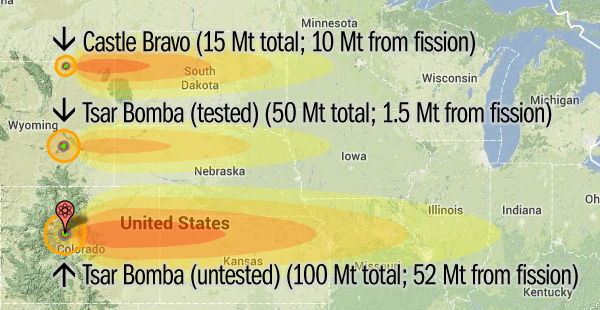
There have been talks about how dangerous radioactive fallout really is, but didnt the environment and the people around the explosion ever get affected, by these tests?
Bomb pulse dating of cells is the result of nuclear testing. The way we know how fast cells die is because the fallout from all the nuclear tests from the 40s-60s left Carbon 14 in the atmosphere, which isn't harmful but is different then normal carbon atoms (their atomic number is 12). This was discovered in 2002.
There were 400 atomic bomb tests between 1945-1963. Part of the fallout was neutrons hitting nitrogen to make Carbon 14 (C14) which doesn't fall out of the sky like other elements released. Wind currents spread C14 all over the planet where it bonded to oxygen that plants sucked up. Animals eat plants (or humans eat plants) and now C14 is in humans. A European group of scientists have been monitoring the atmosphere every two weeks since 1950s which allowed for a graph to be made of how much C14 was in the atmosphere and it was pretty flat until 1955, where it steadily increased until 1963, when the US, UK, and USSR agree to stop testing bombs above ground. There has been a gradual decline in the amount of C14 in the atmosphere since then. The amount of C14 in the atmosphere in a given year is the same amount in our cells from that same year. So say scientists wanted to know how long fat cells lived in the body they would check to see the amount of C14 in that part of the body and then check it to the atmospheric graph. An example is that fat cells live for ten years before being replaced with new fat cells. All of the C14 will be gone by 2030 limiting the amount of research that can be done using it.
All of this is from a Radiolab from Aug 23rd 2015 called Elements. And this segment starts around the 34 and a half minute mark and goes to the 50 minute mark
Operation Castle deposited a large number of fission products into the area of the Marshall Islands. Castle Bravo in particular was notoriously harmful, the most extensive radiological accident in United States history, depositing its fallout on inhabited atolls. The Marshallese suffered from a great number of radiation-related ailments and illnesses over the years, caused either from direct exposure or later, chronic exposures to the fallout products.
The Castle shots were all multi-megaton weapons that derived most of their energy from nuclear fission, detonated on coral atolls at the surface level. This made for huge contamination issues, because the coral readily broke into tiny pieces to which the radioactive byproducts of the bomb could be attached, and then fell out of the cloud relatively quickly. They were basically the "worst-case scenario" for fallout contamination.
The Tsar Bomba shot was not. It was detonated as an airburst, with the fireball never touching the ground, which by itself limited its potential fallout greatly (the fireball stayed hot and light, and so contributed to "global fallout" — small increases in the radioactivity of the northern hemisphere — but had no "local fallout" like Bravo). The weapon itself was unusually "clean": of its 50 megatons of energy released, 97% of that (48.5 Mt) came from nuclear fusion, not fission. Only 3% (1.5 megatons) of energy came from fission. This was a design choice meant to limit fallout (if they had detonated it at full yield, it would have had 51.5 megatons from fission). Bravo, by comparison, was a 15 Mt weapon but with 68% from fission (10.2 Mt).
Fallout contamination is almost entirely caused by fission (there is some local, usually short-lived contamination caused by induced radioactivity). So even if had been detonated on the ground, the Tsar Bomba had 10X less fallout radioactivity than did the Bravo shot. It would have shot that radioactivity the same distance as Bravo with the same winds, but would have been less contamination over all by a significant fraction.
As it was, the Tsar Bomba's burst height meant that it didn't have appreciable local fallout. It did, again, contribute to the background level of radioactivity in the northern hemisphere, as its cloud circulated for several years, occasionally dropping small amounts of longer-lived fission products (e.g., strontium-90) over a vast area. This was measurable, and may have contributed to some fatal cancers statistically, but the environmental effects other than this are mostly nil as far as we know. All atmospheric nuclear testing by the US and the USSR is thought to have statistically contributed to between tens of thousands and hundreds of thousands of fatal cancers globally over the course of the Cold War; large numbers taken by themselves, but small compared to global cancer rates for the same period.
Similarly, in terms of global environmental damage, on the whole it is very small from nuclear testing: detectable increases in radioactivity, but nothing huge. However the test sites where many weapons were tested, especially in ways that deposited fallout (surface bursts), are today still contaminated enough that people should not live there for long periods of time in large numbers (though they are not so acutely radioactive that you cannot visit them, work on them, etc.). Ironically many of these types of sites, like the contaminated area around Chernobyl, are thriving with wildlife, because most wildlife does not live long enough to develop the kinds of cancers that human populations would, and because the most environmentally destructive force is human habitation, and the radioactivity has put limits on that.
On the Marshallese, see Holly Barker Bravo for the Marshallese. On health issues from testing in the US program, see Barton Hacker, Elements of Controversy: The Atomic Energy Commission and Radiation Safety in Nuclear Weapons Testing, 1947-1974. On the cancer issue, see Schwartz, et al., Atomic Audit, chapter 7 ("Victims of the Bomb").