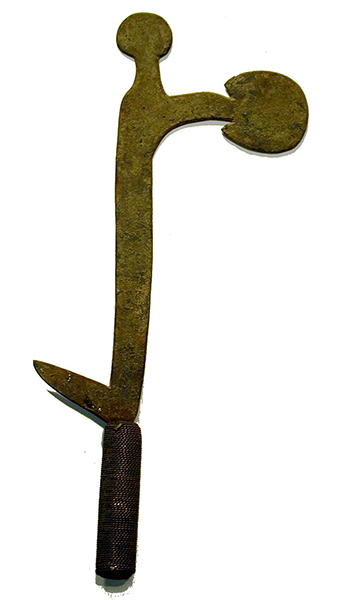
It's definitely a pattern and I'm not really sure what it stems from - were these really primarily throwing weapons? And if they were - why such unusual shapes, instead of a simple star or boomerang pattern?
https://i.pinimg.com/originals/ef/ca/a3/efcaa3a7a15fae6848bc741472793d2d.jpg
https://upload.wikimedia.org/wikipedia/commons/6/66/African_throwing_knives_snake_muder.png
https://www.hamillgallery.com/KNIVES/ThrowingKnives/Banda04.jpg
This needs an African art historian (or specialist in military history), but as a starting stab (so to speak) at the question, keep this in mind: the objects that are collected in Western (and even African) museums were collected because of the aesthetic interests of the collectors, which in varying contexts often meant that more exotic or unusual objects ended up on display as opposed to ordinary or utilitarian objects. If I think about knobkerries (long sticks with club endings) in Southern Africa, the ones you can see in museums and galleries mostly have distinctive carvings or aesthetically interesting character, but a lot of them in practical contexts were just sticks with heavy club endings at the top, intended primarily for use in clubbing other people.
It can be in some sense even more problematic than that in that as the 20th Century wore on, some African artisans understood increasingly that Western collectors actually preferred exotic or strange objects and aesthetics and tried to think of ways to meet that demand. You pretty much need to look at the provenance of every single object you're interested in to gauge how and why it came to be.
Moreover, even in cases where the object wasn't made to satisfy a collector, a goodly number of weapons you see today in museums are not weapons made for use on an actual battlefield, no matter which culture we're talking about. Walk through the Metropolitan Museum in NYC in the arms and armor exhibit and a very large proportion of the weapons you're seeing were decorative, to be used in ceremonial or performative contexts. Judging what kinds of weapons were used by any culture in practical contexts largely takes a different source than most museum displays--you need to rely on archaeological findings and textual descriptions of actual warriors or battles. In that sense, at least in southern Africa, most forged weaponry prior to the 19th Century was pretty spare and practical, from all available evidence.
One of the galleries you link to points out that the objects they collect were not just practical but also ritual, ceremonial and aesthetic, as I've suggested. Moreover, you might observe that even in those terms, there are a lot of bladed weapons they have in their gallery that are pretty straightforward in their basic shape. This is yet another problem: judging what was typical or representative from a narrow selection (which is all museums, when it comes to the history of African material cultures) is perilous. Particularly if you're trying to talk about "African" at that level of generality. I think if you could zoom in on a particular region and specific material culture, it would be easier to talk about the history of weapons, blacksmithing and design.
The use of unusual shapes for African bladed weapons goes beyond throwing knives. Swords from sub-Saharan Africa often have unusual and distinctive shapes, and sometimes axes have unusual shapes too. Some examples of swords: https://imgur.com/a/fRF5w
The designs are not random, but quite the opposite. They are, at least for early 20th century and older weapons (and some many later ones, too), stereotypical. The designs are standard, and the ethnic groups of origin of weapons can, in many cases, be readily identified by the designs. This points to one of the functions of these weapons being a badge of identity. As far as weapons go, the sword is a convenient badge on the battlefield, since it will often be retained if spear, shield, bow, or musket is dropped.
Many of these swords or other weapons one sees today were not made as fighting weapons. More recent ones were often made for the tourist market, and many were made as currency (especially for payment of traditional bride prices). Many, including older weapons, were made for ceremonial/ritual use, for example as royal or chiefly regalia. In many cases, the tourist/currency weapons are made to traditional patterns. In some cases, tourist weapons have grown more flamboyant. In some cases, currency weapons (notably spearheads) are much larger than fighting weapons.
The various Congo basin fighting swords are generally quite functional weapons. They have functional cutting edges, and often functional thrusting points. Where they have exotic features such as flared and spiked tips, or forward-hooked tips, these don't impair function as a cutting weapon (although they might impair thrusting), and often suggest practical use for hooking shields, reaching over shields, or axe-like penetration with the tip. Typical total lengths vary from 16" to 26" (40cm to 65cm), and weights from 400g to 700g. Examples of swords with many ornate little curly spikes on the sides of the blades, multiple delicate spikes on the tip, etc. which could well reduce their effectiveness as fighting weapons should be suspected of being over-ornate tourist pieces, or modern non-fighting regalia (and newness of design can be often be confirmed by comparison with older fighting weapon designs).
As for the "throwing knives", many of them are indeed suitable for throwing. An airfoil cross-section is used (flat on one side, curved on the other), and balance and weight suit throwing. Over much of the range of these throwing knives, wooden throwing sticks are also used (either conventional boomerangs or T-shaped throwing sticks; see Arkell (1939) for examples of T-shaped sticks, made from a branch and its base). The wooden stick was used as the common hunting weapon, and was also used in warfare before modern rifles made them obsolete. The iron throwing knives saw relatively little use in warfare, and were not used in hunting. When they were used in warfare, it was usually as a hand-to-hand weapon (this might have been due to reluctance to throw such an expensive weapon), but they could be thrown, and were on occasion. In the 20th century Sudan, their use in war had largely ceased, and their main use was as badges of rank for men, denoting their level of initiation (Ringdon and Kingdon, 1936). To answer your question, they don't appear to have primarily been throwing weapons, but were used as such, sometimes. (The last one you link, with rounded tips, doesn't appear to be made for use as a weapon.)
Wooden throwing sticks were traditionally restricted in shape to what can be made following the grain of wood as it grows naturally (today, we see a great variety of wooden boomerangs made from plywood, which frees us from the need to follow the grain). Iron throwing knives are freed from this restriction, and a great variety of designs are possible. Multi-pointed designs offer good stability when thrown, and a profusion of points to hit an enemy with. Designs with forward-hooked points (like the first one you link) can allow deep penetration. Others simply provide a distinctive stereotyped design that doesn't impair function as either a hand-to-hand weapon or as a throwing weapon (your middle link).
References:
On sub-Saharan African weapons in general:
Werner Fischer, Manfred A. Zirngibl, African weapons: knives, daggers, swords, axes, throwing knives, Prinz-Verlag, 1978 https://books.google.com/books?id=DJwsAQAAIAAJ
Christopher Spring, African arms and armour, Smithsonian Institution Press, 1993 https://books.google.com/books?id=5CUSAQAAIAAJ
Anthony C. Tirri, Islamic and Native Weapons of Colonial Africa, 1800-1960, Indigo Pub., 2007 https://books.google.com/books?id=Z4AaAQAAMAAJ
On throwing knives:
Arkell, A. (1939). THROWING-STICKS AND THROWING-KNIVES IN DARFUR. Sudan Notes and Records, 22(2), 251-267. http://www.jstor.org/stable/41716335
Jedrej, M. (1975). Ingessana Throwing Knives (Sudan). Anthropos, 70(1/2), 42-48. http://www.jstor.org/stable/40458698
Nalder, L. (1935). THROWING KNIVES IN THE SUDAN. Sudan Notes and Records, 18(2), 297-302. http://www.jstor.org/stable/41710718
Ringdon, F., & Kingdon, F. (1936). THROWING KNIVES AMONG THE NUBA. Sudan Notes and Records, 19(1), 190-191. http://www.jstor.org/stable/41716212