During the period of 1200-1400, was it possible for a commoner in Europe to become a scholar through academic pilgrimage, like it was in the Golden Age of Islam for muslim commoners?

by Hoihe

I've read that in the Golden Age of Islam, it was possible for any commoner to attend teachings at the local mosque under an Imam, and after they learnt everything they could from him, be it mathematics, arts or theology or a combination, the commoner would in what amounts to an academic pilgirmage, visit another mosque and study there and repeat this ad infinitum.

Would such a thing exist in Europe with monasteries/universities?

y_sengaku

In short answer: highly unlikely especially during that period in Medieval West, compared with the period both before and after. I'll illustrate the points from the following three points of view:

  • The Primary Form of Educational Institution: As it is well-known, Europe had had her first universities in course of so-called the Twelfth-Century Renaissance, as first proposed by C. H. Haskins, and the main place of study and education gradually moved from the cathedral or monastic schools to this newly founded universities. The numbers of universities in Medieval West were at most a dozen in ca. 1300. Every study aspirant from Italy to Norway, mainly from aristocratic and/or high rank clerical milieu, rushed to this dozen universities, especially Paris and Bologna. The most of notable teachers at that period was also concentrated in these two universities, so they didn't simply necessarily wander across to look for the best teachers of each field, as their contemporaries used to in Islamic World or even Peter Abelard did across France around ca. 1100.
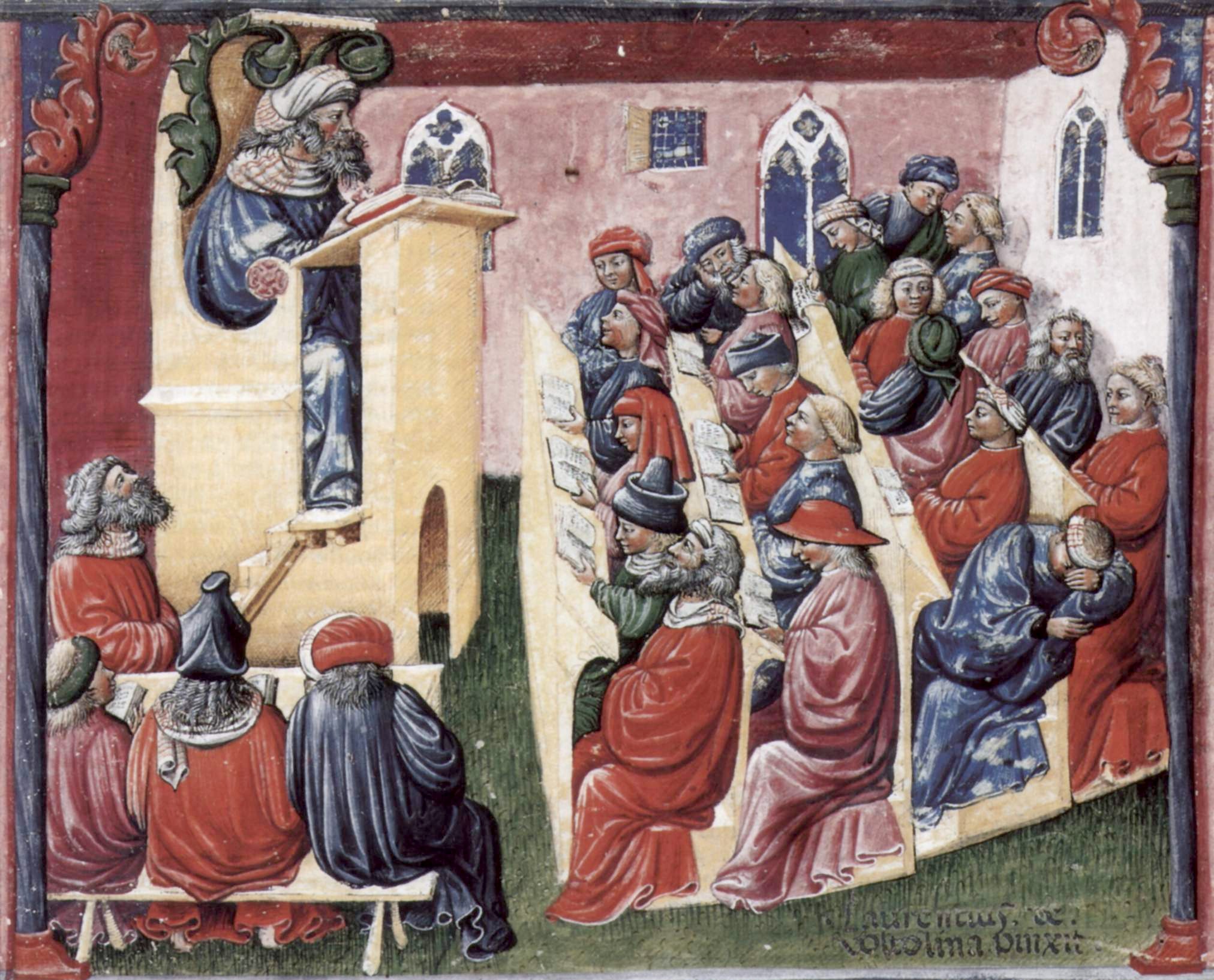
  • Cost of Education: In principle, all the auditor students had to pay the fee to the university/ teacher in order to register in the matriculation records (matriculae) for a full student membership. The student seemed to keep on registering as long as they could pay somehow, but it was not so likely for the case you questioned above (for commoners). In my understanding, your question mainly concerns whether students could attend the lectures as 'irregular' auditors, without paying the official registration fee, in the 13th and 14th century Europe. It is very difficult to answer/ reconstruct from the primary sources, but AFAIK it would get increasingly difficult in the 13th century when the university began to have its own building and lectures held in the interior hall, as shown in this famous paint of University of Bologna. On the other hand, the living cost problem of the students might have improved slightly due to the improving relationship between the city commune and the university community ('universitas') at that period: The former finally acknowledge some privileges attached to the student membership. It also means that, however, the city authority would not necessarily have welcomed some self-claimed students on ground of this legal definition of the student as the privileged any longer.
  • The Possible Future Career Path: Then, what kind of jobs were waiting for the university graduates in 13th century Europe? As for neither clerical nor academic ones, the choice was rather limited. The masters (magister) graduated from the university had gradually penetrated the hierarchy of the royal officials since the end of the twelfth century, but the city council of medieval cities, the origin of such non-noble commoner students, still did not need the university graduates in the 13th century. The secondary education, just appeared in the Italian cities at that time and teaching mainly elementary mathematics and bookkeeping, would have been enough to find such jobs like public notaries or a teacher of ‘elementary reading school’, founded either by the city authority or by some fraternities, and the university was just overkill. Even these jobs were not so widely available especially out of Italy in the 13th century.


In sum, the higher education and its accompanying ‘academic pilgrim’ to get knowledge/ education did not pay for non-noble and non-aristocratic commoners. The middle of the 14th century, however, can be regarded as a breakthrough to this tradition:

  • Spread of the Universities both in Geography and in Demography: Late Medieval West saw many new universities, not only in ‘Old Europe’ (Italy and France), but also in ‘New Europe’, i.e. HRE and beyond. The foundation of University of Prague by King Charles IV of Bohemia/ Germany in 1348 was a pioneer to this trend. In the foundation charter, he states that the young in Bohemia and in Moravia no longer need to take a journey to Italy just to enroll the matriculation, and he gave the royal income from six villages to the university for a cost of running collegium with 12 magister students (Kintzinger 2003: Part II-Chap. 14). This kind of new university was founded to serve the interest of the territorial rulers like Charles (as a king of Bohemia, i.e. kingdom within HRE) who now found knowledge and students useful to run their administrative institution. The amount of the universities in Latin Christendom became ca. 70 in 1500, and much more students were registered in these new universities (from ca. 300 in 1385 to ca. 3000 in ca. 1500 for each year), though the statistic sources were not fully extant in the large part of the 14th century. In turn, the foundation of such new universities generally lessened the necessity of the 'academic pilgrim' especially in Germany, and further, divided Europe into ‘Old’ (SW Europe) and ‘New’ (NE Europe), it means that now both the teachers and the students took journey to study mainly only within this regional unit. To give an example, the main destination for studying abroad of Scandinavian students was going to switch from Paris to the universities in Northern German, Hanseatic cities in course of the 15th century.
  • ‘Intermediate Intellectuals (intellectuel intermédiaire)’ and the career path open to them: Verger regard the rise of this social group, called ‘intermediate intellectuals’, as the main characteristics of the relationship between the education and the medieval society during that period (Verger 1998: Part II- Chap. 6). They mainly consisted of the university dropouts without degree and the graduate only of secondary education like Inns of Courts. Verger estimates that their number could amount to ten times of the ‘official’ graduate of the universities. Many of them were also likely to come from non-noble as well as non-clerical section of the society, the middle to high strata of commoners. They had begun to find jobs out of the higher education also north of Alps after the Black Death, as I wrote above.
  • ‘Poor (pauper)’ Students: The matriculation record had noted this special category of students since the late 14th century onwards. Scholars estimate that the amount of such students could be ca. 20% of the all the students, but we don’t always have a clear idea what kind of the student they were exactly. The prosopography of the social history of students, mainly studied by German scholars like R. C. Schwinges, would perhaps offer more concrete picture of them, but I don’t know much about them for now, sorry.

+++

References:

  • Barrow, Jullia. 'Education and the Recruitment of Cathedral Canons in England and Germany 1100-1225'. Viator 20 (1989): 117-38.
  • Charle, Christoph & Jacques Verger. Histoire du universités. 2nd ed. Paris: Presse de Universitaires de France, 2007.
  • Kintzinger, Martin. Wissen wird Macht: Bildung im Mittelalter. Ostfildern: Jan Thorbecke, 2003.
  • Verger, Jacques. Les gens de savoir en Europe à la fin du moyen âge 2nd ed. Paris: Presse de Universitaires de France, 1998.

[Edited]: typo fixes.