In the days before CPR and defibrillation, what was the usual treatment if someone suddenly went into cardiac arrest? Let's say that they are already in hospital, or that a doctor happens to be nearby. Was there any particular kind of pre-CPR technique that would have been used on the patient, or would they have been considered absolutely unsavable?
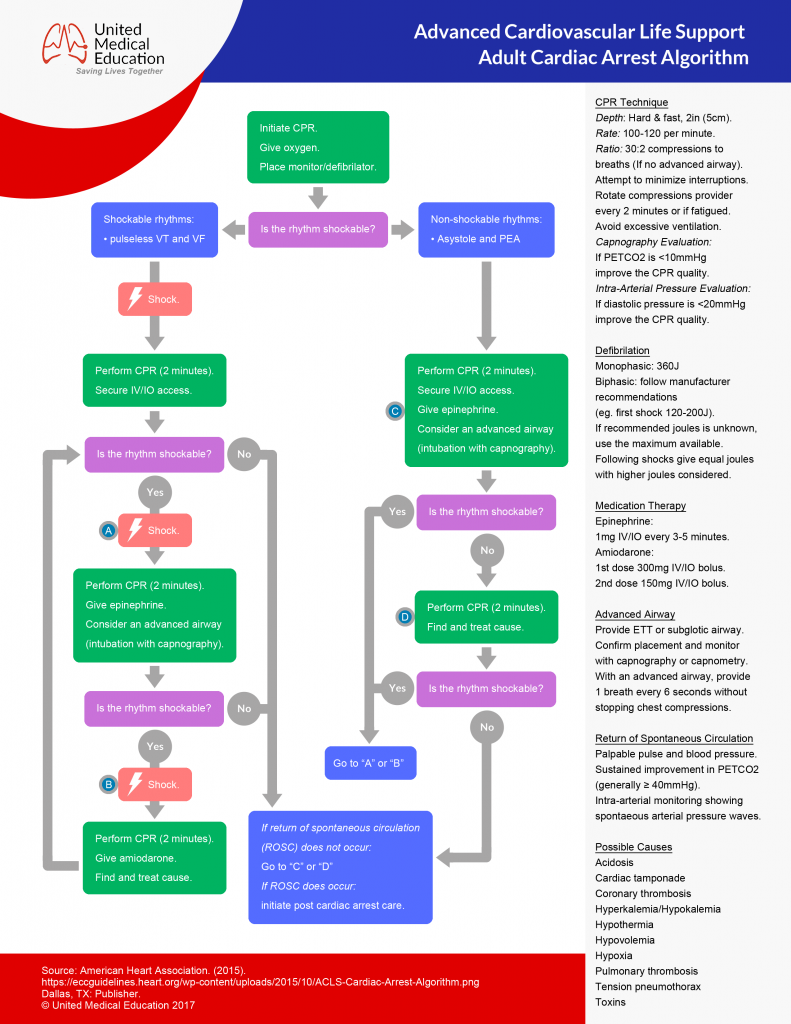
I'm going to limit my answer is scope, so I want to be really specific about terminology because I THINK I know what you're asking. The phrase "cardiac arrest" can cause a lot of confusion, and even major media outlets mess it up a lot (for example, calling it "heart failure" which certainly sounds like it would be a synonym but is a completely different phenomenon). Cardiac arrest means a sudden loss of heart function, no matter what the cause. This is a medical emergency, and if not addressed will naturally cause death. If I'm working on the wards and one of my patients goes into a cardiac arrest, I would follow the AHA Advanced Cardiac Life Support (ACLS) algorithm. You can take a look at it here (https://www.acls-pals-bls.com/wp-content/uploads/2018/02/ACLS-adult-cardiac-arrest-algorithm.png). I am required to undergo training in this algorithm, including "mock codes" every two years, as is every other doctor and nurse who provides patient care in the hospital.
Cardiac arrest can be caused by different things -- but it's an emergency, and you worry about the exact causes later. If you'll look at the algorithm you'll see that the major branch point is whether the patient has a shockable rhythm (VT/Vfib), or has pulse electrical activity or asystole, Despite what you see on TV, you CANNOT shock asystole back. So what you're talking about -- defibrillation and CPR -- refers to only a specific type of cardiac arrest, the VFib/VT arrest, which is what I'm going to talk about.
So before I go any further, I'll give a brief historical overview. What constitutes death has been an ongoing debate starting in the late 18th century, and continuing to this day. 18th and 19th century physicians recognized a condition called "suspended animation" -- a death-like state from which a patient could be revive. There were widespread beliefs that drowning victims could be revived from suspended animation by a tobacco smoke enema, and famously emergency smoke enema kits were near rivers in many cities (I was reading a few days ago about a charitable society in 1790s Philadelphia that supplied them). That cessation of heart as a primary cause of death (aka cardiac arrest) existed was not truly recognized until the mid 1800s, associated with "coronary thrombosis" (an MI, or heart attack).
By the late 19th century, physiologists had largely characterized the electrical conduction system of the heart (the His-Purkinje system). In 1901, Willem Eintoven invented the first prototype of an electrocardiogram (EKG in German -- see here for an early diagram: https://en.wikipedia.org/wiki/Willem_Einthoven#/media/File:Willem_Einthoven_ECG.jpg) which for the first time allowed a direct tracing to be make of the heart's electrical activity. Rapidly doctors described the EKG essentially in the terms we used today (P waves, QRS complex, T waves -- though the first EKGs ran right to left which is confusing as I'm looking at them now). By 1910, Lewis and Gallavardin had shown that both ventricular tachycardia and ventricular preceded cardiac arrest and were "terminal rhythms". Smith then did a number of dog experiments (poor doggos), which confirmed these findings -- prior to cardiac arrest, the heart would be into V Fib or VT.
Doctors naturally postulated that if there were a way to TREAT V Fib or VT, they could likely save the patient's lives (many of these studies were focused on people with structural heart disease, especially heart failure, who tended to go into V Fib, but also VT). By the late 1920s, there was decent evidence that quinidine could stop VT (today we know that it's a class I antiarrythmic), and a study in 1950 found that quinidine given via IV could stop an arrythmia. Armbrust and Levine considered quinidine to be the standard of care, despite the unpleasant side effects: "The fact that the patient becomes nauseated, dizzy, weak, or develops diarrhea or ringing of the ears should not discourage the physician from persisting with this therapy, when the alternative is likely to be a fatal termination." Procainamide and IV lidocaine started to be used in the 1950s and 1960s, largely with the same effects as quinidine, with fewer side effects (also class I antiarrythmics).
Which, of course, leads to the development of defibrillation and closed-chest cardiac massage (AKA CPR, based on the previous technique of opening a patient's chest and actually squeezing the heart, still done in penetrating chest trauma in emergency departments, and intraoperatively). By the late 1950s, defibrillation had been experimentally done (and later cardioversion), and by the 1960s, coronary care units were being developed with constant telemetry monitoring and "crash carts" to immediately defibrillate a patient (as well as give IV antiarrytmics) in an attempt to resuscitate them. But I've gone on long enough.
So, the TL;DR: prior to the invention of defibrillation and CPR, if a patient went into cardiac arrest from an unstable arrhythmia (VT or V Fib), the doctor would give intravenous quinidine or procainamide. If an EKG showed pulseless electric activity or asytole, however, this would have been synonymous with death.
Hope that answers your question!
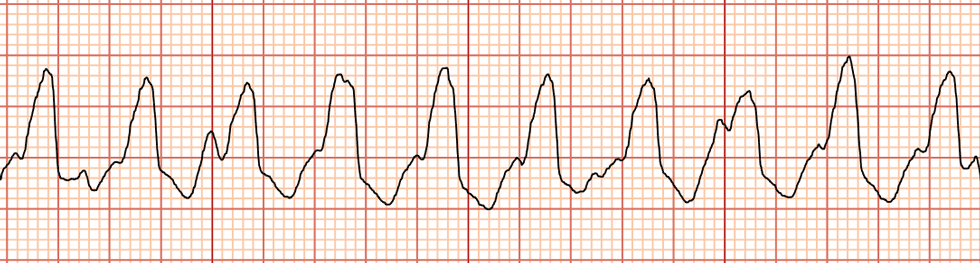
EDIT: Just for fun: V Fib: https://pcs12.azureedge.net/ekgtracings/5.gif; VT: https://media.chemotherapyadvisor.com/images/dsm/ch4594.fig1.png