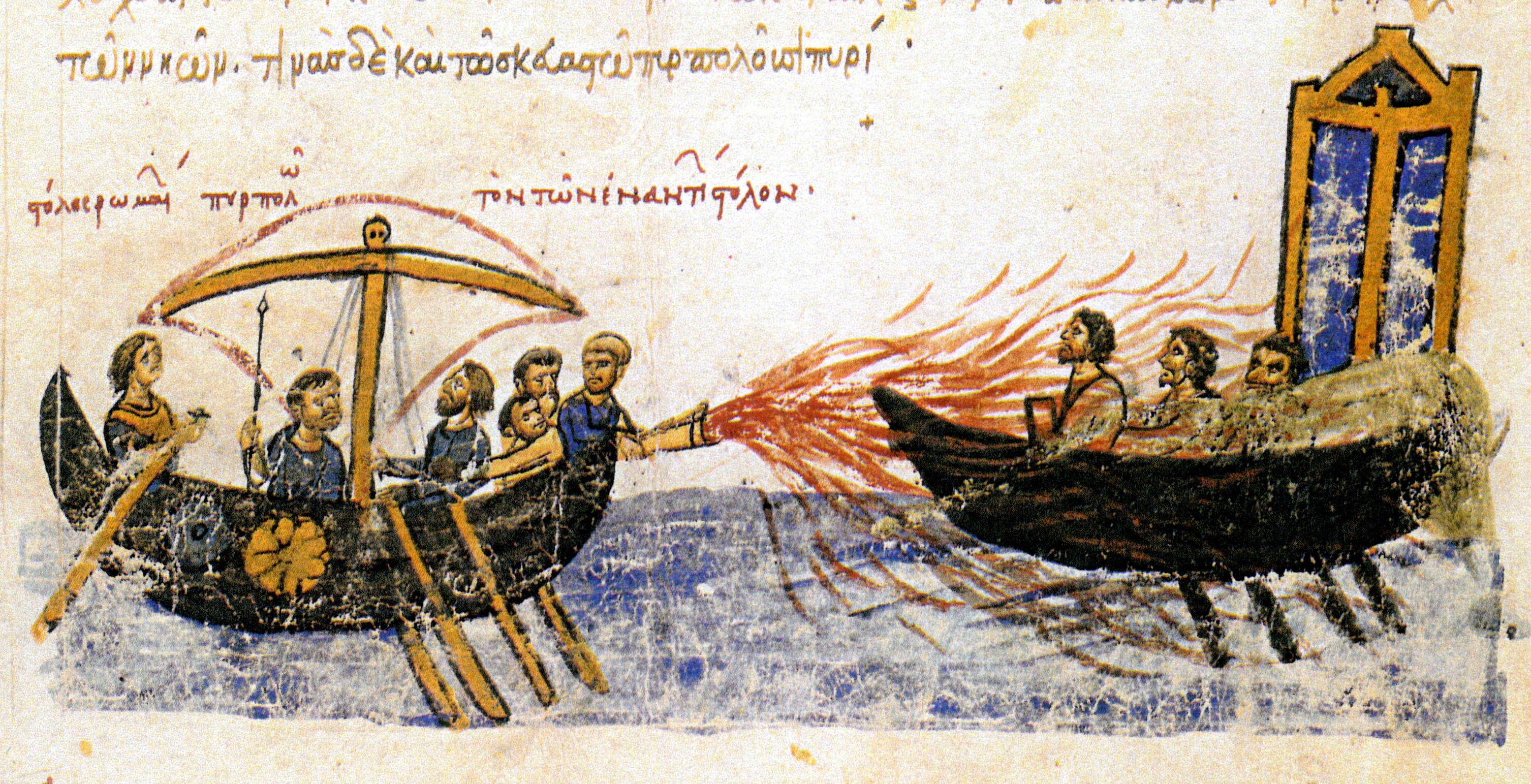
Whether it's ramming in the antiquity or canons later why not fight wooden ships just with fire? Wouldn't be some arrows or whatever to ignite the ships pretty effective against ships made only out of wood?
To attack wooden ships with fire had been recognized as valid method since antiquity. On famous Byzantine Greek Fire (link to the illustrated MS), check /u/Ambarenya 's very detailed comment to FAQ, Greek Fire: how was it used and what were it's effects?.
It was also worth noting here that Roman (and Byzantine) military tactical manuals in fact also provided a model for medieval naval walfares, or at least its idealized tactics, including the use of fires onboard that OP asked above (though the Medieval Europeans failed to find the formula of Greek Fire, so it was lost with Byzantine fleet).
The following passage is taken from King's Mirror, written in royal court of Norway as a pedagogic literature for sons of the king in the middle of the 13th century:
'Weapons of many sorts may be used to advantage on shipboard, which one has no occasion to use on land, except in a fortless or castle.......but coal and sulphur [for fire attack: annotation by the comment author] are, however, the most effective munitions of all that I have named'.
Quoted from: Laurence M. Larson (trans.), King's Mirror, New York: The American-Scandinavian Foundation, 1917, p. 215.
Contrary to your possible expectation, however, this passage does not unfortunately primarily concern probably not how the ancestor of the scribe, the Vikings, actually fought onboard. It's in fact an abridged translation of the famous military manual written in Later Roman Empire, De re militari by Publius Flavius Vegetius Renatus (hereby abbreviated as Vegetius). It has been debated whether this Old Norwegian text is a direct translation from Vegetius's Latin Original or just a secondhand translation via other authors' work(s).
Nevertheless, this Old Norwegian reception of Vegetius in Far North was not an isolated phenomenon in the 13th century Europe: Contemporary Encyclopedic Works like Vincent of Beauvais's Great Mirror (Speculum maius) (ca. 1250) and On the Rule of the Princes (De Regimine Principum) by Giles of Rome (ca. 1270s) also include excerpts of Vegetius on the naval (especially war on seaboard) part of Vegetius (Simek 2000: 107), until then almost neglected. Europeans began to re-discovery the Roman military tactics, including the naval battle with fire, just at this moment, in the late 13th century. Reseachers have just pay more attention to when this re-discovery of Vegetius occured in each country and how it affected the actual way of waging the war (Allmand 2014), but AFAIK they have not extended their focus also on the naval battle. So, this may be a promising area for study, I suppose.
References:
[Edited]: typo fixes.
At least when it comes to the Age of Sail with its blackpowder guns fire was of an enormous concern; arguably even more so than in earlier times, since now it was not only a ship made of flammable materials, but also with a gunpowder magazine (or several) that really could ruin your day if set on fire. I do not know why fire-weapons were not used at least at a distance where you wouldn't get fire wandering from the enemy ship onto yours, and I hope that someone knows better and can give a more on-point answer, but I can at least describe how big a concern fire was:
Naval combat in the Age of Sail actually took the risk of fire into account when it comes to the tactics used. In for example David Steele's The Elements and Practice of Rigging, Seamanship, and Naval Tactics, Volume 4: Theory and Practices of Seamanship and Naval Tactics (I choose this publication because it is quite typical of the time and a good representation of the gathered knowledge in the British navy at the end of the 18th century) we see one of the dilemmas in how you position yourself in the wind: If you take a position so that your enemy is downwind you will be blinded by your own gunsmoke, which might render your gunnery entirely useless if firing at any distance, but if you instead get the enemy upwind you have the problem of the burning wads from the guns (when loading a gun you first loaded powder, then a wad - often made of wool - to seal the powder in, then you loaded the projectile(s), then another wad to keep that in place, and the wad that sealed the gunpowder would understandably catch fire as the gun was fired) blowing back into your ship, for example into your sails.
If you see artwork from line ship battle you might see that the ships usually have their lower sails raised, and part of that reason is because of burning wads and other sparks that might occur (other reasons are to lower the heel and ease manoeuvrability of the ship if winds are too strong, to more easily stay in formation, and to lower the crew requirement to sail the ship so that you can have more men fighting). You can have some ship boys run around to put out/throw away smoldering wads that have landed on your deck during combat, but it's harder to get to them if they are stuck in the sails.
Another telling detail when it comes to the Age of Sail is that the gunpowder magazines almost exclusively were located below the water line, i.e. so low that enemy gun fire won't hit them directly, and even the use of lamps to see what you were doing under the deck was seriously limited during combat to reduce the risk of a fire reaching the magazines, as just a dropped or broken lamp could put the entire ship (and frankly any other ship close enough to be caught by burning debris from an explosion) in danger. Poor fire discipline and other similar recklessness was severely punished through the penal system in the navies of the time.
Lastly, in regards to using fire during boardings, boarding was often more of a chaotic and uncontrolled venture than one maybe would like to think. Unless a captain thinks he could win a boarding action he would not attempt one, and as such it is very unlikely that he'd "let" the enemy anchor the two ships together with grappling hooks and the like if he had any chance to avoid it. As such initiating a boarding combat between two somewhat similar vessels (I am assuming actual fleet war ships here, frigates and larger) was often a ramming action where the the attacking ship strived to get entangled in the enemy ship, their rigging stuck in each other, so that the defending ship stands no chance to disengage in a timely manner. This naturally means that if you set the enemy on fire the fire might wander onto your ship, and with the rigging being a tangled mess it can be a lot more work than a few cuts with axes to get the ships to separate. You'd pretty much doom yourself by setting the enemy ablaze.
With fire being such a major concern it is also understandable that any kind of action that might "spill" fire back onto yourself must be taken under the most careful consideration. Using lamps, torches or other devices to carry fire onto an enemy would be extremely dangerous to yourself unless you can do it under the most controlled of forms, for example after the battle to torch/scuttle the enemy ship. Projecting fire onto the enemy would be the safer method, and I can envision such being done by forms of ballistae and catapults, and simple burning arrows, but as for why that was not standard practice in the navies I don't know more than you do. It would have quite some potential for burning sails if nothing else. I can only speculate based on the above, but I'll refrain from doing so here.