This may not be what you have in mind but when Europeans began exploring and colonizing deeper into Africa they came across large established civilizations in areas known today as Ethiopia and Uganda. Racist Eurocentric beliefs at the time lead many to believe that native (especially black) Africans were unable to create kingdoms on their own. Thus they believed that some earlier “tribe” from the caucuses (to be understood as white) had actually established these kingdoms and ruled as an upper class. Eventually the races or “tribes” mixed and there is no longer any remaining Caucasian features.
This idea was given further credibility at the time due to local origin myths in places like Uganda that stated a man with light skin that came from the north was the first king and established the first kingdom in the Great Lakes region. This was viewed to be in line with this theory and biblical hematic myth as applied to race.
These theories combined with other scientific theories like Darwinism and the less scientific Social Darwinism gave them serious credibility in the western world at the time. It should be noted, just in case, that these theories are now debunked and most likely the human race originated in Africa and spread to Europe, not the other way around.
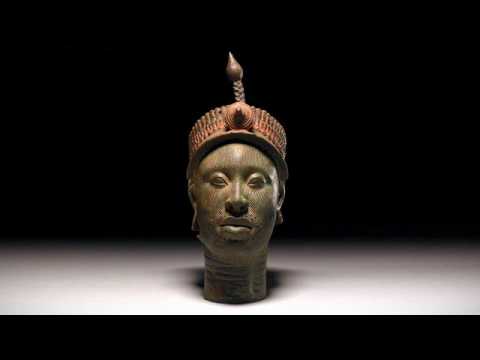
Not a monument, but a piece of art, the head of Ife:
The idea of black African civilisation on this level was quite simply unimaginable to a European a hundred years ago. In 1910, when the German anthropologist Leo Frobenius found the very first brass head in a shrine outside the city of Ife, he was so overwhelmed by its technical and aesthetic assurance that he immediately associated it with the greatest art that he knew - the classical sculptures of ancient Greece. But what possible connection could there have been between ancient Greece and Nigeria? There's no record of contact in the literature or in the archaeology. For Frobenius there was an obvious and exhilarating solution to the conundrum. The lost island of Atlantis must have sunk off the coast of Nigeria, and the Greek survivors stepped ashore to make this astonishing sculpture.
During the (Bronze Age) dark ages, the collapse of civilization was so complete in parts of the Mediterranean people not only forgot how to do things but that they were once able to do them. Old fortifications were one example. On the other hand they had (dwarf) elephant skulls which are considerably bigger than a man’s. The central orifice where the trunk goes can be mistaken for an eye socket by someone who has no knowledge of elephants. The logical conclusion, these one eyed giants built the walls. The most iconic example of cyclopean masonry is in Mycenae Crete.
After they were once more able to do those things, the notion had caught on:
There still remain, however, parts of the city wall, including the gate, upon which stand lions. These, too, are said to be the work of the Cyclopes, who made for Proetus the wall at Tiryns.
Pausanias Description of Greece 2.16.5 http://www.perseus.tufts.edu/hopper/text?doc=Paus.+2.16.5&fromdoc=Perseus%3Atext%3A1999.01.0160