I'm not sure what you mean by "interacted with." Do you mean, are there any records of people from sub-Saharan Africa in 14th century Scotland? If so, I should certainly hope not--because people in 14th century Scotland had no idea what "sub-Saharan Africa" was. To have documentation of their presence would pitch us into a very special episode of Outlander indeed.
The Latin medieval understanding of world geography, for whose presence we have ample evidence for among the late medieval Scottish literati (t.i. the people writing documents), traditionally divided the world into Europe, Asia, and Africa. But just like our modern seven continents are cultural constructs, so were theirs--and they weren't the same.
For example: John of Fordun's Chronica Gentis Scotorum, from the 1380s, assimilates Egypt into Asia. It outlines Africa as including Libya, Upper Ethiopia, and Lower Ethiopia. Reasonable, and reasonably kind of sub-Saharan...except that John's Ethiopia is not our Ethiopia (or, probably more to the point, medieval Ethiopia):
For Ethiopia is threefold: its western portion being mountainous, beginning at Mount Atlas; its middle portion sandy; and its eastern, a desert.
Africa, then, is specifically (our) North Africa:
By the Inland Sea, on the northern coast, is the country of Zeugnis, where Carthage once stood, and this is Africa proper.
I'm citing the Chronica Gentis Scotorum here because it takes us to the requested 14th century. But it's important to point out that even 15th century sources--when there were Ethiopian communities established in Rome, Ethiopian Orthodox delegates to the Council of Florence, Aragonese and Ethiopian royals negotiating marriage alliances--don't differentiate a North and sub-Saharan Africa, and have very European-culture-oriented understandings of "Africa."
For example, Andrew of Wyndoun's Original Chronicle of Scotland, from the 1420s, has a bit better geographic sense than John's. He recognizes the land around the southern Nile as part of Ethiopia, and beyond Ethiopia is just "wilderness." He situates "Africa" as:
So we really should not expect to see records of "sub-Saharan Africans" in 14th century Scotland.
But I assume the interest in this thread has nothing to do with sub-Saharan Africa and everything to do with black people.
Well, I'm afraid you're out of luck there, too. Because medieval European ideas of "race", skin color, and geographic origin were...not ours.
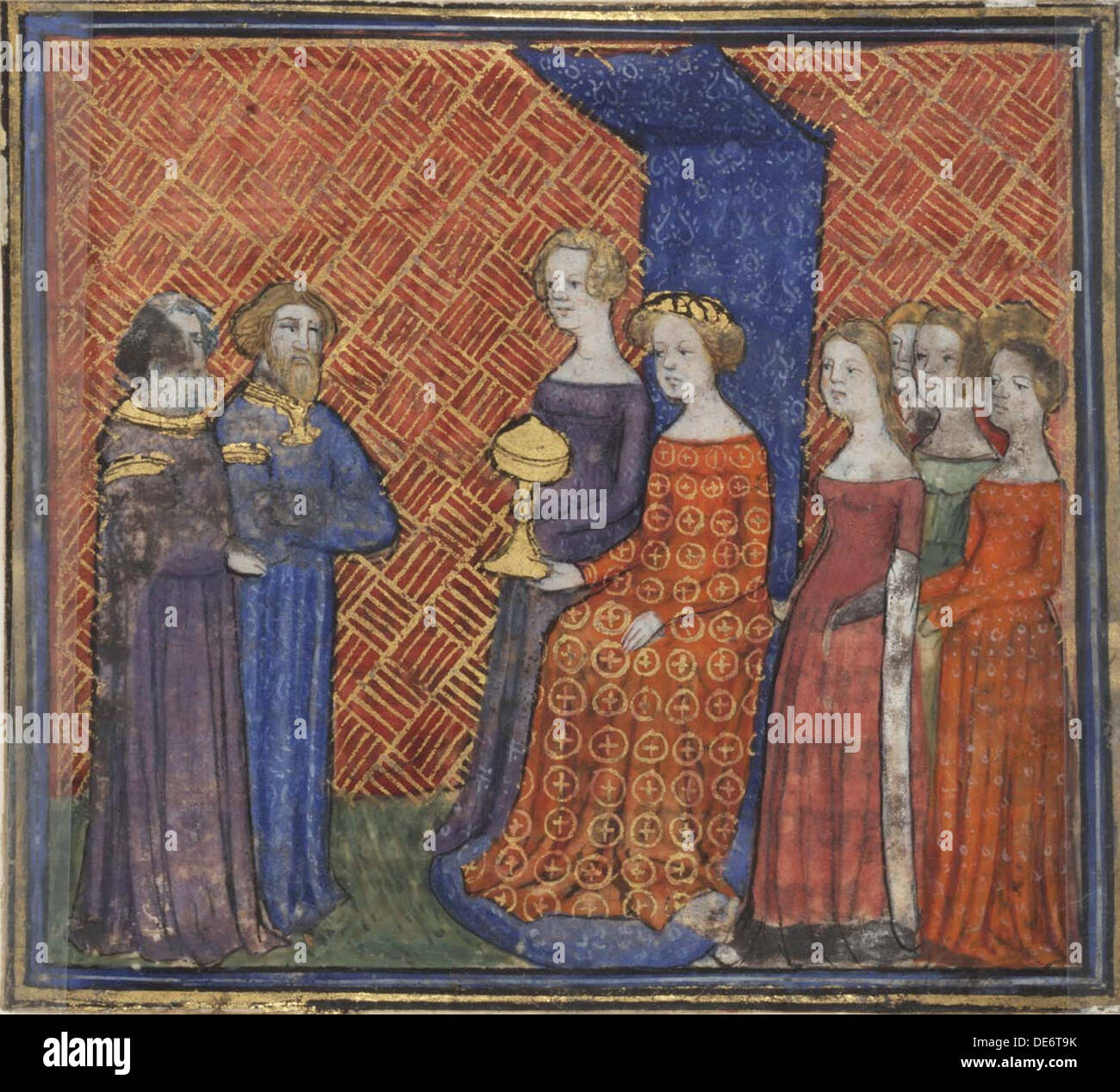
By the 15th century, recall, Europe had more than ample contact with Ethiopia--in Jerusalem, in Cairo, in Rome. Well, here's a 15th century Queen of Sheba. Here's a 15th century Queen of Sheba. Here's a 15th century Queen of Sheba. Here's one from right around the turn of the 16th. Heck, here's one from the 18th century..
Medieval Europeans' ideas about skin color and geography were...very loosely linked. Why should that surprise us? A person of color in medieval Spain or medieval France was...a Castilian or a French person, right?
So what we see in art and in writing is a blend of skin color:geography-based heritage and skin color:morality. (And let's be clear, we are not dealing with nuances of color here). In romance literature, 'Saracen' characters sometimes have their skin change from black to "white as milk" when they convert from Islam to Christianity (Cursor mundi, 14th century). In the most famous German take on Arthuriana, Parzival, Feirefiz has a Muslim parent and a Christian parent, and...is spotted. The Estoria de Espana blasts the conquering Saracens:
Their faces were black as pitch, the most handsome among them was black as a kettle, their eyes shone like candles
and the Song of Roland says about Saracen character Abisme that he is "black as pitch," with the archbishop wishing, "This Saracen seems quite heretical; it would be much better if I were to kill him."
You'll notice a pattern here: dark skin, in medieval writing, is associated much more closely with Islam than with Africa, much less Ethiopia. By the 14th century, Latin Europeans looked to Ethiopia to save them from Muslims. (I've discussed the issue of stark white/black skin color and morality in this earlier answer).
Benjamin Braude has discussed how European scholars gradually linked skin color and geographic heritage over the course of the fifteenth century: via Spanish and Portuguese slavers in West Africa, via Latin European courts deciding that dark-skinned enslaved people made excellent objects to keep at court as a sign of their power and prestige. By the turn of the 16th century, these courts included one of particular interest to us. That is when we start to read about "black Moors," "black ladies," "Blak Elene" who also seems to be named "Elen More," and so forth at the court of King James IV--of Scotland.
Which is exactly what we should expect, assuming no fluxes in the space-time continuum.