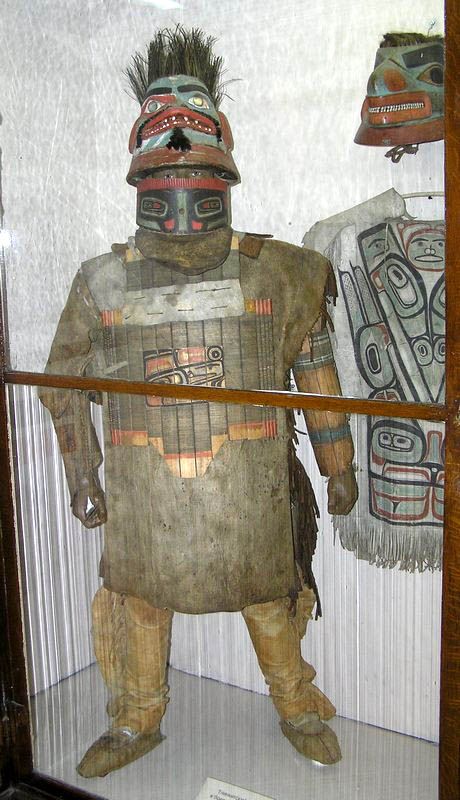
Was rawhide used for protection? Would wicker armor do any good? Would some kind of very early gambeson be possible to construct with that level of technology?
The usual materials are/were rawhide, wood (and similar materials like bamboo and rattan), and fibre. Horn and bone were also used, but were less common.
Rawhide armour could be either rigid, and mostly used for a breastplate or similar torso armour, or softer and more flexible, allowing more coverage. Rigid skirts - as used with steel plate armours - could be used to improve coverage with stiff rawhide while retaining mobility. Soft hide armours could be combined with rigid torso protection (rawhide, wood, etc.). In North America, hide armour were sometimes reinforced by gluing on sand/gravel, either between two layers or on the outer surface. This would provide resistance against cuts and penetration by sharp points (similar glued reinforcement was used on Medieval hide armours in Europe and western Asia).
Rigid torso armour (Sulawesi, Indonesia): https://i.pinimg.com/564x/31/93/fe/3193fee2ca1eef1493c926870cb642ec.jpg
Crocodile hide vest (Cameroon, Africa): https://i.pinimg.com/originals/2a/cb/10/2acb10d21efe05f6550823922f4977bc.jpg
Rigid rawhide armour with skirts (Pacific coast of Siberia): https://commons.wikimedia.org/wiki/File:%D0%9A%D0%BE%D0%B6%D0%B0%D0%BD%D1%8B%D0%B9_%D0%BF%D0%B0%D0%BD%D1%86%D0%B8%D1%80%D1%8C.jpg
Soft elk hide armour, worn with wooden slat breastplate (Alaska): http://4.bp.blogspot.com/-Dt3rombEAcg/VgYRy_ZRMDI/AAAAAAAACAg/7bPMyN51JiQ/s1600/Fibre%2Bwooden%2Bsplints%2Band%2Bwicker%2Bbreastplate%2Bwooden%2Bhelmet.jpg
Sometimes, pieces of hide were attached to a backing.
While shields and helmets could be (and often were) made of a single piece of wood, wooden body armour was usually made of slats or rods tied together (usually with the slats running vertically, so that the armour can be wrapped around the torso), or scale attached to a backing. Jones (2004) notes the use of horizontal-rod armour worn as a reinforcement under vertical-rod armour.
Wooden slat armour (Alaska): https://i.pinimg.com/564x/2b/a0/c1/2ba0c185783a75b3850e0c9cf8e06353.jpg
Wooden slat armour (NW Pacific coast, North America): https://www.britishmuseum.org/research/collection_online/collection_object_details.aspx?assetId=299180001&objectId=529649&partId=1
Rod armour (Alaska): https://i.pinimg.com/originals/97/4c/42/974c424d2e405eeb4cdb89a19c5fc193.jpg (from Jones (2004))
Rod armour (Alaska): https://alaska.si.edu/record.asp?id=40
Wooden slat armour being worn: https://i.pinimg.com/564x/c1/48/1d/c1481d6618ba92b9f874694e49c55ec5.jpg
Wood could also be used to make scales which could be attached to a backing. Most, if not all, example I recall are Toraja armours (from Sulawesi, Indonesia). Some examples and discussion can be found in the already-linked http://www.vikingsword.com/vb/showthread.php?t=16458 (along with seed scale armour and bone scale armour).
Woven fibre could be used. This would usually use thick fibre, and be a single-layer armour, but thick enough to be stiff and protective (unlike gambesons made from many layers of woven cloth).
Fibre armour (New Guinea highlands): https://i.pinimg.com/564x/f1/14/51/f11451c2bfee0892753f0964fdbe5f6e.jpg
Fibre armour, with shark-tooth sword-club, shark-tooth studded gauntlet, and porcupine-fish helmet (Kiribati, Micronesia): https://i.pinimg.com/originals/69/08/df/6908df09966be9e3013b62271c200a64.jpg (the tall back piece is supposed to be to protect the wearer from friendly fire from stone-throwers to the rear). Two armours like this being worn can be seen at http://maa.cam.ac.uk/maa-highlights/oceania/micronesia/ ; the person on the left is wearing armoured sleeves and pants; these are woven fibre similar to the torso armour, but thinner for flexibility.
Finally, other materials such as horn, bone, and teeth can be used. These would usually be used as scale armour or rod/slat armour.
Reference:
Jones, David E., Native North American Armor, Shields, and Fortifications, University of Texas Press, 2004
Since this is a question that predates written records in many parts of the world, you could also ask in r/AskAnthropology