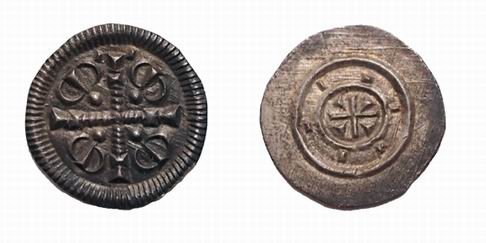
Absolutely! As an antique and medieval coin collector I can tell this was a big problem from the ancient to modern times. This practice is known as clipping in English numismatic literature. Such specimen are known in both gold and silver mintage, though generally its restricted to thinner coins where the process was easier done. Because of the relative softness of the noble metals some wear was expected so little, well-done shaving of the coin could go unnoticed. This is why putting some kind of edge ornament or reeding the coins (the latter a more recent, post-17. century method, inspired by events in England ill mention below) was done. See these examples on a Roman, medieval and early modern coin. Still as you can see there were still parts "beyond" the circular edge, and even a certain degree of wear into the reeds could be accepted. But those committing this act had to be careful to not be obvious about it: In the end the coin was supposed to have a rounded shape. Due to the superior mint quality (and so consistent high standards) of Roman coins clipping is usually restricted to late imperial mints (not that various coin-related crimes weren't thing, the lex Cornelia testamentaria nummaria dwelves quite detailed into types of criminal acts and theur punishments, sadly I'm no expert on Roman law but from what I know the punishment only became execution in the late emperors time) however due to the cruder technics of early to mid middle ages (where even coins of same year and mint can have quite different shapes) it again becomes an issue, perhaps becoming most serious in 17. century England where the punishment was no less than execution, and eventually prompted what is known as the Great Recoinage of 1696. Now one thing to keep in mind about noble metal mintage is that it all really boiled down was weight: As these coins had an inherent value to to their material, their worth was determined by their weight which was standardised in all known cultures and civilizations I'm aware of ( medieval/early modern European, Roman and Ancient Greek coins). Weighting coins also told if it was counterfeit made of an alloy, which is why in various media you can see/read shopowners and merchants measuring up coins by weighting them on scales.
However clipping wasn't just an individual endavoeur - it was a practice done by the royal mints too on the orders of rulers, in this case it becomes a form of debasement. When certain series show consistent clipping, then its a mark of centrally dictated debasing. What typically happened is that the ruler suddenly needed lot of money (like for war efforts), so older coins were declared to be only usable for say up to one year and had to be presented to designated officials and exchanged for new currency weighting less but nominally the same value. This was a pretty dirty and scorned process though, it was more usual to just lower the % of noble metal content in new mintage, as the latter was also harder to notice. I could go on quite long about practices of Hungarian kings as that is what I'm most versed in if anyones interested.
In the early modern era there were actually a few coin clipping rings throughout England, in which numerous people in an area would shave off a small piece of each coin that passed through their business or household and sell the metal by weight to a counterfeiter. The counterfeiter would then forge new coins, usually of lower quality.
It was a big enough problem that between the years 1674 and 1816 113 people were executed with clipping as at least one of their convictions at the Old Bailey, London's central court. The counterfeiting of coins was actually considered a type of treason at the time.
The case of Joseph Wood is perhaps the most notorious clipping cases, and indicative of why the English Crown saw the crime as so dangerous as banking and paper notes began to take over London's financial scene. He would clip the coins, counterfeit them, and use them to secure notes from a bank. He did this to the tune of £2000 (nearly $500k USD) over the course of two years. He was caught because eventually nobody believed a man of such low birth could be dealing with that kind of money on a regular basis and thus the investigation began.
That was the common thread of this crime, at least in that time and place. The Crown only allotted a certain amount of money to paying the mint solicitor for prosecutions of this crime. Once that amount, (£400 before 1742, £600 after) had been billed, prosecutions simply stopped for the year regardless of the number of cases presented. They tended to be most concerned with investigating the instances that went beyond a single household making a few pence on the side. Wood's case is uncommon, generally the sums being dealt with we're not large enough to focus Parliament's attention. The much bigger threat at this time by their estimation, was bank note fraud.