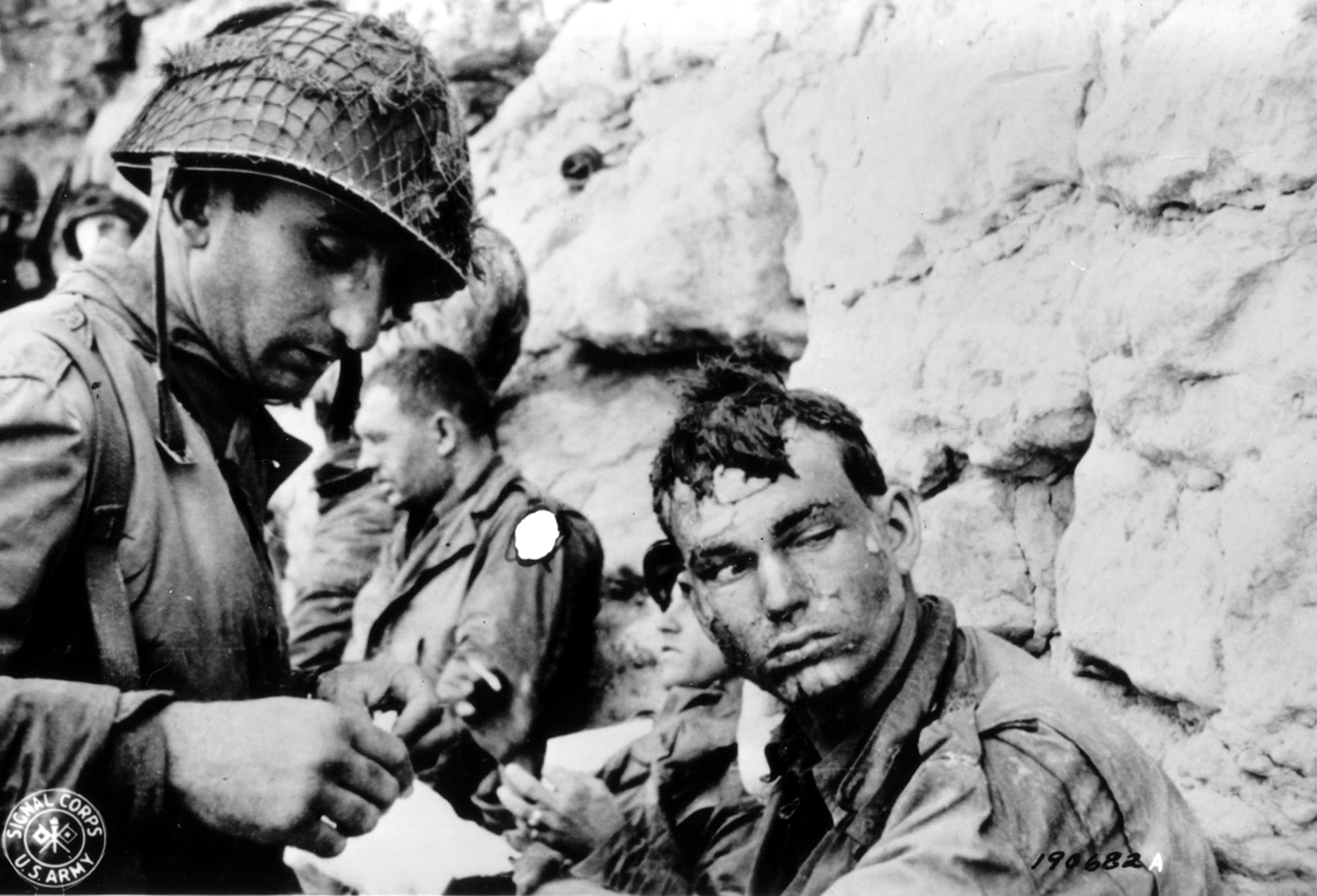
I'm watching band of brothers and all the Americans have "fishnets" on their helmets. What purpose does this service, if any?
i answered a question similar to this one some time ago here, but I'll repeat it below.
The nets weren't specifically issued for beach landings; soldiers made them up themselves, received them from camouflage shops, or later, received them as an issue item. Netting could be used to attach scrim (camouflage) such as pieces of tree bark, leaves, or fabric. Soldiers often found other uses for the nets, shoving packets of cigarettes or first aid kit components underneath them. The nets also reduced the shine of the helmet when it was wet; an unintended advantage.
At first, the U.S. Army did not issue a specific type of net, and soldiers waiting on D-Day in England experimented or took whatever they could find from British, French, or Canadian stocks. This produced possibly hundreds of thousands of nets, and many variations; the netting varied from very tight (1/4" squares) to loose (1/2" to 2"-3" squares) One specific variety that only seems to have been used only by the 79th Infantry Division has very large squares, resembling Japanese helmet netting. Eventually, the U.S. contracted the British to purposefully manufacture various types of nets. Most of the nets were of knotted construction like the above types, but some were thicker and woven, like the extremely common "shrimp" net (1/4"-5/16" squares) The "shrimp" material was declared unsuitable by the U.S. Army for making large camouflage nets for vehicles, but found a second life on helmets. From March to July 1944, about 1,700,000 "shrimp" nets were procured from the British, and several hundred thousand more were made in U.S. camouflage shops in England and on the Continent.
In late 1944, the purposefully-manufactured "M1944" net (technically called "Net, Helmet, with Band"; many small or inconsequential items didn't receive "M-" designations, and many popular "M-" designations for items are in fact post-war inventions by historians, reenactors, and collectors) with an elastic band began to be issued. Several hundred thousand made it to Europe before the end of the war, mostly with replacements or divisions that arrived in late 1944 and early 1945. Helmet nets seem to be less common in the Pacific.
It's for camouflage. The net itself softens the unnatural curve of the helmet by adding some texture. To further break up the outline of the helmet and help the wearer blend in, bits of camouflage could be stuck in the net. This could be leaves, grass, or other natural material. Usually, bits of dyed fabric "scrim" were stuck in the helmet. You can see some 502nd Parachute Infantry Regiment, 101st Airbone Division troopers with scrim on their helmets. You can seen another example in this famous photo.
For paratroopers, the netting was a popular place to attach a Packet, First Aid, Parachute aid kit. The British also attached shell dressings to the outside of their netted helmets or underneath the netting
There was substantial variation in the shape and size of the netting, as this photo survey shows. Netting was secured from a range of American, British, and locals sources. As you can see, some infantry divisions even procured their own unique netting!
The Germans, by contrast, tended to use wire, in lieu of netting. You can see examples here and here.