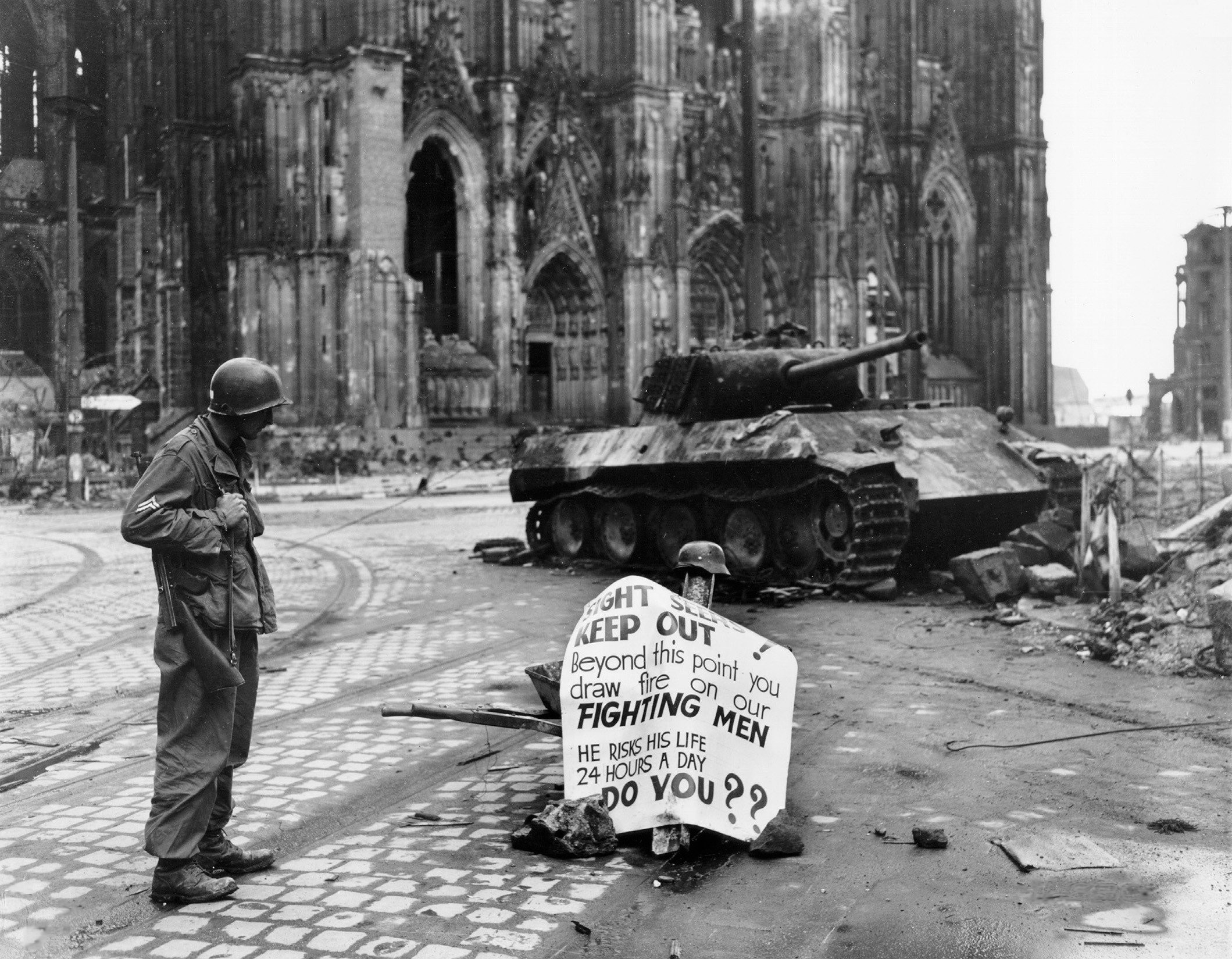
I get that war tourism has always been a thing after wars, but I really doubt that civilians would just gather around the corner to watch a bloody urban battle, especially in a battered city like Cologne (plus, the sign is in English).
Was this directed at US rear personnel that liked to get too close to the action, maybe to get cool pictures to show back home? Or perhaps at war reporters (but weren't they embedded with US forces under their orders, and as such didn't need such signs)?
How common was this problem during the war and what was the US army policy about it? Were signs the only thing used to avoid non-combatant interference, or did men usually have to isolate a fighting area and secure its perimeter to let others fight with no distractions? And what would happen to someone caught where they shouldn't be, endangering soldiers' lives?
Edit: the sign actually says "Sight seers", not "fight seers". My mistake, thank you for the correction u/bikeheart! But I think its implication remains the same: curious people were getting too close for comfort in active urban battlefields.
Edit 2: u/Neuromante found another photo of the same (or an identical) sign taken further away from the cathedral. You can read it more clearly, and you can also see the lines used to draw the letters, which means it was hand-painted and not mass printed (my first thought when looking at the first photo, since the letters are so perfect). I remain curious about how common this was in the war and how the army dealt with it, but what happened in Cologne that lead to these signs being needed?
Signs of all kinds were a common feature near the battlefields of the Second (and First) World Wars. They could be place nicknames, directions, jokes, or serious warnings. The Cologne sign is a combination of the last two.
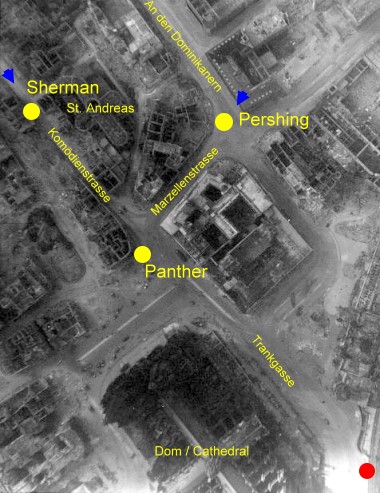
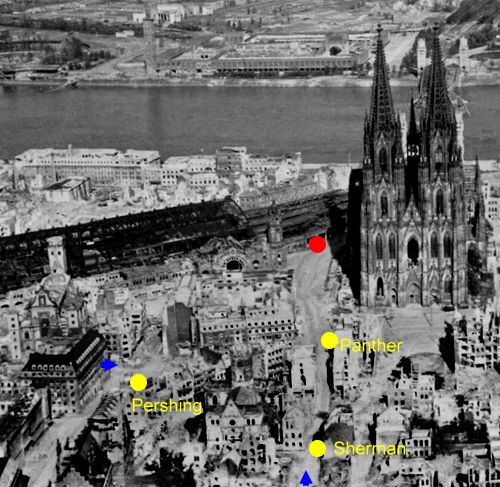
To understand the sign, we have to understand the evolving situation in Cologne between early March and mid April 1945. On March 6th, the American 3rd Armored Division entered the city and cleared the Western part of the city after two days of street-to-street skirmishing. During the fighting, an M4 tank and a M26 Pershing tank fought a now-famous duel with a Panther outside Cologne Cathedral, one of the few tank battles ever caught on film. The Panther killed one tank, only to be destroyed a few minutes later by a Pershing. (Note: This site has a good breakdown of the fight and how the footage was shot. This image and this image give you an idea of how close the fight was to the cathedral itself.)
However, the eastern side of Cologne remained in German hands. The retreating Germans had blown the bridges across the Rhine, leaving the city divided. Neither side had the resources or the will to immediately capture the other half of the city. So the Germans and the Americans contented themselves with harassing the opposite bank with shelling and sniper fire. This was hardly a unique situation in the ETO. If you've seen the Band of Brothers episode "The Last Patrol" or read Ambrose's book, you'll see immediate parallels. Just like Cologne, the Americans were on one side of Haguenau and the Germans were on the other, with both sides launching tit-for-tat raids and artillery barrages. It wasn't until the fighting of April 12th-15th that American troops managed to get across the Rhine and clear the eastern half of the city.
Understandably, this all made parts of Cologne very unhealthy places. A strip about 500 yards west of the Rhine was declared to be a restricted area, effectively making it off-limits to anyone who didn't have to be there. This zone included the Cologne Cathedral (the Kölner Dom), as you can see from this modern map.
For nearly a month, the western half of Cologne was relatively quiet and deceptively "safe." There wasn't active street fighting, but it was being randomly shelled and any observed movement could draw German fire. Cologne was a warzone, but it was peaceful enough to lull GIs into a false sense of security. So there you have the reason for the "sight-seers" sign. The original location of the sign is a few blocks south of Cologne Cathedral, right at the edge of the 500 yard restricted area.
So why the hell were GIs wandering into Cologne, anyways? Well, for one, GIs were notorious souvenir-hunters. Some souvenirs simply became personal keepsakes. But war trophies were a useful barter currency to get scarce supplies. During the advance across France, one unit had traded two truckloads of war trophies to a supply depot in exchange for food. In that sense, trophy-hunting was a kind of indirect foraging for front-line units. Support troops, of course, also looked for souvenirs.
Also, as all this was going on, the burnt-out Panther was still outside Cologne Cathedral, where it had became quite photogenic. There are a great many pictures of GIs inspecting the tank or posing with the tank. One redditor's grandfather even climbed aboard for a photo.
This seems to have happened so much that the "sight-seers" sign had to be moved next to the Panther sometime in late March or early April. By April 4th, it had been moved again for this famous photo with an 82nd Airborne trooper, the one the OP posted. Eventually, as Cologne became safer, this sign was used as a prop by more photobug GIs.
There are plenty of examples of similar warning signs from every theater of the war.
"Stop! Go no further enemy!" sign from the 51st (Highland) Division in North Africa during 1943.
"All ranks British troops will wear steel helmets" at Anzio in 1944.
"Slow[!] Dust Brings Shell-Fire" also from Anzio in 1944.
Shrapnel-scarred "Danger. Road Under Heavy Shell-Fire Keep - 100 yd. Interval" at Loiano in 1945.
A similar sign from Okinawa in 1945 that warned "Road Exposed to Enemy Artillery. Keep to Right".
"Mines in Verges" warning from the Royal Engineers 1944.
There were also plenty of credit-taking signs in Cologne and elsewhere.
There was this sign on the door of Cologne Cathedral, "You are now in Cologne. Compliments 1st Bn. 36th Armd Inf. Regt. TFX "Spearhead", from a formation of the the 3rd Armored Division in Cologne during 1945.
Or this "Welcome to Köln Courteousy The Spearhead Division" sign from the 3rd Armored Division.
"Roads and Shoulders Cleared of Krauts - 2nd Armored Division" from 1945.
One company of engineers even built a bridge over the Rhine named after Patton. Patton personally visited the bridge and it later got some rather unusual decorations.
You can see many more examples of units posting triumphant signs here.
Sub question - were there any other European based English speakers during WWII that this sign might be directed at?



!["Slow[!] Dust Brings Shell-Fire"](https://i.imgur.com/9nCtY84.jpg)


