0- Asking this question to know if germany had at chance at the start of kaiserschlacht ?
1- was taking paris a possibility ?
2- if paris were to put under siege or even fall was france going to ask for an armistice v
2-how important was the city of amiens strategically for both the german and british army ?
3-if amiens were to fall was the british army going to retreat from Flanders
4-how important was the role of the AEF in stopping the offensive
Also what do you think of this book The German 1918 Offensives: A Case Study in The Operational Level of War by david zabecki
The war wasn't exactly a "down to the wire" narrative as its often portrayed during Germany's Spring Offensive. Germany may have closed the Eastern Front and could devote their remaining troops to a large offensive on the Western Front, but the German Army and the Empire's internal politics was deteriorating at a rapid pace, and ultimately fell victim to riots, mutiny, and at the end, revolution.
Before I get to the meat of the issue that was the Western Front. We have to talk about Germany's allies within the Central Powers.
The Ottoman Empire in 1918 was in no position to combat the British/Arab combined offensive up the Levant and Mesopotamia. Baghdad was captured by the British in March of 1917, along with Jerusalem just before Christmas of that year. By 1918, the British and Arab Revolt would be in Damascus and Aleppo and poised to push into the heart of Anatolia. No matter the outcome for Germany in the Western Front, the Ottoman Empire was going to fall.
Next is Austria-Hungary, who was still engaged in bitter fighting on the Italian Front. 1918 saw a complete reversal of all Austro-Hungarian success on the front made in 1917 at the Battle of Caporetto, and its entire army was for all purposes obliterated at the Battle of Vittorio Veneto in October 1918, suffering over half a million casualties/captured in just under 2 weeks.
This is to show that no matter how successful a German Offensive might be in the West, Germany's allies were all in a hopeless or failing situation. They were going to fall regardless of the outcome on the Western Front.
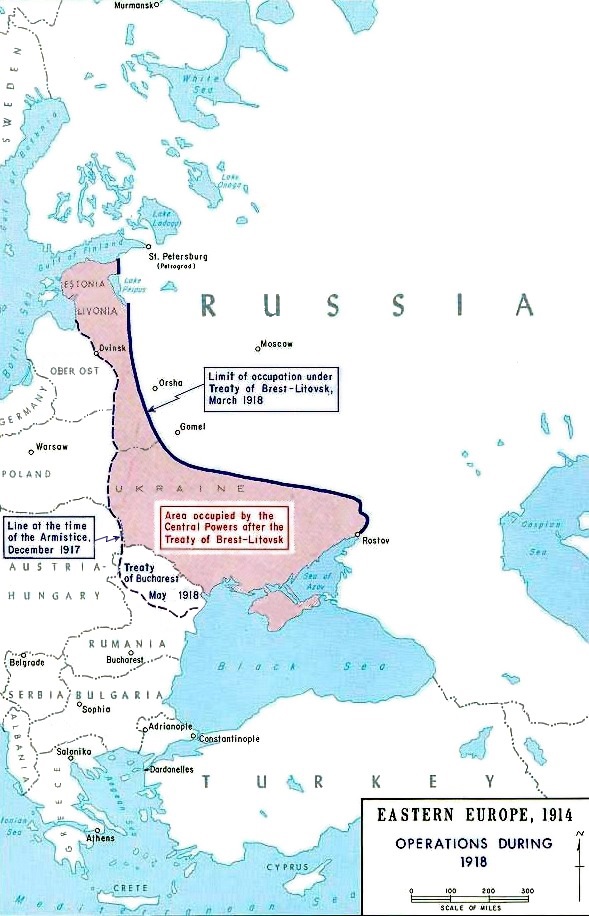
Now lets get to Germany itself, where its misfortunes in 1918 start with its victory against Russia. Erich Ludendorff, chief of the German General Staff, had initial hopes that Russia's withdraw from the war would begin a negotiation with the remaining Allied Powers from a position of strength. The resulting Treaty of Brest-Litovsk with Russia however, which saw an extreme amount of territory taken from Russia shown here, was seen as so harsh in its terms that it strengthened Allied resolve against Germany in fear of similar terms enforced on them, no negotiation was opened because of this.
What the Treaty of Brest-Litovsk did do though was free up 50 German divisions from the East for the Spring Offensive. Ludendorff knew that once fresh troops from the US started arriving in large numbers, the war was surely lost. Germany had essentially no reserve troops left to replace losses, so the Spring Offensive was by its nature a desperate, all-or-nothing gamble to capitulate France before Allied troops could reinforce their frontline with fresh troops.
As for the Spring Offensive itself, the goal of the offensive changed constantly even down to the days before the offensive's start. Initial goals changed from the Channel Ports of Calais and Dunkirk to cut off allied supplies and incoming soldiers to important rail junction yards, then eventually for Paris itself. In the end, almost all the land Germany captured in its offensive was strategically worthless. No major rail yards or ports were captured. Germany suffered nearly 700,000 casualties without gaining any real strategic advantage while the Allies kept reinforcing their defenses with more and more fresh soldiers. By the time Germany attempted to break through at the Second Battle of the Marne, the advance was wholesale stopped with the help of freshly reinforced divisions. After that failure, Germany no longer had any capability to launch any offensive operation, and were driven back during the following Hundred Days Offensive.
The situation for Germany at home was equally, if not more dire. Food shortages as a result of the British blockade led to food riots across the Empire. The German Navy was ordered to perform its own all-or-nothing breakthrough of the British blockade to reopen food imports, which resulted in the Kiel Mutiny by German sailors seeing the order as complete suicide. This mutiny sparked the wider German Revolution, which resulted in the complete collapse of the German Monarchy.
To answer your points directly though.
0 - Kaiserschlact was very flawed in its planning stages, without even a concrete strategic objective in mind at the start. With objectives switching back and forth between the channel ports and the railyards all the way to its execution, with none of either objective actually taken. It had little chance of actually succeeding.
1 - No. The Germans were wholesale beaten outside of Paris at the Second Battle of the Marne, the casualties taken in this battle were so extreme that German forces were incapable of any offensive action afterward.
2 - this goes into /r/historywhatif territory for me, as I have not read or heard of any French contingency plan for if Paris were to fall. If anyone has such a document, I'd love to read it.
3 - Amiens was one of the strategically important railyards mentioned earlier, having great importance for its center of supply and reinforcement. The British used the city as its primary forward base because of this easy source of supply and reinforcement, and was where we saw the beginning of the Hundred Days Offensive.
4- Again, there's no way of predicting the British reaction to a situation that did not happen. If there is a document regarding such contingency plans, I'd love to see it.
5- the American Expedition was nothing but a boon to the Allied forces, raising morale and providing fresh reinforcements for both defending against the Spring Offensive and the counterattack during the Hundred Days Offensive. The debate over their importance being the deciding factor between allied victory or defeat is up for debate between some people, but this isn't about debate and the definitive answer is that the AEF did contribute positively to the Allied war effort.
Sources:
Kaiserschlact 1918: The Final German Offensive of World War One by Randall Gray
The Kaiser's Battle by Martin Middlebrook