Today:
You know the drill: this is the thread for all your history-related outpourings that are not necessarily questions. Minor questions that you feel don't need or merit their own threads are welcome too. Discovered a great new book, documentary, article or blog? Has your Ph.D. application been successful? Have you made an archaeological discovery in your back yard? Did you find an anecdote about the Doge of Venice telling a joke to Michel Foucault? Tell us all about it.
As usual, moderation in this thread will be relatively non-existent -- jokes, anecdotes and light-hearted banter are welcome.
I'm happy to announce that some of my research into how some unsavory people online reacted to the inclusion of minorities in the First World War video game Battlefield 1 (and why) has finally seen the light of day. I initially wrote this article in late 2016 and I am very pleased to finally have it available for you all to read. Peer-review, editing, and overall journal stuff takes quite a bit of time. The article is titled Race, Battlefield 1 and the White Mythic Space of the First World War and you can find the PDF here.
Ideally, it would have been a longer article, but I was given limited space by the editors to work with (they were so excited to include cultural perspectives on WWI video games that two scholars got 'half' an article each!). Yet, I hope it will be an interesting read. Here's the abstract which neatly sums everything up:
The popular perception of the First World War has remained an inherently white mythic space in which white men fight against other white men and where minorities, when and if they are featured, are given an anonymous secondary role and are subject to the will and motivation of their white heroic leaders. This article will be considering the white mythic space of the First World War by focusing on the video game Battlefield 1 (2016) and investigating the backlash by players on online message boards against the inclusion of soldiers of color in the game’s multiplayer features. In the online discourse, these players diminish the role that minorities played in the First World War and although the presence of minorities in the historical First World War is to a minor extent acknowledged, their space in the video game is nonetheless denied. I argue that this backlash is based on a rejection of the inclusive collective memory as portrayed in Battlefield 1, supported by racist arguments against the backdrop of the white mythic space of the First World War and that their rejection of the presence of minorities in Battlefield 1 can be constructed as a continuation of the denial of agency for soldiers of color by white individuals that took place during the First World War and the postwar period.
As a bonus, there's a follow-up between myself and Iro Filippaki where we go back and forth about some of the things that we've brought up. Filippaki's article is titled Great War Games: Notes on Collective Memory, the Adynaton, and Posthumanism (PDF) and our mutual conversation (The Great War and the Use of Video Games as Historical and Educational Resources: A Conversation) can be found here.
I must put in a word for Mickey Mouse, too. His popularity I suppose is chiefly with the juvenile portions of the audience, but there's a subtlety in the execution of the cartoon figures which makes the reactions rather than the actions of the characters the great value of the program. The utter horror expressed by the dog Pluto's up-shooting ears and widened eyes is a marvel of drawing and action (incidentally, there we have cartooning acquiring a third dimension of continuous action, in which as great a skill is required as in the inanimate "stills" of yore.) Mickey's thin-voiced braggadocio and Donald Duck's belligerency after all danger is past, is (are—is) an eloquent commentary of human frailty, and the astonishing deftness with which chickens and ducks and dogs and other fauna are invested with marvelously human actions by the slightest shrug of feathered shoulder or inclination of canine head. The Popeye the Sailor cartoons are not very good—depend upon the comic strip published in the newspapers for their value, but the Disney Symphonies and cartoons are better in action than inanimately. (that's almost a pun, though unintentional.) I hadn't realized until now the third dimension of cartooning which has grown up so strongly in the last few years—the ability to put life itself into the motions of its characters on the screen. It's a brand new art which has developed so recently that artists of fifteen years ago couldn't even have imagined it. I do wonder what surprises the future holds!
What do you guys do with 'microdiscoveries' (for lack of a term)? That is, when you figure something out or make a discovery or connection etc, that's non-trivial, but at the same time there's not quite enough to say about it to warrant writing a whole article about it, perhaps not even a 'short communications' type one. Yet at the same time it's too peripheral to what you're doing to work it into that.
Do you just find some researcher to whom it'd be relevant and send them an unsolicited FYI?
This is something that I only just remembered but which I had come across some months back.
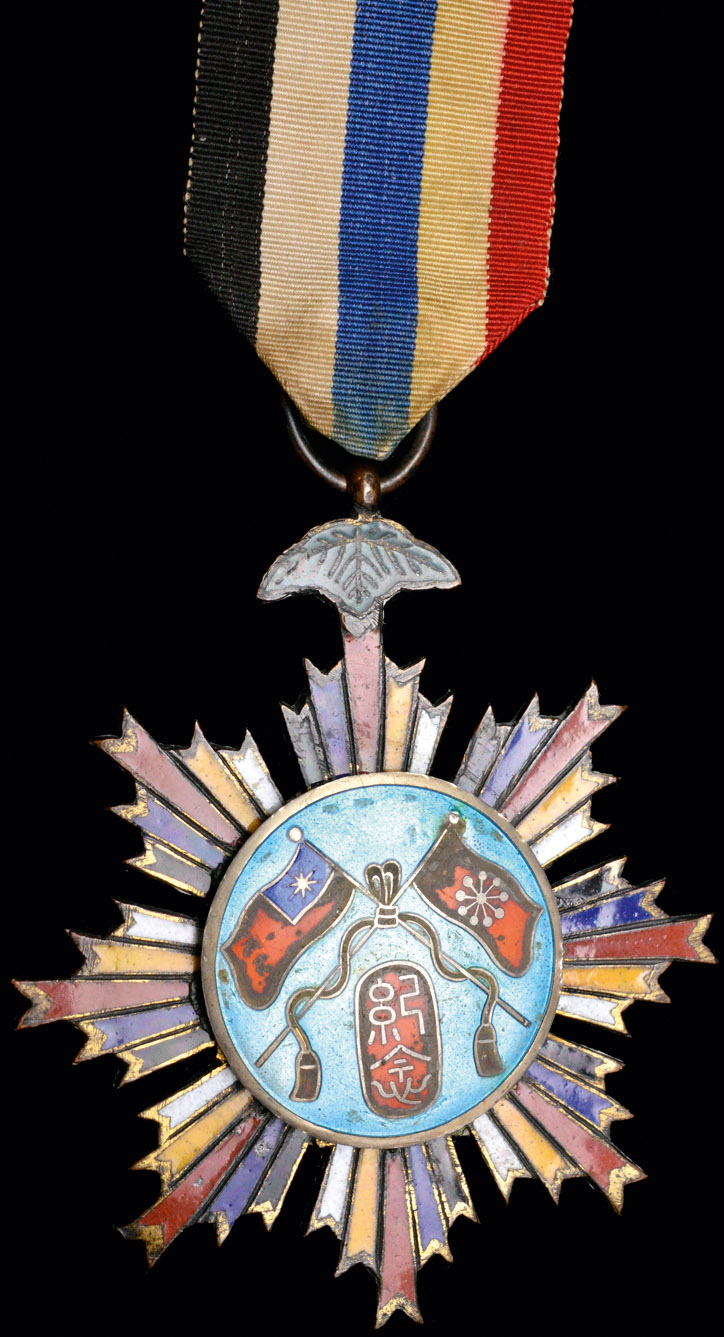
While I was in Hong Kong back in December last year I popped down to the Sun Yat-Sen Museum, where there was a temporary exhibition on the Beiyang Warlords. One particular vexillological point the exhibition made stood out, particularly regarding the significance of the replacement of the five-striped flag, which represented Sun Yat-Sen's broad categorisation of the Chinese people into Han (red), Manchu (yellow), Mongols (blue), Hui (white) and Tibetans (black), with the red saltire by Yuan Shikai. What it suggested was that where the old flag implied concord between the five nations, the new one emphasised the Han as the binding force.
What was not pointed out but which did, however, stand out somewhat, was warlord medals. On medals such as this one, this one or this one, the longest points of all the stars are red – Han – in a clear break from the original colour scheme of the five-striped flag and a similar vein to the transition to the saltire. Intentional? I think so, but it's so far largely circumstantial, and I forgot to take photos of the medals which is a huge shame as it's likely to be the most complete collection of warlord medals on display for a while.
Hi everyone. Just looking for book recommendations. I recently finished Rick Atkinson's Liberation Triology about the US in the European theater in WWII. Can anyone recommend similarly comprehensive books/series on the Pacific theater or the Soviet war effort? Thanks!
I still can’t decide was Austro Hungary a good or a bad deal for us (Croatia).
Still somehow I think if it remained it would have stopped a lot of bloodshed and we could have been far better off economically.
On the other hand the Hungarians and Austrians would have been the owners of our beautiful coastline which is unthinkable for me and frankly a bit scary.
Why did Germany not ignore the neutrality of Switzerland in 1914, they ignored Belgian neutrality and it would help during the race for the sea?
I am writing a story about the Beothuk people. Are there anything I should be sensitive about? I know the historiography of the Mikmaq's role in their extinction is controversial.
Any other cool facts about the Beothuks are also welcomed!
How did the US know the Congo had the most enriched uranium and know where the mines were? Other uranium in US and Canada had something like 1% purity where the Congolese Uranium was around 60%. Who shared this information with only the US and somehow kept it secret from the Axis?
Apparently I'm competent to tutor undergraduate students now...
When did Friday become the standard 'payday' day. Was it just with the advent of the 5 day work week? What day was it in earlier times? Is it different in different countries?
I have a question but it is not major enough to warrant its own thread. I am looking for a WW1 painting. From what I remember of it, it looked like William Orpen's To the Unknown British Soldier in France in terms of colour and style. The painting was rather big, and looked to be of a funeral with the UK flag sprawled over a coffin. I seem to remember horses and an epic building in the background but I cannot for the life of me remember what it was called. I tried looking up Orpen's paintings but it does not seem to be one of his. Anyone aware of the painting I am talking about, please?
Huzzah, ladies and gents, I have found it! It is The Passing of the Unknown Soldier by Frank Owen Salisbury. I had to go through a Tate PDF guide to find it.