Opening caveat: my area of study is the later European Middle Ages, so I'll focus on that for my answer. I am drawing this from a variety of sources but none more than Phyrr and Breidings 'The Armoured Horse in Europe 1480-1620'.
Like so many 'how common' questions, this is a hard one to answer, and like so many 'were they practical' questions, that answer is 'yes, but with qualifications'. Which is to say, it was more useful than the Horse Armour for your Oblvion Character. But I get ahead of myself. Let's start at the beginning.
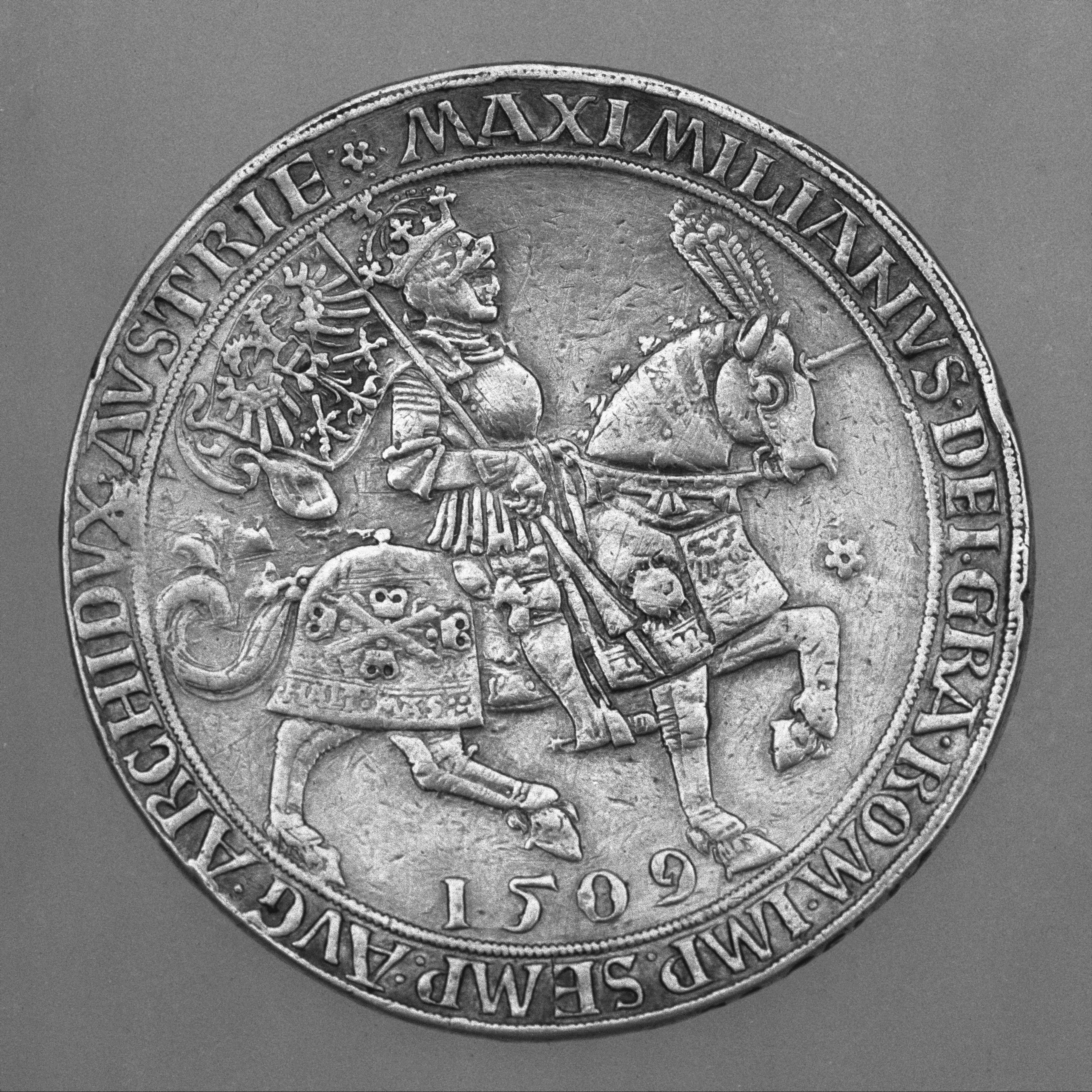
First, we'll need to define our terms. What counts as 'full plate or mail armour' for a horse? For a man the answer is simple enough - metal that fully encases him when he is on his feet and fighting, enclosing all except perhaps the soles of the feet, the backs/undersides of various joints, the fork of the legs and the palms of the hands. But what about a horse? To answer your question, we must confront the age-old query - if a horse wore full plate armour, what he wear it like this or like this?
The first of these, from a coin of Maximilian I, is a very rarely depicted type of armour that encases the legs of the horse as well as the head, neck and body - note the joints of the armour around those thing, horsey legs. The second of these simply protects the head, neck and body and leaves much of the legs exposed. If by 'full horse armour' we mean the first one, protecting the horse snout to hoof, then it is virtually unknown save in a few depictions in the late 15th and early 16th century, generally associated with the Imperial House of Habsburg and the Helmschmid armouring family. Only a few of these armours were probably ever made, and they may never have been used in battle.
But in the Middle Ages and early modern period it was the second type of armour - protecting all but the legs - that was called a 'full bard'. And this form of armour is much more common, though it can be hard to tell exactly how common it was at its height in the early 16th century.
But now that we've defined our terms, let's go back in time and look at the history of horse armour as a whole. Horse armour dates back to the 1st millenia BC and was used by the Assyrians, Persians (pick a dynasty), Hellenistic Successor Kingdoms and late Romans. The most common form of horse armour was what the medieval French and English called a chamfron or shaffron - basically [a horsey helmet](https://i.pinimg.com/originals/b6/3e/00/b63e00df1df8b25ecc48064705080c94.jpg] that covers the top/front of the head. But among the Persians and late Romans in the east we also see large-scale use of full horse armours made of small metal plates, either riveted to a backing (scale armour) or laced together (lamellar armour). These would cover the body, neck and upper legs. These fully armoured horses were ridden by fully armoured soldiers, called variously clinibinarii or cataphracts. Later states in the near east would also use this kind of heavy cavalry as well.
In western Europe, horse armour falls out of use with the break up of the western empire in the Germanic successor kingdoms. We begin to see signs of it being reintroduced in the 12th century, where we first see depictions of trappers of mail - basically mail garments that cover much of the horse. One reference is from Baha al-Din Ibn Shaddad, who recounts seeing one of his crusader enemies riding horse covered in mail 'to its hooves' - a rather long trapper, or perhaps simply hyperbole. Trappers of mail appear occasionally in art as in this 14th century chess piece and in inventories, though never very commonly - there is only one recorded in the tower inventories of the 14th century, for instance, alongside thousands of other peices of armour. At this same time, it became fashionable for horses to be draped in caparisons of fabric (not unlike the contemporary surcoats of their riders) so this may hide some mail trappers - or they could also include fabric armour in its own right in the form of layers of fabric or stuffed and quilted armour.
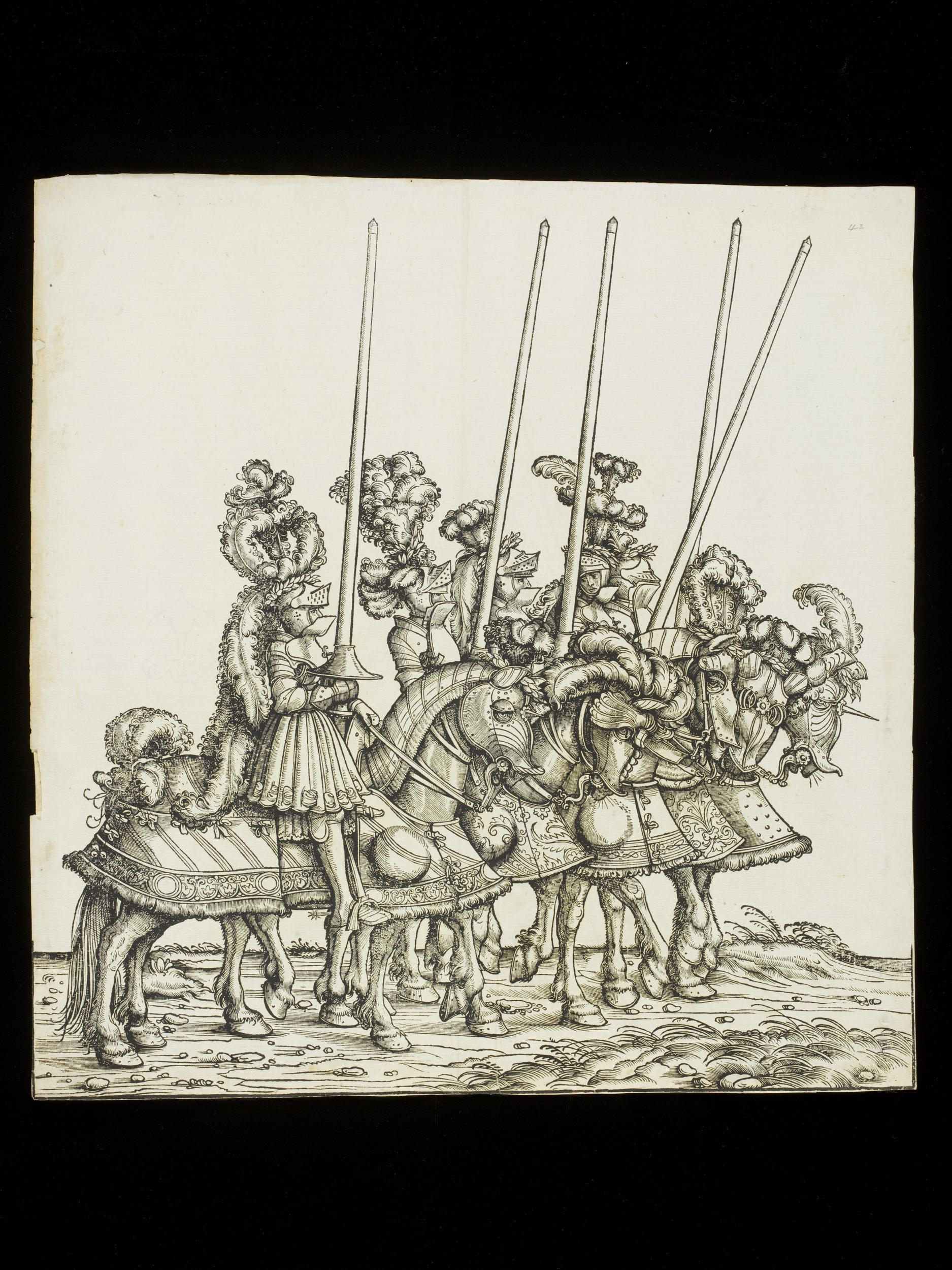
In the 13th century we see references to shaffronts and other plate armour for horses, though some of this is apparently made of leather (like the cuir brulee armour that 13th and early 14th century knights used to supplement their mail). However, unlike cuir brulee for men, which had a brief heyday as reinforcement for maille and then was often used as sporting equipment for tournaments, leather horse armour continues to be use for centuries more, perhaps more commonly than metal - it is hard to say. We can see it in art in the form of painted plates laced together that cover horses, looking very much like metal armour except for the laces (which wouldn't support steel). You can see this in The Triumph of Maximilian I from the early 16th century by Burgkmair and others.
Plate armour for horses develops alongside plate armour for men in the later 13th and 14th centuries. It is used in various combinations with fabric caparisons, leather bards and mail trappers. Over the decades we see chamfrons/shaffrons for the head, crinets for the neck, peytrals for the chest, croupers for the hindquarters and flanchards/flankers for the sides. Often these seem to be made of leather, but some are metal. In addition, just plate armour for the a man's chest might be a 'pair of plates' made of up smaller plates, we sees references to what are probably similar armours of smaller plates on the inside of a backing for horses, like 'trappers of plate'.
The Full metal bards for horses that we saw at the beginning of this answer don't seem to come into being until the 15th century, at least in common use, and even then it is hard to say how common they were, only that they became more common as the century drew on. Strickland and Hardy argued that plate barding might have been the key to the victory of the Italian men at arms over English archers at the battle of Verneuil in 1424 (making the horses extremely resistant to arrows, rather than very expensive pin cushions as they had been at previous, more famous English victories). In 15th Century Milan we see more and more horse armours produced by the cities plate armourers - by the end of the century, they are offering packaged deals for dozens of plate armours and matching bards. By the middle of the 15th century metal plates and leather are the dominant materials of horse armour, and we see both in art and in inventories. This takes us all the way up to the zenith of horse armour (and probably armour in general) in the early 16th century, before the nascent developments in early modern warfare shifted equipment away from full plate armour and barded warhorses.
And in that period, how common was the 'full' bard for horses? It is hard to say. Art seems to be all over the map in this, showing horse armour as either [ubiquitous](https://upload.wikimedia.org/wikipedia/commons/e/e0/Autor_nieznany_%28malarz_z_kr%C4%99gu_Lukasa_Cranacha_Starszego%29%2C_Bitwa_pod_Orsz%C4%85.jpg] or as entirely absent. There are artistic reasons for both - artists may prefer to display knights at their most perfectly and splendidly equipped and thus show bards on all the horses, or they might prefer the aesthetics of muscular horses straining in the charge, and thus never hide those magnificent beasts under armour. Moreover, it is sometimes hard to tell which horse armours are metal and which are leather when they are painted or covered in fabric, unless we can see the laces of leather armour. Documentary evidence, including the presence of bards in inventories and sometimes different rates of pay for men at arms with barded versus unbarded warhorses tell us that bards were indeed commonly seen and common enough to be important, but that they weren't universal. But this isn't enough to provide some kind of ratio of 'horses that were unarmoured/partially armoured/armoured in metal and leather/fully barded in metal' for any particular battle. We can speak of general trends - horse armour became more common and more complete over the course of the 15th century, and was at its most common and complete in the early 16th century.
Regarding practicality, the old saw (which is more than a little true) is that if armour didn't work they wouldn't have used it, and that when it stopped working it was discarded. This broadly fits with the history of horse armour - we see a gradual increase in the armour worn by horses, and then we see a reduction in the armour of horses as warfare changes in the middle decades of the 16th century, until all but neck and head armour is largely discarded at the century's end. This coincides with the move of cavalry away from the fully armoured man at arms toward lighter and more flexibile forms of cavalry in response to firearms, new infantry tactics and new cavalry tactics.
But beyond this very suggestive and rough sketch, there has been a great deal less written about horse armour's effectiveness than about armour for men - there are few studies of its thickness, or metallurgical quality, or destructive tests of how well various forms of horse armour stood up to various attacks. But what we can say is that men and horses were able to successfully use it in battle for hunrdreds of years.
![https://i.pinimg.com/originals/b6/3e/00/b63e00df1df8b25ecc48064705080c94.jpg]](https://i.pinimg.com/originals/b6/3e/00/b63e00df1df8b25ecc48064705080c94.jpg%5D)
![https://upload.wikimedia.org/wikipedia/commons/e/e0/Autor_nieznany_%28malarz_z_kr%C4%99gu_Lukasa_Cranacha_Starszego%29%2C_Bitwa_pod_Orsz%C4%85.jpg]](https://upload.wikimedia.org/wikipedia/commons/e/e0/Autor_nieznany_%28malarz_z_kr%C4%99gu_Lukasa_Cranacha_Starszego%29%2C_Bitwa_pod_Orsz%C4%85.jpg%5D)
