The quote is from Gwynne Dyer.
I get that the fighting was very fierce, but why didn't any other day of fighting come close to the death toll we see in Borodino (apparently) until the first day of the Somme? What was so exceptional about it?
It's not like they had machine-guns, or there was some massive rout where one side got massacred. The Russian army retreated more or less in order.
To begin, with the First Day on the Somme wasn't the deadliest day of the war. There were just over 19,000 British and Commonwealth dead on July 1st. By contrast, France lost 27,000 dead on August 22nd, 1914, and that was just one day of the Battle of the Frontiers. In the August 1914 Battle of the Frontiers, there were 400,000 casualties on both sides, followed by another 500,000 to 600,000 in the Battle of the Marne, fought over less than a week during early September 1914. In those cases, most of the dead were killed in attacks over open ground when they were hit by artillery. Machine guns and rifles also caused quite a few losses, but artillery was by far the biggest killer during 1914.
Getting into your question, Borodino itself gets extremely bloody because it's a very concentrated battle, and concentrated battles tend to be bloody ones. In a concentrated gunpowder-era battle like Borodino, thousands and thousands of men and horses smash into each other at very specific points and just grind each other into a pulp.
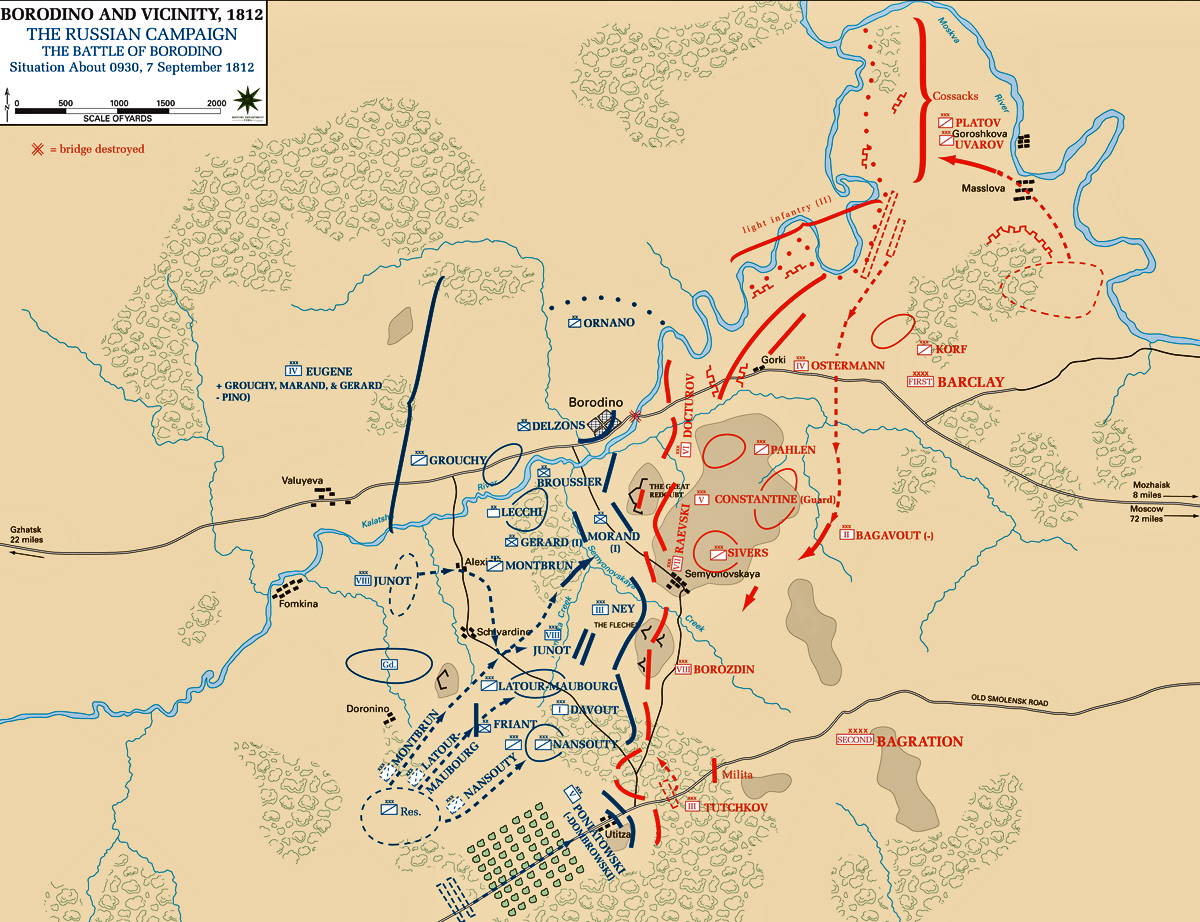
The Russians had made good use of the time ahead of the battle to build massive earthworks on the heights east of the small town of Borodino. If you look at a map of the situation at the height of the battle, you can see that the fighting became concentrated around the Great Redoubt (aka the Raevsky Redoubt) in the north and Bagration's flèches in the center of the Russian lines. These defenses became the battle's center of gravity and both sides threw thousands of men into the contest for the fortifications.
Concentrating the fighting in to relatively compact areas had several effects. One, it made artillery devastatingly effective. Advancing French columns got hammered by Russian shot, shell, and canister (although they could have been even more effective had they been positioned better). Russian reinforcements got clobbered by French artillery. Two, it made musketry far more effective, since firing into densely-packed formations or a confused melee made hitting someone much more likely. Three, it literally forced both sides together as pressure from men in the rear forced the men in the front into inescapable combat.
In the final assaults of the Great Redoubt, Napoleon even sent French and German cavalry to charge into the redoubt itself. Their attack succeeded, albeit with murderous losses.
"Fighting for the Bagration Flèches" by Aleksandr Yurievich Averyano
French heavy cavalry make the final assault on the Great Redoubt by Louis-François Lejeune
"The End of the Battle of Borodino" by Vasily Vereschagin - French cuirassiers cheer the capture of the Great Redoubt
Furthermore, the intentions of both armies make them commit fully to the battle. At this point, Napoleon is at the end of his logistical tether and he's been slowly losing men to attrition all the way into Russia. He wanted decisive battle that would smash the Russian army, open the way to Moscow, and win him the war. Kutuzov and his staff on the other hand, wanted to stop the French here and now. If they were pushed back at Borodino, it was very likely Moscow would fall. As a result, they wanted to destroy, or at least maul, Napoleon's army and force him to retreat from Russia. With so much at stake, both sides were willing to pour tens of thousands of men into attacks and counter-attacks, when in other cases they might have retreated and lived to fight another day.
French and allied (Napoleon had thousands of Germans, Italians, and Poles in his army) troops made four to six major attacks (depending on how you count) on the Bagration Flèches, along with three major attacks on the Great Redoubt. These were were matched by several major Russian counterattacks by infantry and cavalry, which were in turn counter-counter-attacked in several cases. On top of all this, there was bitter fighting elsewhere on the field that killed thousands and thousands of men.
By the height of the battle, 300 French guns and 200 Russian guns were engaged near the Great Redoubt. For comparison, Napoleon only had about 240 guns at Waterloo, and they were hampered by wet ground. At Borodino, the ground was dry, allowing cannonballs to skip through packed ranks of men like a murderous bowling ball. The carnage was just unimaginably awful...
Both sides also made tactical blunders that lead to higher casualties. For example, Russian formations were too deep in places, which made them a bigger target for French artillery. Future military theorist Karl von Clausewitz, who was at the battle as a staff officer on the Russian side was scathing in his critique of the bungled Russian deployments of infantry and artillery. Russian fortifications also had some critical weak points, which was one factor that allowed the French to get in and fight a bloody struggle when they otherwise been repulsed before coming to grips with the French.