Was it Hollywood? Was it Asterix?
It was common in the Middle Ages for Roman soldiers to be depicted wearing Medieval armor. But it seems to me that later artists started to develop an image of what a Roman soldier looked like, and many had a somewhat different idea from what we picture today: Example 1, Example 2.
When did this set (literally the first result in Google Images for "Roman Soldier") became the icon that it is today, so popular that it's even used in modern movies set in periods where legionaries should be wearing something else? (looking at you, The Eagle and The Last Legion)
I wouldn't blame Hollywood; older Hollywood Romans were all over the place, armour-wise: leather breastplates, funky helmets. The Roman soldiers in Life of Brian are fairly typical of movie-Romans: https://i.pinimg.com/originals/8a/92/03/8a92032e367280a3d1bac79f480aaba5.jpg (both in Hollywood and elsewhere).
While Asterix is visually accurate in some elements (as noted by u/the_aura_of_justice in https://www.reddit.com/r/AskHistorians/comments/1jrfp0/how_real_are_the_asterix_comics_historically/ from many years ago), it isn't really the kind of source people look at for accuracy.
I'd say that the main culprit is Trajan's column, with a wealth of depictions of Roman soldiers, with your modern stereotype prominent. The influence of Trajan's column spread a lot when modern books with photographs of the reliefs became available, and copies of the reliefs went into various museums (and in Rome, too, spread out where they can be easily seen by visitors). Sketches drawn from the Column were circulated earlier than that, but the modern books circulated widely.
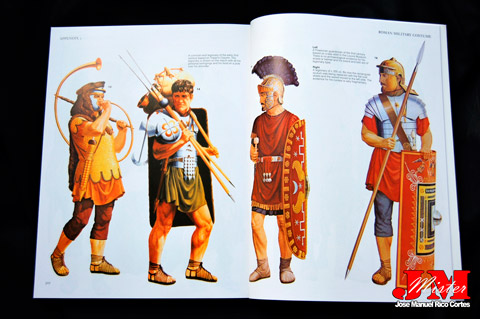
The growth of miniature wargaming in the 2nd half of the 20th century made many gamers interested in authentic Roman costume, and this encouraged books covering a broader range of armour etc. But there aren't that many wargamers. One influential book - not just a wargamer's book, but a popular history book - was Peter Connolly's Greece and Rome at War, originally published in 1981, brought a lot of accurate art of Roman soldiers into people's homes. However, due in part to the prominence of the depictions on Trajan's Column, the stereotypical Roman soldier commonly appeared on the covers of any such books (and he appears on the current reprint editions of Connolly).
Note: see the range of soldiers on the Ludovisi Battle sarcophagus:
If this artwork was as famous as Trajan's Column, our modern stereotype might look quite different.
The short answer is: Trajan’s column.
The long answer takes you down the rabbit hole of archaeological discovery and its use in re-enactment.
As a piece of propagandic sculpture, that simplifies the equipment, methods and military dominance of the Roman military under Trajan (arguably the height of the Roman Empire) in a way that makes the history of that war understandable to a visitor to Rome with minimal knowledge or background on how the roman military on the Danube was equipped or operated, Trajan’s Column has been incredibly successful. It creates simple rules to follow in understanding what you are seeing in the various dramatic scenes of Trajan’s Dacian Wars. From a cursory look there is a difference in equipment between the Legions, Auxillia and the Officers of both. Legionaries appear to almost exclusively be equipped in ‘Segmentata’, an armour made from strips of Iron held together with bronze hooks, hinges, and leather straps and ties.
Legionaries preparing for an assualt
The Auxillia are equipped almost exclusively in ‘Hamata’ or mail armour.
Auxillia presenting trophies to the Emperor
The Officers are generally wearing lighter armour, the Standard Bearers are equipped in mail.Whereas the full officers, generals and Emperor Trajan himself are wearing Subarmalis with Pteriges, a very light armour made of glued linen and leather, layered to create a kind of ancient stab-vest .
The Emperor rousing his troops
This differentiation in equipment makes it relatively easy for a passer-by to understand the important events. There is also a fair chance that the pillar was also brightly coloured to make this differentiation yet more clear. It would be easy to tell whether it was legion’s that fought one battle as compared to Auxillia and whether the Emperor had given a rousing speech and at what moments they had been blessed by the Gods.
Trajan’s Column as it may have been
If you were to follow Trajan’s column to every one of its clearest rules as a re-enactor, using archaeological finds to fit your assumptions from the monument you will generally end up looking like this:Legions:
Ermine Street Guard Legionary’s
Auxillia:
Ermine Street Guard Auxillia
The group I have shown is known as the Ermine Street Guard and they have, through a generation of hard work, set the standard in Roman Re-enactment within the UK if not globally, their image of the Roman army has appeared frequently in documentaries, films, school textbooks, and the image is heavily borrowed from in the films you mention. They were in many ways the first group to take Roman Re-enactment seriously having started out in 1972 at a local village fete. This was fortunately timed with the discovery of the Corbridge Hoard, an incredible find of what could be a legionary quartermasters complete set of spares, from spear heads and artillery bolts to 6 complete halves of Segmentata armour.
Corbridge hoard_composition
This allowed Russell Robinson an expert in oriental armour to reconstruct the segmentata that had been seen in Trajan’s column, known to exist but unknown in terms of construction, and finally to offer his technical drawings to the Ermine Street Guard as they were in the 70’s equipped in fibreglass armour. Peter Connolly then created fantastic pieces of artwork in his book Greece and Rome at War, as previously mentioned, he then remained president of the Ermine Street Guard until his death.
Peter Connoly ‘Greece and Rome at War’ sample page of late 1st Century legionary
I would agree that this book had an influence but it contains far more than just the classic First-Second Century Legionary, it details the Roman Army from pre-Marian reforms up until the end of the Western Empire. Providing ample supply of information and his own reconstructions to beat this stereotype.
The ‘Movie Roman’ of Sword and Sandal films is based on a slightly different heritage that you highlight in images you linked. During the enlightenment Roman artwork was copied without understanding some of the inaccuracies in the way Romans chose to show their own army. For example, the helmets of Trajan’s column are infamous, a helmet resembling the helmets of Trajan’s column has never been found in a Roman military context apart from a very few, very dodgy, antiques. But these types are still prevalent in movies up to the modern day. It is believed that the Roman sculptors chose to stylise actual Imperial-Gallic helmets to have thin cheek pieces and smaller neck guards in order to show the faces of the soldiers and make the job of carving them easier:
Trajan’s Column display stylised thin cheek pieces and missing neck guards-
Legionary Helmets Trajan’s Column
A real find ‘pseudo-attic’ helmet: Roman Cavalry, large cheek piece and small neck guard (neck guard probably undesirable to cavalry in the event of being unhorsed)-
Theilenhofen Cavalry Helmet
Another great influence on early modern art and sword and sandal films is the Praetorian Relief, which was heavily restored in relatively recent history, the heads of all 3 foreground figures and their lower portions have all been reconstructed:
‘Praetorian’ Relief
Rather clearly influencing costumes here in the 1963 film Cleopatra:
Mark Anthony Costume Cleoptra
And here in the 1785 piece ‘David Oath of the Horatii’
David oath of the horatii
The Hebron helmet, Imperial Italic G, Hadrianic and probably deposited during the Bar Kachba Revolt, one of the earliest helmets found with the cross bar reinforcements adapted during or shortly before the Dacian Wars, allowing it to be safely dated to an Early Second Century Helmet.
Hebron Helmet
As such you can see how the ‘real thing’ becomes adapted in art until you are left with two separate stereotypes.Longer answer....