I wrote a bit in this thread about the Eddas and what they are (and aren't) The key point here though is that they were not written down to preserve the old Norse religion but to preserve the literary tradition of skaldic poetry and the stories about the gods that the poetry was about and built on. So the mythology recorded by Snorri in the Eddas didn't necessarily have much cultic/ritual importance, even if that's another matter. They were the stories that were popular enough to have persisted into his day, in Iceland. (or which Snorri had come across in his trips to mainland Scandinavia) There's every reason to believe Snorri didn't include stories that were older, less spread, unknown to him for other reasons. (or -for all we know- he may have excluded stories he considered to lack literary value)
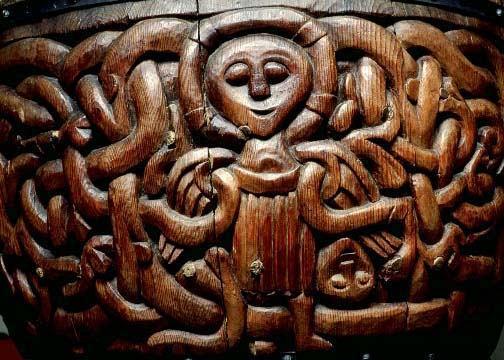
We have artifacts which bear witness to the enduring popularity of some of the stories; the baptismal fonts of Norum and Näs in Sweden, which are contemporary with Snorri (i.e. late 12th or early 13th century) both have imagery of Gunnar in the snake-pit from Völsunga Saga. At the same time, the fact that sacred Christian objects were made (and preserved) with this motif on them indicatest hat at at least that story was not perceived as having a particular 'pagan' significance. Another example of cultural continuity from the VIking Age on is the font of Alnö, dated to 1210-1220, which is artistically quite similar to the mid-10th century Harald Bluetooth's stone at Jelling. Neither of those artworks have entirely agreed-upon interpretations, although the intended audience probably did. So even in Snorri's own day we have Christian objects that we don't know how to interpret.
Going farther back and it become quite clear there were many very spread myths and ideas that we know nothing about. One example is the 'dancing warrior' motif that's found on a number of objects from the 6-8th century and found on artifacts ranging from Sweden in the east to England in the west. (and Germany in the south according to a 19th century article I read but don't quite trust) It's implausible a motif would be so consistent and widely spread without there being some story behind it.
The picture stones of the island of Gotland have many motifs that elude us. Take the Lärbro stone for instance. At the bottom we easily recognize a longship (which by the way are consistently depicted with sails made up of squares , not the stripes ubiquitous in present day viking imagery), a bit farther up you have a horse with 8 legs, so that's obviously Slepnir.
There's another horse with some interlocked triangle shapes beneath it. Now, various books, Wikipedia and the internet will assure you that this is a 'valknut' - a knot of the 'valr', or 'knot of the slain [on the battlefield]'. Which is a term that simply doesn't exist in any Norse sources, much less in reference to that particular symbol. (and even if the term existed, absent an etymology of the term it's ambiguous and could mean anything from 'Gallic knot' to 'knot of choice') Anyway, bad news for people with those things as tattoos but the more interesting thing to me is the sword-carrying men following the horse carrying rings in what looks like a kind of procession. What does it represent? Again, we don't know. It could be an image from a lost story. It could also represent an actual ritual procession. So-called amulet rings are a common find at Norse cult sites, but we have no idea how they were used other than that they were probably hung up on wooden posts at the sites. At the top there is a battle scene, but it's again unclear what the details reference, if anything.
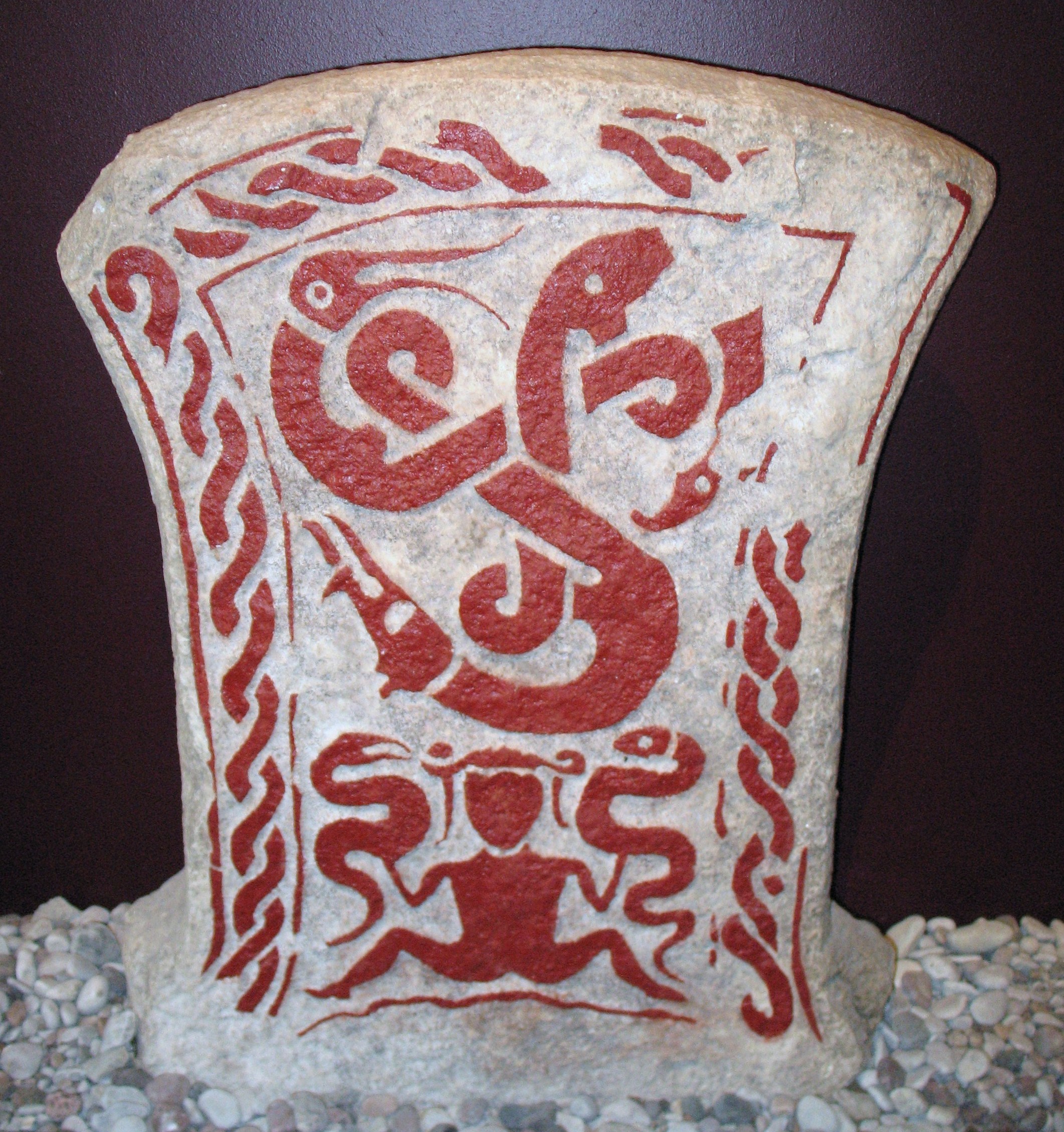
Another Gotland image stone has a myth we know of, but not from Snorri's Eddas, it's the three intertwined snakes from the dream of Hwitastierna in the Gutasaga (Saga of the Gotlanders) and is a local origin myth. Here it's not hard o explain the absence; Snorri was probably unaware of the local legends of that area, Gotland being in many ways culturally distinctive from mainland Scandinavia.
Another thing worth noting here is that Norse artifacts tend to be interpreted through the lens of the Eddas and Sagas and that this risks us believing we know more than we actually do. Just because an interpretation is popular doesn't mean it's certain. For instance, in the case of the above objects with Gunnar and the snakes, there are details such as his hands being bound which allow us to identify the myth. But it's not hard to imagine that if the stories of the Völsungs hadn't been preserved, people wouldn't revert "we don't know" but rather claim just as confidently that it's the sagas' other snake-pit death, Ragnar Lodbrok, since that would be the only one we knew about.
(on the Alnö font and its dating, see Leif Grundberg, Medeltid i Centrum, 2007)