In the song "SS marschiert in Feindesland" (a marching song from the SS) there are multiple lines like:
SS marschiert in Feindesland und singt ein Teufelslied (SS marches in the enemies land and sings the devils song)
Und der Teufel, der lacht nur dazu ha, ha, ha, ha, ha, ha (And the devil laughs like ha, ha, ha, ha, ha, ha)
There are also other things like their skull rings that seem to indicate that they know they are the bad guys. Now I'm wondering, wouldn't they want to see themselves more as some kind of heroes (Not trying to imply they were at all, just trying to think from their perspective)? Wouldn't it make more sense to say god is on their side? How could a group that obviously sings about being evil attract so many people and justify what they were doing?
Modified from an earlier answer of mine
In this case and others, the SS was not aligning itself with the forces of darkness. There was a long tradition in German martial culture to connect the fighting spirit of the men to supernatural forces. It is advisable not to read this as explicitly Satanic. Many militaries employ much the same language and rhetoric; cherubs do not inspire fear or signal badassery. Some Waffen-SS belt buckles had the phrase Gott mit uns/God is With Us like their fellows in the Heer. The Waffen-SS tended to be very light compared to its Heer counterparts in having Christian chaplains attached to their units, but this was part of the larger antipathy of the SS towards organized Christianity and the political power of the German churches rather than something explicitly evil. Much the same can be said of the SS's uses of skulls in its iconography. The use of the skull had a long pedigree in German martial culture and the SS sought to co-opt this tradition.
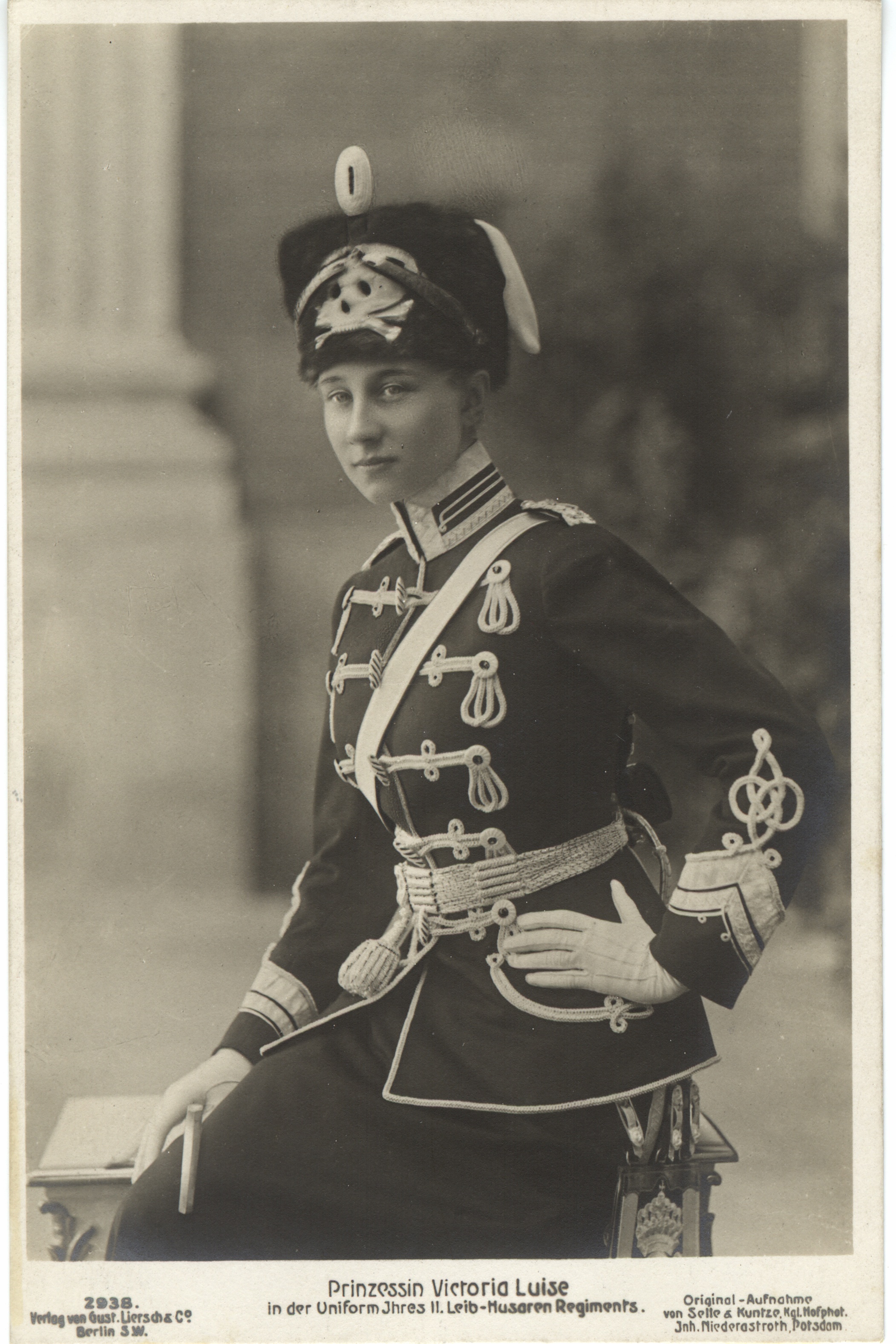
Although the SS's use of the skull and crossbones suggests they were the baddies, the emblem and its attending black uniform had a long heritage in German military history that the SS sought to co-opt. The symbol originated in the armies of Frederick the Great and a unit of Hussars, but it gained wider notoriety during the Napoleonic Wars. Napoleon had dissolved the Duchy of Brunswick and absorbed into the Kingdom of Westphalia. The duchy's dispossessed Duke, Friedrich Wilhelm, raised a regiment and offered his service to the opponents of Napoleon. The "Black Brunswickers" had as their uniform colors stark black (some also wore green) and emblazoned their shakos with a white metal Totenkopf. The regiment served both in Austria in 1809, the Peninsular War, and in the Hundred Days where Friedrich Wilhelm died at Quatre-Bras. The activities of the Black Brunswickers as well as their stark uniforms became potent symbols for the romanticization of the Napoleonic Wars, such as Milias's famous 1860 The Black Brunswicker and Friedrich Matthäis's Tod des Schwarzen Herzogs. A regiment of the Brunswickers survived the Napoleonic period and was incorporated into the Prussian army after unification. Their emblems and battle honors remained an important part of their traditions, as seen in this photo of the Hohenzollern Princess Victoria Louise in a tailored uniform of the regiment which functioned as a life guard regiment for the imperial house.
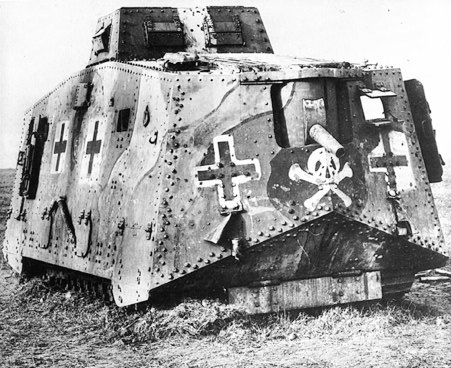
The skull and crossbones became an unofficial emblem for various German units during WWI, such as their embryonic tank corps and their badges. The Totenkopf underwent a further iteration under Weimar where it was adapted as an emblem for some of the Freikorps, such as in this photo and later used by some of the panzer troops after Hitler's seizure of power as they saw themselves as the heirs to the Hussar tradition. Some aircraft in the Condor Legion used the emblem in the Spanish Civil War. The Luftwaffe's KG 54 bomber wing used the Totenkpf, such as in this photo of a Ju 88. The SS modified the Totenkopf design, making it more angled and squat, to differentiate themselves from earlier and contemporary versions.
The emblem by the SS covered two major bases. Firstly, it set itself up as an elite that was personally charged to safeguard the leader of Germany. A Totenkopf was a clear symbol of this as it was a recognized heraldic device that conveyed this message. The Black Brunswickers held themselves as an elite unit, and this was an image the SS cultivated as well. Secondly, the Totenkopf was laden both with contemporary and historical meaning that the SS desperately wanted to connect with. The Black Brunswickers were a formation that wanted to overthrow foreign domination of Germany, and this was a tradition that meshed well with the rhetoric emanating from the NSDAP about the Weimar period. Like many National Socialist organizations, the SS sought to portray itself as the culmination of German history and its true heirs. The irony is that the SS were arguably so successful in co-opting the Totenkopf that SS's use of this symbol overshadows its use in earlier periods German history.