I recently learned that Celtic helmets had much more apotropaic finials of animals on their tops compared to helmets in the High and Late Middle Ages. I think that's because polearms in these later periods could hook these finials. But then I wondered if the Celts had long axes like the Norse or anything like the axes of the High and Late Middle Ages. I couldn't find a paper specifically about this on Google. Does anyone know if Celts had long battle axes? I'm sure they had small wood-cutting axes or similar tools, but battle axes? Are the CGI and cartoon "Celtic" axes on the the first page of Google images just fantasy weapons?
During which time period in particular?
Gaelic Irish used hand axes since prehistoric times as evidenced by the archaeological record (Wilde's Catalogue), and later adopted the Norse battle-axe during the Gallowglass era. During much of earlier recorded Gaelic history, they seemed to mostly use spears, javelins, swords, and daggers. I am not aware of overt evidence of longer polearm battle-axes being in use until later introduction and more heavily armoured opponents threatened.
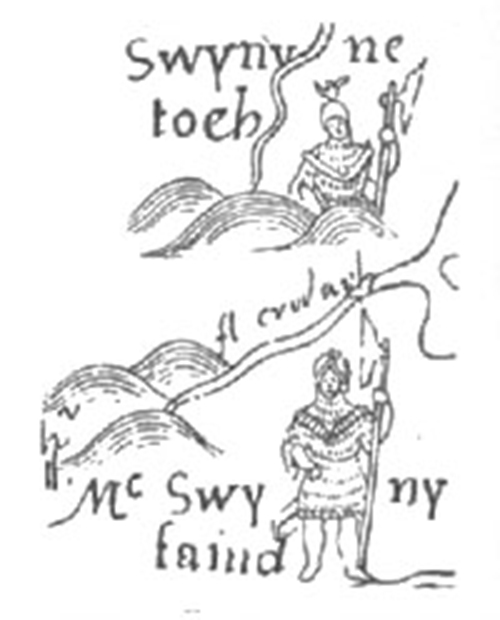
Giraldus Cambrensis also mentions use of a narrower battle-axe called a sparra or sparth, as can been seen in woodcuts from the time period (approx early 12thC): https://www.libraryireland.com/SocialHistoryAncientIreland/images/25z.jpg
No, the Vikings introduced the axe as a weapon to Ireland, so you're looking at the 9th century onwards. Prior they were only considered as tools, and the Gaels mostly fought with spear. The concept of the battle axe was however adopted readily, and within a century or so it was an extremely common weapon among the Gaelic Irish. There's precious little really written about weaponry in early medieval Ireland (at least from a historical viewpoint; I'm a historian rather than archaeologist by training), but if you're interested in the subject I would recommend Bartlett's Military History of Ireland. J. P. Mallory also has something on the subject in In Search of the Irish Dreamtime, and he's quite accessible even to a layperson. This was a website put together by a group associated with my university, it's concise but a useful primer on weaponry in early medieval Ireland: https://dh.tcd.ie/clontarf/Weaponry%3A%20How%20to%20Kill%20your%20Enemy%20and%20Defend%20yourself%20in%20Viking-Age%20Ireland
If you've any further questions don't hesitate to ask! I can try my best to help.
The period about which you're asking is the Iron Age, which in Ireland runs from roughly 800 BC to AD 400. It was believed until relatively recently by archaeologists that 'Celtic' people from the continent invaded Britain and Ireland during this time bringing their culture and art. However, leaving aside the existence or not of a 'Celtic' race or group or ethnicity anywhere in Europe at this time we can say with some certainty that neither Britain nor Ireland saw a large incoming movement of people from continental Europe. /endrant
Weaponry from Ireland at this time is known almost exclusively from finds in wet places such as rivers and bogs. In terms of polearms we only have spears such as those from lisnacrogher. Swords and spears from this period are often found in the same stretches of river and the same areas of bogs and or lakes. This treatment is thought to have been religious or ritual in nature and the fact that we dont tend to find axes in similar contexts alongside these other weapons would indicate that axes didnt have the same 'aura' around them that weapons created specifically for battle like swords and spears did. While axes obviously existed and its possible or even likely that people in Iron age Europe used them as weapons if they lacked the status or resources to arm themselves with a sword or spear, these would not have been dedicated battle axes like those we find in later periods and as such lacked the specialness of the sword or spear
A really readable resource for this period in Ireland would be Raftery's Pagan celtic Ireland (to match your title) from 1994, it covers key concepts but lacks a lot due to having been written before a lot of evidence was uncovered by the massive amounts of archaeological excavation in the late 90's and pre-crash 2000's