The history channel says a sharp shooter killed him, do we know who specifically?
1/2
No, we don't know who killed him. There were many instances in warfare of the time that generals or obviously visible leaders were killed, and it was seldom that any one man would come forward and claim credit for the shot. It's unlikely that anyone could possibly know if it was their shot in the chaos of battle, but even so the desire to claim credit for the killing of high-ranking enemies did not seem to be a strong desire. At the very least, it wasn't much remembered, with a notable exception, explained below.
Let's consult a brief list of officers of rank killed around this period.
General James Wolfe, at the Battle of Quebec in 1759.
General Richard Montgomery, at the Battle of Quebec in 1775.
Admiral Horatio Nelson, at the Battle of Trafalgar in 1805.
General Isaac Brock, at the Battle of Queenston Heights in 1812.
This is an incomplete list, more for example and comparison than thoroughness. But let's go through it.
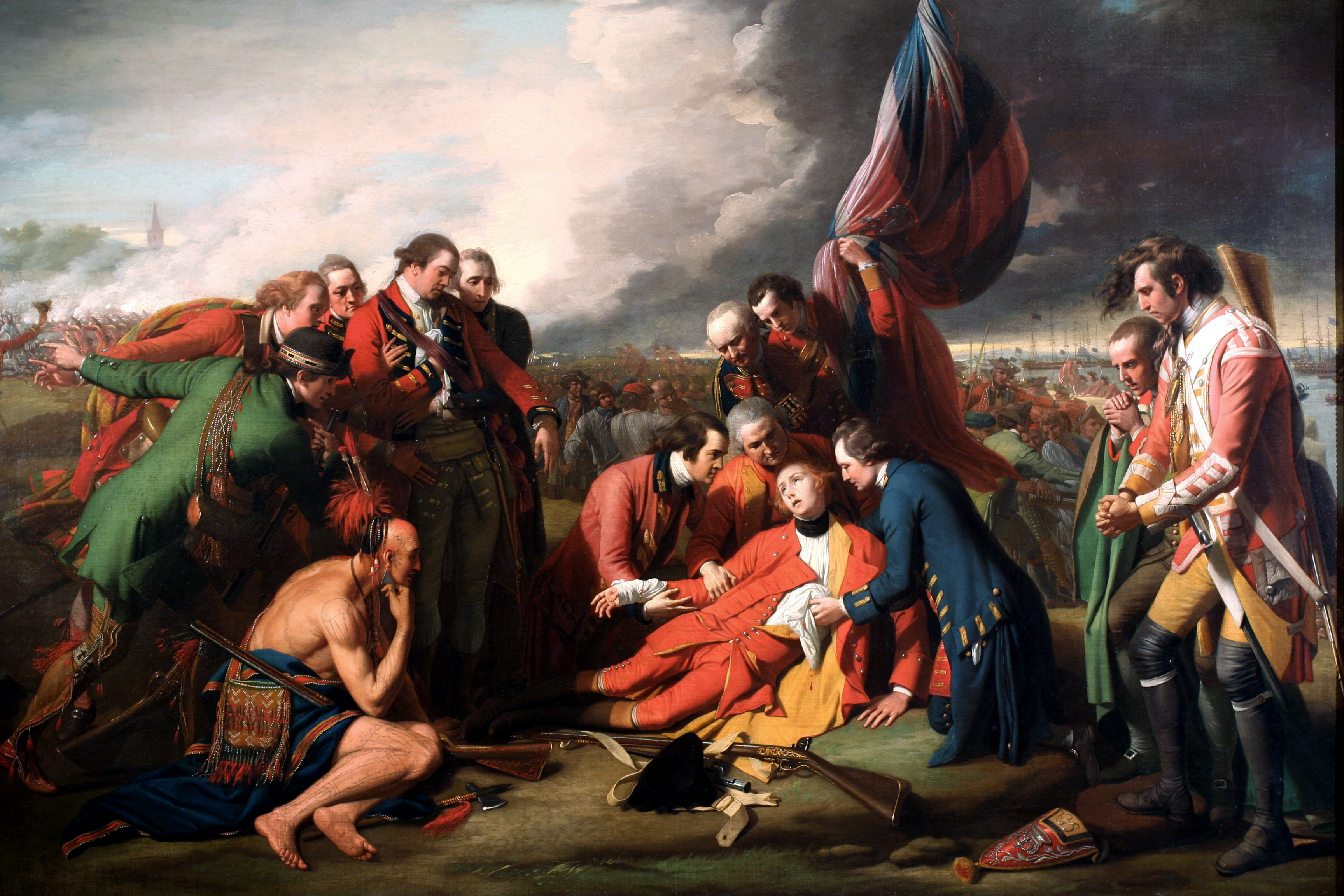
Wolfe was killed while leading a counter-charge after the right flank of the British advance was broken. The description of his wounds is as follows:
At the English right, though the attacking column was broken to pieces, a fire was still kept up, chiefly, it seems, by sharpshooters from the bushes and cornfields where they had lain for an hour or more. Here Wolfe himself led the charge, at the head of the Louisbourg grenadiers. A shot shattered his wrist. He wrapped his handkerchief around it and kept on. Another shot struck him, and he still advanced, when a third lodged in his breast. He staggered, and sat on the ground.
After being dragged back to the rear, Wolfe had time to hear that the French were fleeing in disarray:
Then, turning on his side, he murmured, "Now, God be praised, I will die in peace!" and in a few moments his gallant soul had fled.
The description above is from Montcalm and Wolfe, Francis Pakman's somewhat purple retelling of the French and Indian War and the relationship between the two opposing commanders. In all the excess of the description of Wolfe's rhetorically heroic death, not a word is spared for the man (or men, as it is doubtful that one man shot him three times) who may have shot him.
Montgomery's death was no less dramatic, and no less overwrought in memory. John Trumbull's justifiably famous painting of the scene puts Montgomery's death as equal to that of Wolfe, down to a strikingly similar style and composition to that of Wolfe's death, painted by Benjamin West. Rufus Wilmot Griswold, a biographer of American generals of the War for Independence, makes this connection in memory between Wolfe and Montgomery that he starts his chapter on the latter by recalling "the Plains of Abraham" and "the storming of Quebec" in the first sentence.
Moving right along to Montgomery's fate, Griswold gives us an equally florid account:
On the 31st of December, 1775, the movement of troops commenced before daylight upon the Plains of Abraham. Montgomery advanced at the head of his division... the dauntless band pushed forward, and carried the first barrier with a vigorous assault.
A moment, but a moment of pause, to reassure his self-exhausted troops, and the gallant Montgomery waved his sword, onward: "Men of New York, follow where your general leads!" and he pressed toward the second barrier, cheering his men, and performing prodigies of valour.
There is a rush -a deathlike pause - a merging to and fro of armed men - the plume of the gallant leader sweeps the snow of the battle-field. The Cold December sun came forth and looked upon that red waste, and the gallant Montgomery, dead, pierced with three wounds.
Dead on the doorstep of Quebec, dying a hero at the head of his men, even an equal number of wounds (though Montgomery, described in better detail elsewhere, was the victim of a close-range discharge of canister shot from a cannon). Unlike Wolfe, Montgomery died before he was aware that
Quebec and the Canadas are still the property of the foe.
Again, not a word offered for the man who lit the fuse. I have heard an anecdote (in a source I no longer have handy, sadly) about a drunk, retreating Briton who did not want to claim that he didn't fire a shot in defense of Quebec. Still, even that example represents Montgomery's killer as a faceless soldier with projected motivations.
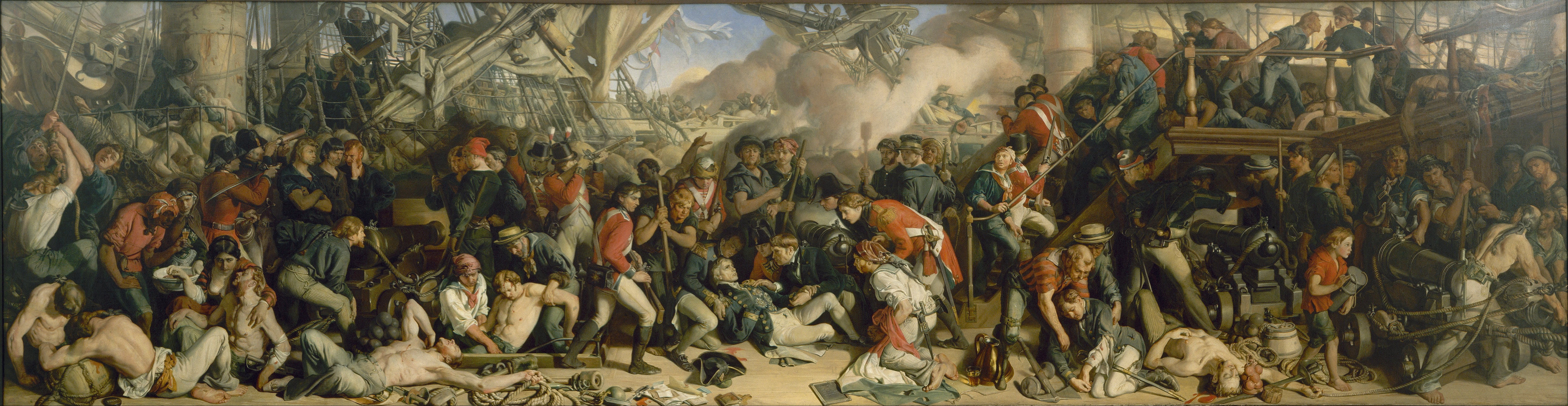
Nelson, of course, is also immortalized by many paintings.
Nelson's death was as dramatic as anyone could ask for, and an early biographer gives the following account of Nelson taking his initial wound:
It was from this ship (the Redoutable) that Lord NELSON received his mortal wound. About fifteen minutes past one o'clock, which was in the heat of the engagement, he was walking the middle of the quarter-deck with Captain HARDY, and in the act of turning near the hatchway with his face towards the stern of the Victory, when the fatal ball was fired from the Enemy's mizen-top; which, from the situation of the two ships (lying on board of each other), was brought just abaft, and rather below, the Victory's main-yard, and of course not more than fifteen yards distant from that part of the deck where His LORDSHIP stood. The ball struck the epaulette on his left shoulder, and penetrated his chest. He fell with his face on the deck. Captain HARDY, who was on his right (the side furthest from the Enemy) and advanced some steps before His LORDSHIP, on turning round, saw the Serjeant Major (SECKER) of Marines with two Seamen raising him from the deck; where he had fallen on the same spot on which, a little before, his Secretary had breathed his last, with whose blood His LORDSHIP's clothes were much soiled. Captain HARDY expressed a hope that he was not severely wounded; to which the gallant Chief replied: "They have done for me at last, HARDY."—"I hope not," answered Captain HARDY. "Yes," replied His LORDSHIP; "my backbone is shot through."
An astonishing amount of specific detail about the relative position of the ships, the trajectory of the ball, even the gallant wounds suffered by the admiral's clothing, and nothing said about whoever may have fired it. The enemy fired it, of course, and that was enough. The description continues, as rather than dying on the spot, Nelson lasts for quite a while as doctors and surgeons and officers and crew desperate to catch a glimpse of the man come and go from his quarters. After spending several more equally dense paragraphs describing Nelson's failing strength:
HIS LORDSHIP became speechless in about fifteen minutes after Captain HARDY left him. Doctor SCOTT and Mr. BURKE, who had all along sustained the bed under his shoulders (which raised him in nearly a semi-recumbent posture, the only one that was supportable to him), forbore to disturb him by speaking to him; and when he had remained speechless about five minutes, HIS LORDSHIP'S Steward went to the Surgeon, who had been a short time occupied with the wounded in another part of the cockpit, and stated his apprehensions that HIS LORDSHIP was dying. The Surgeon immediately repaired to him, and found him on the verge of dissolution. He knelt down by his side, and took up his hand; which was cold, and the pulse gone from the wrist. On the Surgeon's feeling his forehead, which was likewise cold, HIS LORDSHIP opened his eyes, looked up, and shut them again. The Surgeon again left him, and returned to the wounded who required his assistance; but was not absent five minutes before the Steward announced to him that "he believed HIS LORDSHIP had expired." The Surgeon returned, and found that the report was but too well founded: HIS LORDSHIP had breathed his last, at thirty minutes past four o'clock; at which period Doctor SCOTT was in the act of rubbing HIS LORDSHIP'S breast, and Mr. BURKE supporting the bed under his shoulders,[17]
Thus died this matchless Hero, after performing, in a short but brilliant and well-filled life, a series of naval exploits unexampled in any age of the world. None of the sons of Fame ever possessed greater zeal to promote the honour and interest of his King and Country; none ever served them with more devotedness and glory, or with more successful and important results. His character will for ever cast a lustre over the annals of this nation, to whose enemies his very name was a terror. In the battle off CAPE ST. VINCENT, though then in the subordinate station of a Captain, his unprecedented personal prowess will long be recorded with admiration among his profession. The shores of ABOUKIR and COPENHAGEN subsequently witnessed those stupendous achievements which struck the whole civilized world with astonishment. Still these were only preludes to the BATTLE OF TRAFALGAR: in which he shone with a majesty of dignity as far surpassing even his own former renown, as that renown had already exceeded every thing else to be found in the pages of naval history; the transcendantly brightest star in a galaxy of heroes. His splendid example will operate as an everlasting impulse to the enterprising genius of the British Navy.