I don't want to say "dark ages," but a book I was reading claimed that the denarius (penny, pfennig, etc.) was the standard unit of currency in circulation, and that gold coinages had disappeared. Is this accurate, or (as I suspect) is the situation more complicated?
Gold coins did not disappear after the fall of the Western Roman Empire. As long as there was gold around, kings made gold coins. For most of the 'Dark Ages' the standard gold coin was the tramissis, a gold coin of standard weight which was used across early medieval Europe. It was based on a late-Roman coin of the same name. It was unlikely that most people would ever handle many of these gold coins, as they were mostly used for expensive transactions and most people just didn't have that kind of wealth, but they were nevertheless the literal gold standard against which the other currencies (pennies etc.) were pegged and an integral part of post-Roman coinage.
Here is a Visigothic gold coin from around 570 AD. The Visigoths minted gold coins pretty much constantly from their conquest of Spain to the Islamic Conquest. To begin with they used Roman designs, but eventually used their own.
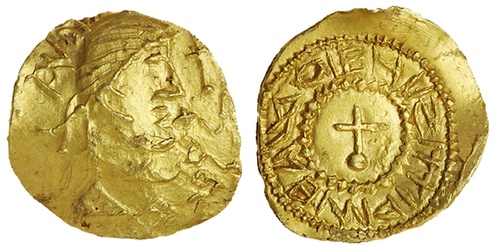
Here is an Anglo-Saxon gold coin from the reign of King Eadbald of Kent (c.630s AD). Anglo-Saxons certainly made fewer gold coins than their Visigothic counterparts, but they did make them.
Here is a gold Frankish coin from the 6th century.
I'm really not sure where the idea that gold coins disappeared comes from, because it's just not true. There are plenty of gold coins from the 6th century produced by a variety of kingdoms, most of which conform to the standards of the late-Roman tramissis. What did largely disappear was the solidus, a bigger and heavier version of the tramissis, because there was just no need for it in the rather poor kingdoms of early medieval Europe, though it continued in the Byzantine Empire until around 1090.