To preface this question I want to give some context, I am a soldier in the US ARMY and recently I have been watching World War II in Color on Netflix and I noticed that most, if not all of the countries showcased in the series are wearing similar uniforms, the German, US, Japan etc. I can understand why duty uniforms might look similar, necessary kit like helmets, ammo pouches and so on are worn by everyone because in war these things are necessary, But why are the things like the dress uniforms for the Navy so similar with medals and so on placed on the same side with the same hash marks and stripes on the sleeve and the same neckerchiefs on, I'm not sure if it's so other countries will be able to recognize who is a higher value Target and more easily be able to recognize people of other ranks and so on.
To sum up my question, why do different countries in different parts of the world all wear similar uniforms in the military, both historically and today.
1: Adopting the insignia of other nations - The rank insignia used by the U.S. goes back to the 18th and 19th century.
The chevrons worn by NCOs today go back to the 1700s and 1800s. The same goes for the hash marks/service stripes worn on American dress uniforms and service uniforms.
In 1777, French soldiers began wearing a small, point-up chevron on their coat sleeves to slow length of service. This was also a British practice around the same time, and the practice eventually spread to the young United States. In 1782, Washington allowed men with three years of service with "bravery, fidelity, and good conduct" to wear a "narrow piece of white cloth, of angular form" on the left sleeve of their coats.
In 1802-1803, the British made NCOs wear a point-down chevron on their uniform coats to indicate rank. Prior to that, Corporals had indicated their rank with a shoulder knot or a single simple epaulette. Sergeants worse sashes and sometimes carried weapons like spontoons as badges of their rank.
The practice of using chevrons in this way was also commonplace in other European militaries of the early 1800s, and the Americans soon picked up on it.
From 1820 onwards, U.S. Army officers and NCOs wore rank chevrons. Captains wore one gold or silver chevron above the elbow. Lieutenants wore their below the elbow. Different branches of the Army had different colors
Sergeant Majors wore a braid chevron above the elbow, while Sergeants wore braid chevrons below the elbow and Corporals wore one on right sleeve above their elbow. In 1833, this all stopped -- officers went back to wearing epaulettes. We see the beginning of the modern NCO rank convention in the Dragoons -- dragoons Sergeants wore three chevrons and Corporals ore two. Other NCOs wore epualettes to indicate rank. Then, in 1851, all NCOs start wearing point down chevrons on their sleeves, which are later moved to face point up in 1902.
2: Adopting the uniforms of other nations - Countries often borrow from the military fashion of the most dominant or admired military powers of the era.
In the mid-1700s and 1800s, many nations copied the dashing uniforms of the Hungarian hussars -- you can see an example of French hussars from the early 1800s, and simpler variations of this uniform were worn up until WWII this 1910 photo of a German trooper from the 10th (Magdeburg) Hussars shows.
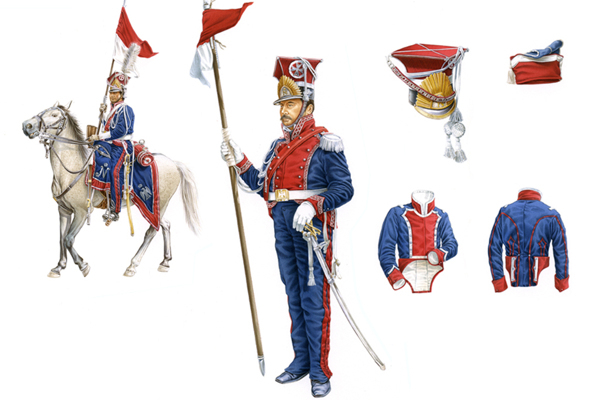
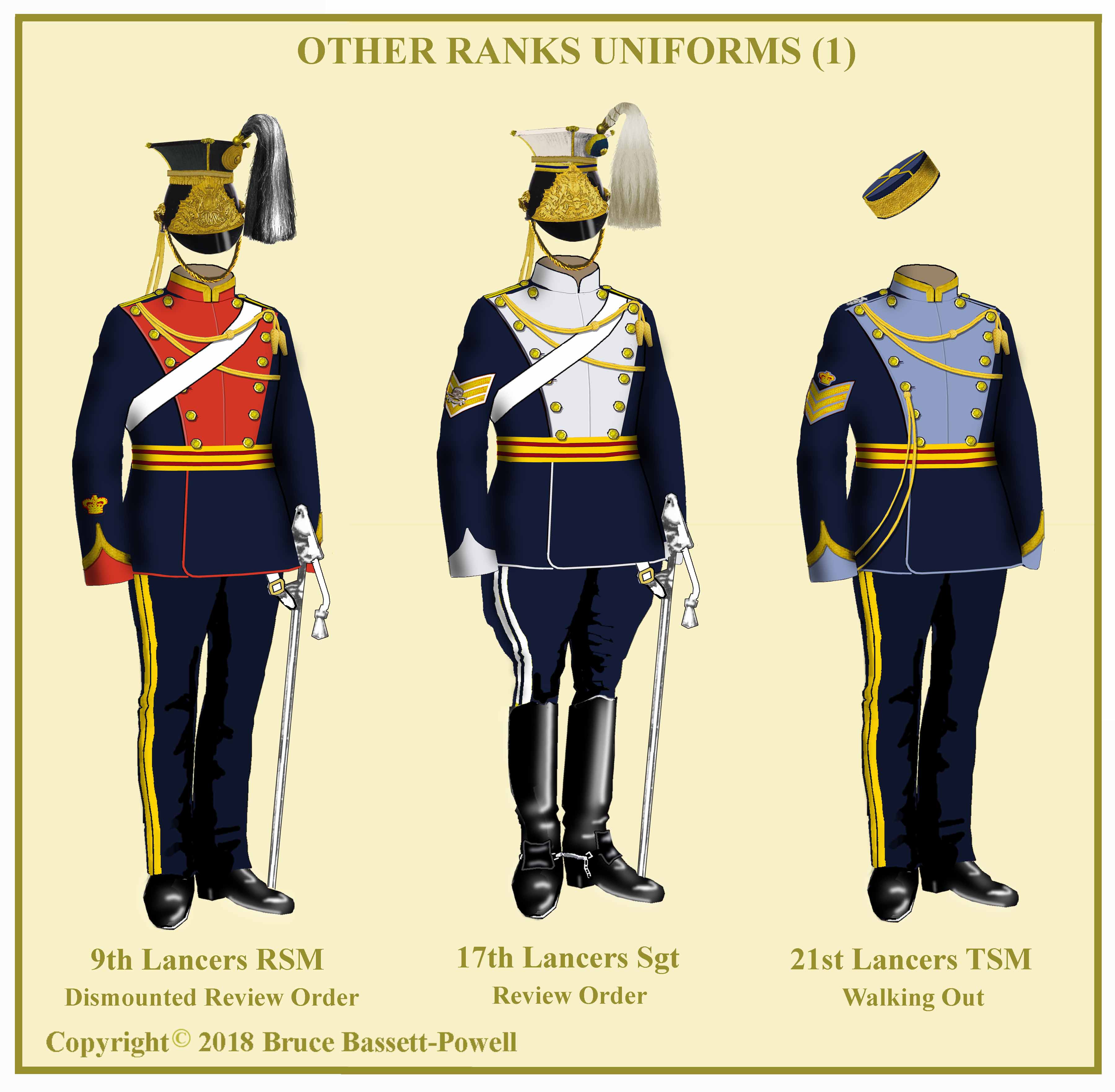
The success of Polish lancers in the Napoleonic Wars inspired other nations to adopt the lancer concept and the lancer's uniforms. Variants of the Pole's distinctive Czapka cap were worn by many European lancers like the Prussian uhlans, the Russian Life Guard Lancers, the British 16th Lancers and 17th Lancers, and many others.
You can see immediate similarities between the uniforms of these Polish lancers serving in Napoleon's Imperial Guard and the uniforms of the British 17th Lancers (the British didn't wear the Czapka as part of their daily dress, but only on parade and occasionally on campaign). The broad-front uniform, the cut of the trousers, etc. are all very much the same.
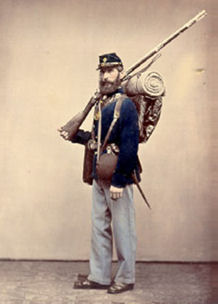
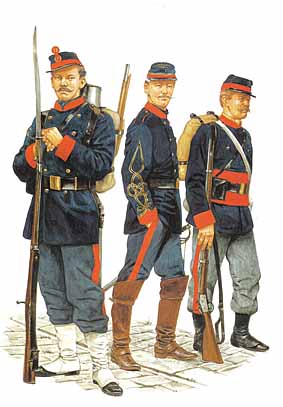
In the 1860s, France was the dominant military power in Europe. French tactics, military fashions, artillery, and much more were being imitated by other nations. You can see obvious similarities between this Union soldier from the Civil War and these French soldiers from around the same time period. The kepi you see the soldiers wearing on their heads was a French fashion trend the Americans had picked up on.
The American Civil War saw other French fashions being adopted. Some soldiers on both sides were dressed in elaborate "Zouave" uniforms, based on the North African-inspired uniforms worn by some elite French light infantry, the the Zouaves.
Colonel Elmer Ellsworth had brought the Zouave craze to America with his pre-war drill team, the Zouave Cadets of Chicago. When war started, he raised one of America's first Zouave regiments, the 11th New York Volunteer Infantry Regiment. They were better known as the "Fire Zouaves since Ellsworth had recruited heavily from the rambunctious firemen of New York City's volunteer fire companies
After France's defeat in the 1870-1871 Franco-Prussian War, French fashions fell out of favor and the military fashions of the victorious Germans became all the rage. Some American soldiers even wore spiked German-style helmets as part of their dress uniforms!
3: Civilian fashions - military fashions have long followed civilian fashions. In the 1700s, for example, military uniforms were cut in a very similar style to civilian clothes. The same goes for military uniforms in the modern era. The dress and service uniforms of the U.S. Army today are similar to business suits in many respects. So as civilian fashions around the world have evolved, the uniforms worn by soldiers around the world also changed to match it.