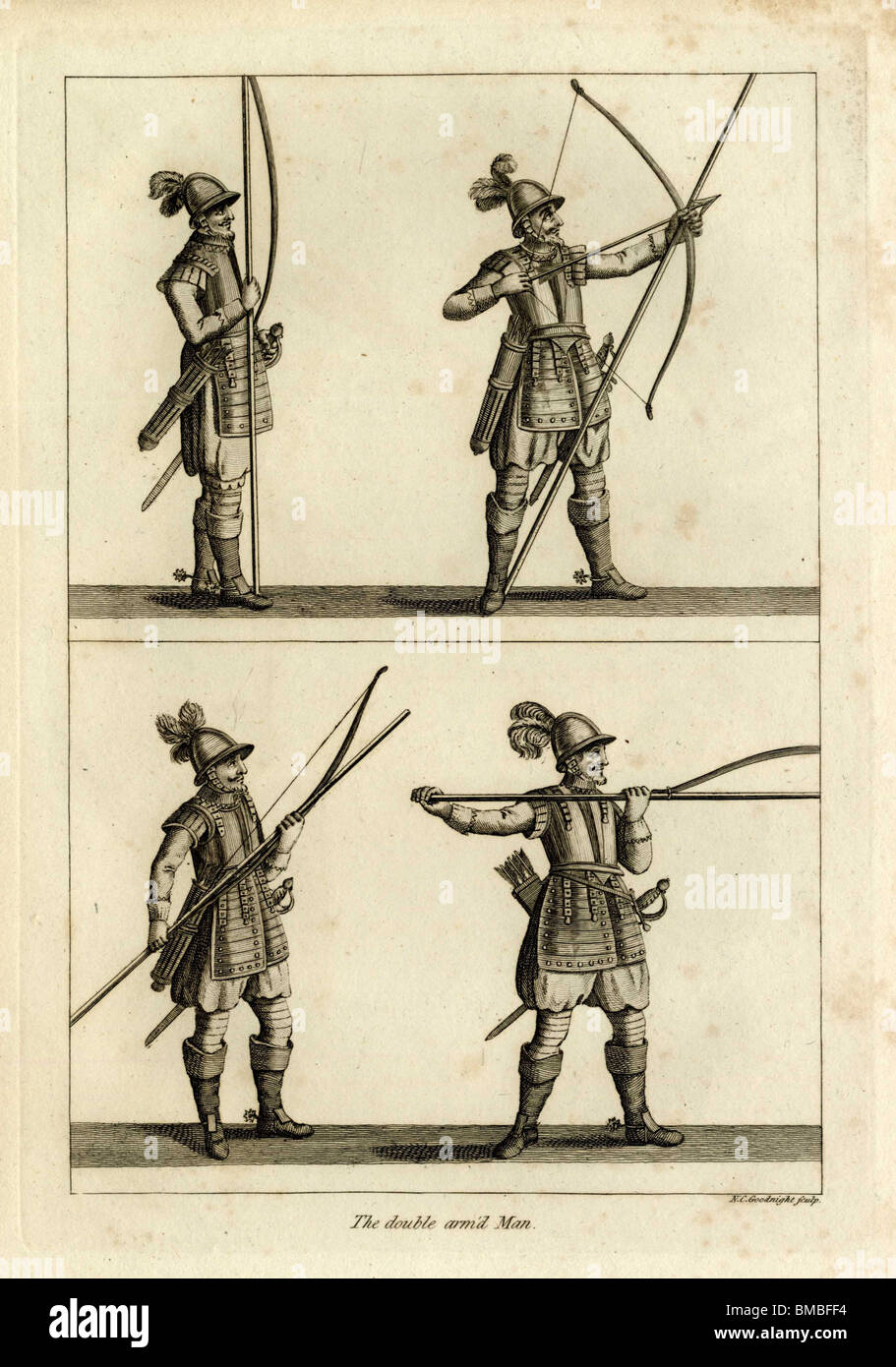
Others have linked to discussions on the shock value of firearms, but I specialize in Tudor and Stuart England, and can speak to the role of heavy armor during the time of transition from arrows to muskets in that respect. Heavy armor actually did stand a very good chance at stopping musket fire, particularly pistol fire. It was common to "proof" a suit by firing a musket ball at the breastplate point-blank. The reality was that heavy armor was anything but obsolete, rather it was proving to be more useful than ever before, yet it still beat a hasty retreat from the battlefield. The change we see here is not so much the result of evolving weaponry, but more so the changing role of those who fought the battles.
There's a bit of a misconception in your question, that infantry had access to heavy armor. Heavy armor was not ubiquitous in early modern combat. Full suits of armor were exceptionally expensive, and required a skilled craftsman to custom-fit the armor to the individual. The nobles clad head-to-toe in shining armor were the wealthiest members of their societies, and wore their armor as both a status symbol and as a means of protection. You may be aware of a few videos online of people in full metal armor jumping around and being rather agile. This is the armor as a medieval knight, not the armor of someone fighting in the days of muskets. Armor ca. the English Civil War could weigh 80 lbs easy. The wealthy men of status that could afford this armor made up heavy cavalry units called Cuirassiers, and played only minor roles in the English Civil War past the first year or so. Not because they weren't effective on the battlefield, but because of the increasing danger they found themselves in. With the widespread use of cannon, prolonged sieges became less practical for defenders as their defenses could be blown away well before the enemy might be hit by supply shortages or disease. This led to more proper battles on open terrain, in which there was a very real chance of a wealthy nobleman being killed, despite their superior protection. The consequences of this being that the men who made up the heavy cavalry outsourced their role to retunines and plied them with cheaper armor, and/or took on more ceremonial roles like guarding the commanders on either side of the battle.
The infantry could never have hoped to afford any sort of heavy armor. It was a luxury reserved for the wealthy and their choicest of men. The best they could hope for in this time was a thick leather buff coat that did well against swords and pikes, but next to nothing against musket balls.
So why no arrows? As I mentioned before, a combination of cost and hazard forced the few men who could afford heavy armor off the battlefield rather early on. Light cavalry of the time continued to wear chest armor which could also stop a musket, but this too would eventually prove too costly. Infantry never had access to anything that could protect against musket fire. Arrows were very effective weapons, but there was little they could do that muskets could not do better. Crossbows were cheap and easy to use, but lacked the range and power of muskets. English longbows recovered from the Mary Rose ca. 1545 had draw weights of up to 180 lbs. and could very well compete with early muskets. But the skill required to use these bows was immense. English archers trained for years to be able to draw that kind of bow. We can identify English archers by their remains because their arms would deform from the force need to draw the bow. In comparison, muskets could be used by any old peasant with little training. If combat in the early days of firearms interests you, I’d recommend checking out Stuart Reed’s “All the King’s Armies,” and Peter Young’s “English Civil War Armies” for a more in-depth account of the military side of the English Civil War.
Edit: /u/Chickendoodles4u has brought up a lot of great counter points to my last paragraph, please take the time to read through his remarks below.
This prior thread seems to get at the heart of your question:
There are answers touching on a few points including fire rate, psychological impact, and physical limitations of equipment by /u/vonadler and /u/FrostDuty
You should check out u/wotan_weevil’s recent answer here about the use of armor to protect against firearms. It was effective and in use for longer than you might think!
You might be interested in this i wrote on why england gave up the longbow.
In short the prevalence of armor was already rapidly in decline during the last couple decades of the 16th century and the argument that bows should be getting more effective again as a result was definitely brought up quite a bit during the "bow vs gun" debate that started heating up in england at the time. For arquebusiers and musketeers in particular, most military theorists were starting to reccomend that they wear no armor at all in order to maximize their stamina and agility on the battlefield.
Unfortunately, even with armor becoming less and less complete, this still doesn't seem to have done very much to make up for firearms other advantages such as range, power, and accuracy in practice. Some pro-gun writers such as Sir Roger Williams even turn the argument around pointing out that though a longbow might be able to shoot 6 times as often as a heavy musket, against unarmored opponents a musket can instead be loaded with 6 pistol bullets per shot.
According to Barnabe Rich, a significant number of longbowmen were mustered and sent to ireland at one point during this period, the idea being that they would be more useful there since the Irish tended to be pretty poorly equipped in terms of both weapons and armor. However he says that the Irish soon responded by making large, lightweight wicker shields about the size of a man and carrying them in front of their forces in order to defend against english arrows, which is what finally convinced the English captains there to start replacing the rest of their bows with firearms. At the same time even perhaps the longbow's most ardent defender, Sir John Smythe, kept complaining that all of the English captains who were returning home after years of experience fighting on the continent seemed to despise the longbow.
Reccomendations for reintroducing the longbow continued to be batted around for quite a while during the 17th century. During the Ile de Re Expedition in 1627 there were instructions given for at least 24% of the levies raised to be armed with bows and arrows, and while the actual number of archers likely never got that high French sources do mention English arrows being shot into the fort. In 1625 William Neade published a short pamphlet suggesting pikemen be armed with longbows as well which was pretty widely circulated for a while. There are also quite a few scattered accounts of longbows occasionally seeing use during the English Civil War. However again none of these seem to have ever fully succeeded at re-popularizing the bow as a weapon of war.
It seems like most of the answers have been focused on Western Europe, but how specific were the circumstances that led to the transition from bows to gunpowder weapons? Do we see the same patterns as gunpowder weapons are developed or introduced in other parts of the world, such as Eastern Europe or Japan?