Music's etherial power over the emotions has a long and storied history. Traceable as far back as the mythological story of Orpheus and the lyre that could hold the Gods in sway, or Pythagoras who could change the temperament of a raving man by playing songs in certain modes. The point is, music has a hold over our souls that we have long struggled to find an adequate explanation for. So, as we often do with phenomena that escape our explanatory power, we attribute that power to supernatural forces.
Music enchants, mysteriously so. This is a problem for many church fathers. St. Augustine (in the Confessions, see the excerpt translated in Struck's Source Readings in Music History) has a veritable crisis over music, wrestling with the fact that music at its best can give the word of God greater lustre, but at the same time that music incites pleasure, and pleasure is a sure path to weakness of spirit and, thence, sin. Music's place in the church was thus complicated, the subject of much debate, and ever-shifting. But to cut through this interesting and multifaceted history with the bluntest of machetes, music was fine so long as it amplified text and was therefore subservient to the word of God. Music for its own sake was not. Practically, this means that singing (and lightly accompanied singing) was good. But instrumental music existed to give pleasure and to incite revelry through practices like dance, and such things were no bueno.
Thus, music has a powerful effect on our souls that we have attributed to supernatural forces. Secondly, instrumental music, through its associations with pleasure and dance, were seen as temptuous and therefore sinful. The next step in our history is the personification of sin in the Devil, who is seen as an agent in the world actively impinging upon human existence. While Satan is of course a figure in the medeival church, he did not exercise a whole lot of power. The satan-as-master-villain view arises more as a fixture of protestant theology. Accompanying this growth in Satanic agency is the mounting fear of his alleged earthly conspirators: that is, witches.
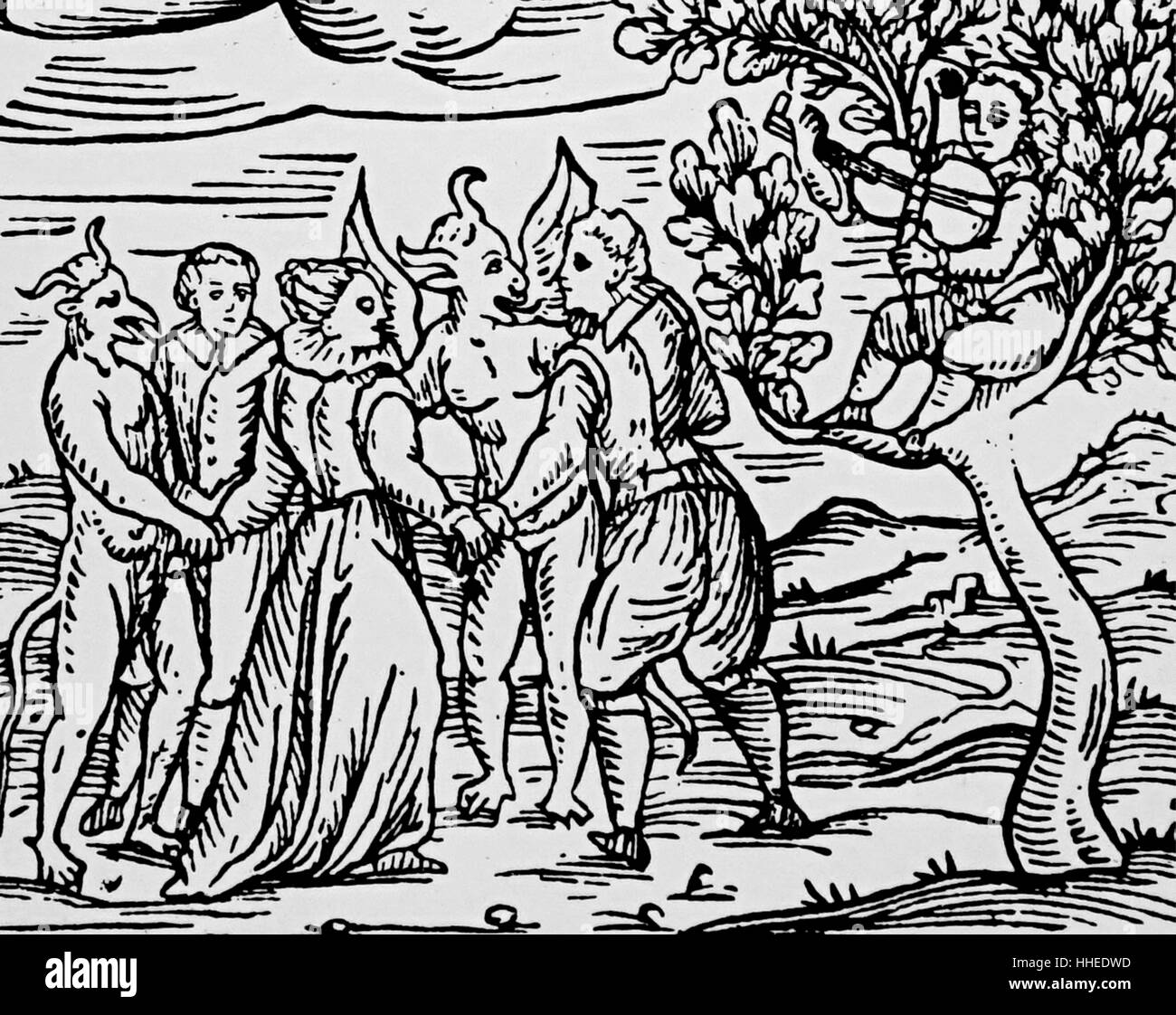
And it is here, around the 16th century, that we begin to see the violin associated with demonic forces. It is precisely the violin's role as a dancing instrument that is at stake here, it starts to appear in artistic representations of witches sabbaths, like the following from the Compendium Maleficarum (the 1626 edition). In its role as a dancing instrument, the Violin was in many ways the polar opposite of the human voice. Singing alone is capable of giving life to musical sound and words at the same time, and thus singing was easily interpretable as an elevation of speech toward the divine. But the violin glorified sound for it's own sake, it tempted its hearers to dance, and thus it became viewed as a way of conjuring Satan as sin personified.
The rise in witch panics over the 15th and 16th century likewise points to an emerging attitude that viewed apparently supernatural abilities as evidence of a pact between that individual and the devil. This in turn is the origin of the "deal with the devil" view of musical virtuosity, the lengthy history of associating dazzling musical talent with satanic origins. In truth, this attitude is not necessarily violin-specific, though the 19th century virtuoso Paganini is one of the most iconic examples of this myth, it was also attached to, say, guitarists like Robert Johnson. What is important is that the tongue-and-cheek accusation called out virtuosic performers (it wasn't typically applied to composers, unless they were also performers), and it called attention to a kind of "sinful" excess in the playing, something so excessive that it didn't seem humanly possible.
Lastly, and returning to the violin, one aspect of this instrument that is special is that it has deep connections to both high and low art. The violin, after all, is perhaps the most central instrument in the symphony orchestra, and it remained an important instrument for social dancing well into the 20th century. This is important because it means that the violin is one of the only instruments capable of carrying both aspects of the "satanic" legacy traced in this post: its "low culture" association with revelry and dance and its "high culture" association with seemingly otherworldly virtuosity.
I am less familiar with the history of actually representing the character Satan: ie, Paradise Lost or Faust. So I do not know precisely how the jump was made from "violin conjures Satan" and "violinists make pacts with Satan" to "violin is played by Satan." But hopefully this post has helped you understand why the association of violin with Satan makes sense within the European mythos!