There was a game called chunkey. It involved rolling a round stone on the ground while participants either shot arrows at it or threw spears. I used to be an archaeologist, and found one on a site that dated to around 1000 ad. This particular stone had a circle engraved in it that was about 2 inches in diameter. The middle of it had an extreme concentration of pock marks, showing amazing skill and accuracy with the projectile used. It truly was a remarkable artifact. We interpreted it as a chunkey stone due to historical records of the game being played. Here is a link:
https://peachstatearchaeologicalsociety.org/index.php/22-game-stones/151-chunky-stones
Edit:
The stone we uncovered was not as ornate as the ones in the photos and was located on a site near Cahokia. However, I believe it predated Cahokia and was considered to be a late woodland site.
There are a few games mentioned as being played by the Aztecs. Durán, in his Book of the Gods and the Ancient Calendar, references a game he likens to checkers, as well as another game played on a “board” of divots carved into a floor “in the manner of a lottery board.” In this game both players had 10 pieces they moved about the board, with the number of moves corresponding to the number of split reeds which fell face up when cast. Durán is pretty vague on the details but apparently the game ended when one player with moved all of their piece’s off the board, or eliminated their opponent’s pieces.
The most famous board game of the Aztecs, however, was/is patolli. In patolli, two or more players would take turns casting a number of beans, whose markings would show how many spaces they could move a playing piece around an X-shaped board with two columns of squares making up each arm of the X. The player would move all of their pieces from the center starting square, up and down each arm, and return to the start, whereupon their piece would be removed from the game. The first player to get all of their pieces around the board won the game.
The above is a very very very basic explanation of game play. The original rules of the game, unfortunately, have not survived to present day. We also have no surviving game boards, which is not too surprising considering contemporary accounts say they were invariably reed or cloth maths painted with rubber to form the cruciform playing area (Durán also mentions juice from squash leaves or pine ash could be used). These are not the sorts of materials which tend to preserve over several centuries unless specifically set aside.
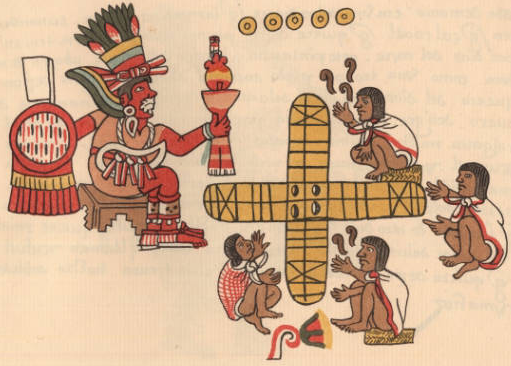
Fortunately , we do have depictions of the playing mats from materials that were produced and preserved. Sahagún depicts men playing patolli in Book 8 of his General History of the Things of New Spain, and the Codex Magliabechiano similarly shows a game in progress.
On those boards, note the pattern of the boards and the differences between them. Magliabechiano shows a playing area of 4 arms of 12 squares, with 4 in the middle, for a total of 52 squares. The mat also shows the penultimate squares at the distal ends of the arms are marked with an X. In Sahagún, the third from the end squares are instead marked with an X, and we have one axis of 6 paired squares and one axis of 7 paired squares for a total of 56. So even just looking at our surviving depictions we have a suggestion of variations of the basic field of play. Nevertheless, the consensus is that most mats used equal sized arms totalling 52 squares, a number that matches up with the symbolic Calendar Round.
The Aztecs, and Mesoamericans in general, used a dual system of calendars. There was the solar calendar, the Xiuhpohualli, which counted 18 months of 20 days each, for a total of 360 days plus the 5 “empty” days at the end of the year. Alongside the solar calendar was the sacred calendar, the Tonalpohualli, which was made up of 20 months of 13 days each, for 260 days total. The time it took for both of these calendars to cycle back around to point where they both started was called a Calendar Round and designated a period of 52 years. The advent of a Calendar Round was a cause for significant observance and we can even see Nahuatl annual histories noting when these events were celebrated. For modern, Western people, the easiest analogue is to think of these as “Aztec centuries.” A playing field of 52 squares, in this light, makes symbolic sense, and indeed the cruciform layout of the playing mat calls to mind the Aztec division of the world into quadrants.
As to the specifics to gameplay, we do not have much from the time, but the game itself has survived until present day. Soustelle mentions in his A Daily Life of the Aztecs that it was still being played by Nahuas and Totonacs in the Sierra del Puebla when he did research there in the early 20th Century and variants on the game are still played in indigenous communities. Modern rulesets tend to glean what they can from primary sources while standardizing later versions of play. So, with all that aside, let’s learn how to play.
How to Play Patolli
Make a playing field of an X with 4 center squares and each arm having 2 parallel rows of 6 squares each.
The third-to-last square is a “penalty” square, marked with an X or wedge shape. Any piece landing there requires the play to pay out a set amount to their opponent. The squares at the tips of the arms are “bonus” squares. Landing there lets you take another turn.
Each turn consists of a player throwing a set of beans, marked on one side to indicate the number of squares a player can move. Most variants involve 5 beans with a dot on one side; the number of dots corresponding to the number of squares and 5 dots up giving 10 moves. Durán, however, says the game could be played with 5-6 beans “depending on how one wanted to play,” and the beans were painted with numbers which could add up not just to 5 (giving 10 moves), but up to as much as 10 (giving 20 moves). Sahagún complicates things by stating moves were counted by scattering “four large beans with holes bored into the surfaces” onto the mat.
Each player had 6 pieces. Traditionally these were red and blue, to be split between two players, but primary sources again indicate that up to 4 players could take part at one time with the 12 pieces subdivided between them, perhaps even playing on teams.
Primary sources are mute on how pieces were introduced to the mat, but commonly a player needs to “roll” a 1 to place a piece on their starting square. Another alternative grants each player a starting piece at the beginning.
The starting squares are the four spaces in the middle. Most versions have the pieces proceed clockwise up and down the arms of the X, ending either on a finish square which was either their own starting square or in the square immediately before it.
A player can only move one piece at a time, for the full number of squares they rolled, and an exact number was needed to “finish,” by moving onto the final square, whereupon the piece was removed from the board.
Two pieces cannot occupy the same square at once, except in the finishing squares, where moving your piece onto an opponent’s piece sent their piece back to their start square and requiring them to pay out a penalty to you.
The game ends when one player either has all of their pieces reach the final square (which could also incur a pay out from your opponent), or else “bankrupts” their opponent through penalties during the game.
Place Your Wager
Again, the rules above are a syncretism of the scarce primary sources with later ethnographic data and modern rulesets. Every indication we have suggests that even during the Postclassic there was significant variations on playstyles, akin to how poker or billiards have different games played under the same name and using the same equipment. One thing is for certain though: patolli was a betting game.
Indeed, Durán probably spends more time decrying the venal aspects of the game like gambling and drinking then he does describing actual gameplay. Sahagún makes the connection even more explicit by listing the sort of things that might be wagered, including:
golden necklaces, green stone, fine turquoise, bracelets on which were round, green stones or fine turquoise, quetzal feathers, slaves, houses, fields, precious capes, mats, large capes, green stone lip plugs, golden ear plugs, duck feather capes.
The above list obviously represents a sort of high-stakes game. Every game, however, seems to have had some sort of pot of goods the players contributed to at the start, from which the penalties during the game would be drawn from and the winner would ultimately claim at the end. Infamously, bad wagers to lead a player to fall so far into debt they ended up selling themselves into slavery. People with the name-sign of Ce Calli (1 House) were considered particularly prone to be profligate gamblers.
The lucre list provided by Sahagún also illustrates how the game crossed social classes; everybody played patolli. Soustelle notes that the puritanical attitudes the Aztecs expressed towards drunkenness and sex never seemed to apply to gambling. Sahagún mentions, for instance, that one of the duties of the ruler of a city was to ensure patolli games were being fairly conducted. Gomara, in his biography of Cortés, mentions Motecuhzoma playing the game. Durán even relates a story of how, at a sermon by a fellow Dominican, some in the crowd grew bored with the pontifications and scratched out a board in the dirt to start a game.
Consistent with other primary sources, Durán notes the crowd started betting on the players right there. Though we have indications there were “professional” players, patolli appears a game that was not just widely known and played, but also a spectator sport.