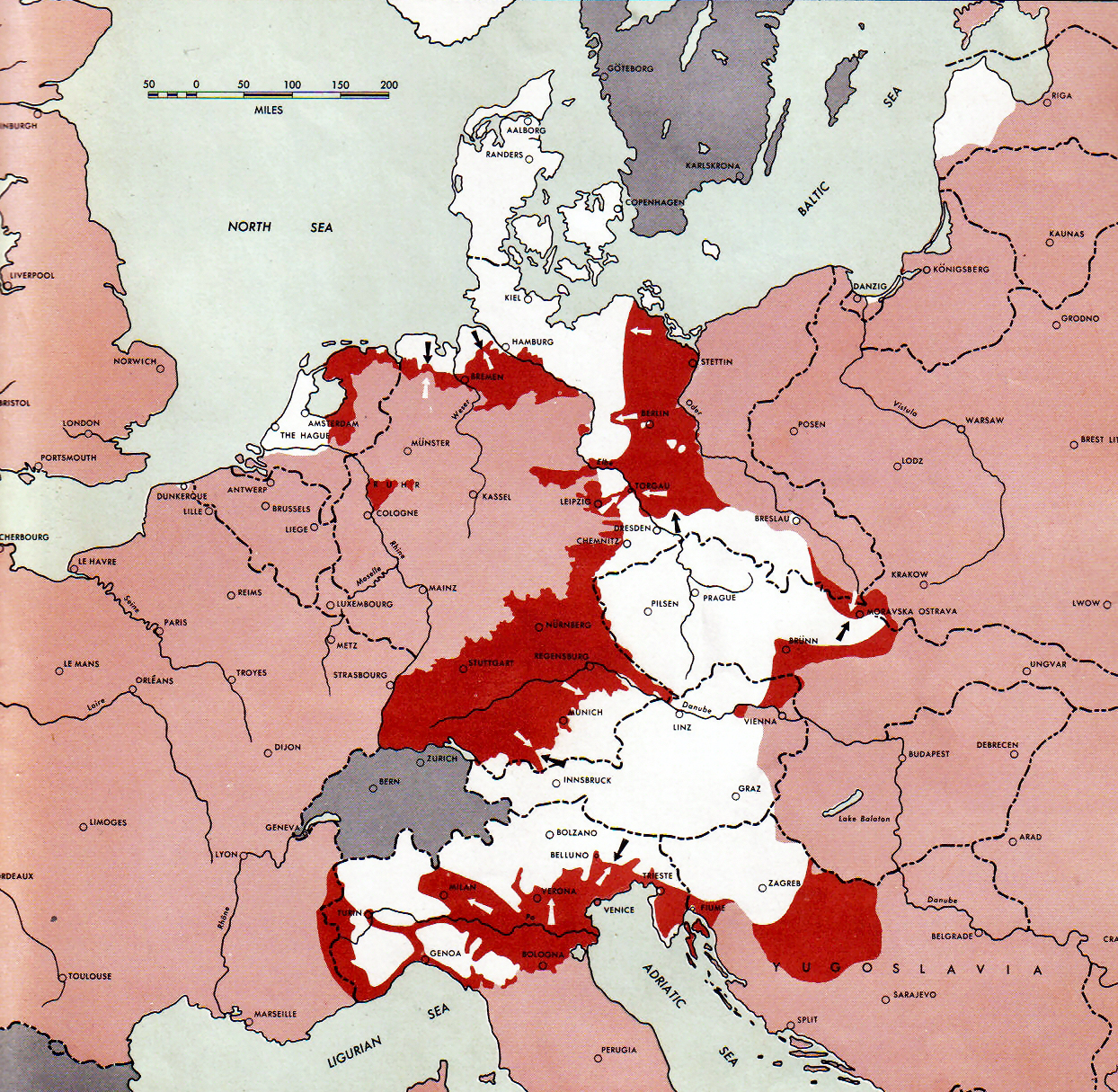
The Flensburg Government didn't hold much authority over Germany. By the time of its formation, which itself was a haphazard, incomplete, and tumultuous process, Germany was only technically in control of the areas in white. The remaining territories of Germany had also been effectively divided in two by Allied advances in Brandenburg. Due to the fact that the government was forced to relocate several times, the various ministries were not centralized, but instead were located in different areas of Germany. Flensburg is mostly important in this as that is where the Oberkommando der Wehrmacht (OkW, the High Command of the Armed Forces) relocated, and it was still functional.
The primary goal of Dönitz's government was to attempt to negotiate a partial surrender to the Western Allies, while continuing to maintain the war against the Soviet Union, while maintaining authority and control over the fragments of the Wehrmacht, and removing the influence of the remaining Nazi hierarchy in order to facilitate negotiations.
Secondary to this, since it was assumed it would likely fail, was to evacuate civilians and military from Eastern Germany (both what is today Kaliningrad and significant parts of Poland as well as Brandenburg, Pomerania, and Saxony) to Western Germany (such as Operation Hannibal). Their goal in this regard was to safeguard as many civilians and troops from what was presumed to be Soviet revenge as possible, and to minimize the number of Germans who would fall under Soviet authority.
Otherwise, their policies primarily continued previous policies, though obviously with much-diminished authority, though Hitler's "Nero Decree" (Demolitions on Reich Territory Decree) was officially rescinded, and the scorched earth policy was terminated, though Albert Speer had never implemented it in the first place.
Their most significant accomplishment, of course, would be surrendering and ending the war in Europe, which also led to the dissolution of the Flensburg Government when all members of the government were arrested by the Allies. The German State has no government at all for about two weeks (May 23 until June 5), until the Berlin Declaration and the assumption of the authority of the German State by the Allied Powers (the Allied Control Council), including the assumption of control of the OkW (and the remainder of the German armed forces), which dissolved the German Reich, but explicitly did not annex it, but rather the ACC assumed the role of the government of Germany.