It’s difficult to find a person who even knows the difference between a nondescript Greek combatant and an literal Spartan. I can’t find any images that contextualize Spartans as being different than Athenians, but being that they were at war with each other there had to be at least some differences.
Ancient Greece had no professional militaries and no uniforms, but Spartans were still easily recognisable. Their laws prescribed certain kinds of dress, hairstyle and armour that made them look similar to each other and different from other Greeks. It's right around the time of the Peloponnesian War that we get the first evidence that non-Spartans were noticing the differences between them and riffing on Spartan stereotypes:
LYSISTRATA: Oh you lovely Lakonian girl, Lampito, welcome! You look stunning, darling, and so sweet! Your body's so fit and firm and curvy. Bet you could strangle a bull.
LAMPITO: Ah reck'n ah's could, by gawd; Ah's gets nekkid an' jump it behind.
LYSISTRATA: And such a nice pair of titties you have, too.
-- Aristophanes, Lysistrata 78-83 (with thanks to /u/ancienthistory)
The Spartan woman is presented here as the product of the peculiar Spartan habit of allowing women to exercise, probably in the nude, just like the men. She is also presented as a barely articulate Doric-speaking hick. Any Athenian with eyes and ears would know this character for a Spartan from miles away.
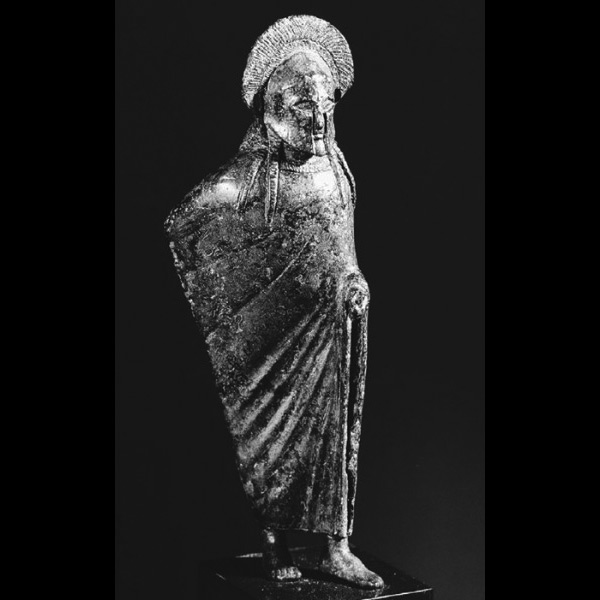
Spartan men were similarly marked by stereotypical attributes that were associated with their lives as leisured gentlemen. They went about with canes and long cloaks wrapped tightly around them - signs that they couldn't use their hands even if they wanted to. This was how the Greek leisure class announced its status to others. Since all Spartiates were wealthy estate owners by definition, all were able to afford this lifestyle and dress. They also notoriously found their canes convenient for beating those of lesser social status than themselves. The cloak and cane are brought up later in Aristophanes' Lysistrata (985-994) when a Spartan herald enters; you can imagine the comic potential of a man eager to resolve a sex strike and carrying a long stick underneath a tight cloak.
Spartan men wore their hair and beard long - another marker of high status - and spent much time before battle oiling and grooming both. Greek sources offer many reasons why the Spartans preferred to wear their hair long, and one of these is that it made them more intimidating in battle. There's no doubt that a Spartan battle line would be unusually hairy; most Greek men at the time wore their hair and beard practically short, and Athenian sources mock the young rich dandies who hung around the agora wearing their hair in the long Spartan style.
But there are other things that made a Spartan phalanx look distinct and terrifying. It's around the Peloponnesian War that we get the first (and in fact the only) fragment of evidence that forces under Spartan command carried shields with a uniform blazon: the letter Λ for Lakedaimon, the proper name of the Spartan state. At the time, no other Greek state yet mandated a general shield blazon for its hoplites, though a few states adopted one later. We can assume that the Spartans started this trend. But the troops thus identified in the fragment were actually armed helots, not Spartiates, and our very late source Plutarch suggests that Spartiates could carry their own blazons of choice into battle. The Spartans themselves may never have used the iconic Λ shield.
What we do hear is that Spartan commanders, at least by the very end of the Peloponnesian War, tried to make sure that all their hoplites carried shields with a full bronze coating, instead of just the bronze rim that was a common cheaper alternative. This bronze facing was polished to a high shine before battle. At the same time, in the final decades of the 5th century BC, Spartans appear to have standardised their battle dress into a single red garment (possibly a cloak, but more likely a simple tunic). This was the first time the Greek world saw anything like a uniform used in war. The result was that a Spartan-led phalanx appeared to its enemies like a solid wall of red and bronze, rolling forward as one. Again, some others tried to copy this, but while bronze shields and red clothes would have been common to Greeks everywhere, no other state fielded entire armies uniformly dressed.
So that's how the Spartans stood out: cloak and staff, long hair and coarse ways in peacetime, red tunics and bronze armour in war. All these elements also existed elsewhere as part of leisure-class attire or battle dress, but no other state forced all citizens to appear the same in the way the Spartan state did.